




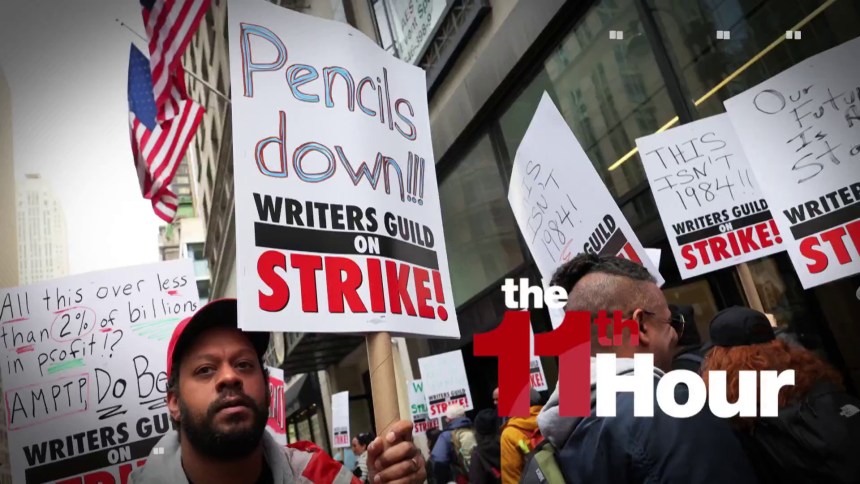
These days, television shows are viewable whenever anyone wants to watch them. While that convenience has been a game changer for audiences, it’s become a financial nightmare for the writers whose creativity makes these shows possible.
As a perfect illustration of this disconnect, which has helped lead the Writers Guild of America to go on strike this week, check out this tweet from “Abbott Elementary” writer Brittani Nichols:
Let’s break that down a little. Before Hulu, Netflix and approximately two dozen other streaming services were available on your phone, tablet and television, if you missed episodes of your favorite TV shows when they aired, you could only see them in reruns during the off-season. Or, more likely for those that crossed the fabled 100-episode line, it’d be once they get picked up for syndication.
Nichols, as the writer of the “Abbott Elementary” second-season finale, was paid for her work writing the episode. While like in the pre-streaming days, she’ll still receive a check in the mail for that episode re-airing on ABC, the amount she’ll get for streaming viewership — a growing share of the audience — will be for a much lower rate, despite the massive numbers the show has racked up.
These residuals have long been key to how TV writers make a living, especially when between projects. But the streaming boom has made that system untenable. Here’s how Charles Slocum, assistant executive director at the WGA West, explained it to Deadline:
“In streaming, the companies have not agreed to pay residuals at the same level as broadcast, or the same reward-for-success as they have traditionally paid in broadcast,” he said. “If you write for a streamer, you get two residuals payments — one for domestic streaming and one for foreign streaming. It’s a set amount of money. If it’s a big hit, you do not get paid more residuals in streaming, whereas in the broadcast model, you do because of its success.”
On the other side of negotiations, the Alliance of Motion Picture and Television Producers, or AMPTP, argues that because shows that might not have made it to the threshold for syndication are still available on streaming platforms, writers have the chance to earn residuals that they otherwise might not get.
(Note: Comcast, the corporation that owns MSNBC’s parent company NBCUniversal, is one of the entertainment companies represented by the Alliance of Motion Picture and Television Producers, which is bargaining on behalf of the companies involved. Some editorial employees of the NBCUniversal News Group are represented by the Writers Guild of America, the union behind the strike.)
If that were the only point of contention, there might be more room to see both sides’ arguments here. But the writers have a very solid case for the studios to meet their very reasonable demands, as detailed in a document from the WGA explaining the gap between the groups’ positions as of Monday.


In recent years there’s been a surge in “mini-rooms” where a small group of writers produce work for shows that aren’t yet greenlighted. These “mini-rooms” simultaneously are under higher pressure to produce quickly, yet yield a lower fee. The trend toward production studios ordering shorter TV seasons has meant that writing gigs also last a shorter amount of time. They often have been operating with smaller staffs as well, again amping up the stress levels for those staffers and for the showrunner who has to oversee everything without being able to delegate as many tasks. Meanwhile, the share of writers working for the minimum salary allowed under the so-called minimum basic agreement, or MBA, that covers most guild projects has increased from 33% to just under 50% over the last decade.

It’s not like there isn’t the money available to alleviate those issues. Josh Gondelman, television writer and one of the nicest people on the internet, laid out in The Nation how the AMPTP is nickel-and-diming writers: The “WGA proposals would net total yearly gains of $429 million for 20,000 writers. Netflix, Paramount, Comcast, Disney, Fox, and Warner Bros reported a total of $28–30 billion in operating profit each year from 2017–21.”
But instead of sharing those profits, many of the writers’ proposals were rejected with no counteroffer from studios, according to the WGA. Among the most troubling clauses to be rejected was one dealing with the integration of artificial intelligence into writers rooms. The WGA wanted to be able to use it as a scriptwriting tool on MBA-covered projects, but keep studios from training AI to draft final products using MBA-covered scripts. The studios instead only offered “annual meetings to discuss advancements in technology,” according to the WGA document.
That would be less worrying if the AMPTP didn’t have a history of misunderstanding, if not outright downplaying, how much technological shifts would change the industry. During the last writers strike, which lasted for 100 days from late 2007 to early 2008, the conflict revolved around things like DVD sales and digital downloads. Streaming was an afterthought, and rightly so given how little digital infrastructure existed to support it compared to today. And while writers won some gains at the time, nobody foresaw how streamers like Netflix and Hulu jumping into producing original content would change the game.
Given the huge profits and vast amount of money being thrown around over the last decade, it should be a no-brainer that these companies can afford to offer the stability and security that once made it possible for writing for the screen to be a career instead of a temp gig. Instead, the current system has made it so that writers whom many would consider a success (including friends of mine) have had to in some cases apply for government assistance while waiting for the next opportunity to come along. And while the narrative that studios used reality TV to backfill the dearth of new content in 2007 doesn’t quite stand up to scrutiny, it’s easy to see why it gained so much traction over the years.
I have to hope that this strike doesn’t last as long as the last one, as it will have a major impact on the writers themselves and the people who help make movies and television productions happen. But until the studios get serious about paying the creative minds who fuel their success what they’re worth, I support the writers who want nothing more than to be able to tell stories and make their rent each month.

Hayes Brown is a writer and editor for MS NOW. He focuses on politics and policymaking at the federal level, including Congress and the White House.