




I suppose we should be grateful. Congress has finally reached a deal on a new round of coronavirus relief funding, nine months after the first package was signed into law and five months since the bulk of that funding ran out.
With this deal, an estimated 12 million Americans would avoid seeing their weekly incomes hit $0 as their unemployment benefits expired. Eviction protections would be renewed, keeping families from being taken to court and thrown into the streets soon after the holidays. And households that use SNAP benefits, aka food stamps, would get more loaded monthly onto their EBT cards until June.
This is all great news. Provisions in this bill are desperately needed to help bridge the gap until Covid-19 vaccines can be more widely distributed. But if that’s the case … why does this bill still feel like such a disappointment?

It may just be the holidays talking, but the watered-down, belated efforts in this new package feel like when you’re a kid on Christmas morning, after you spent ages curating your wish list. You’d been diligent and thoughtful after combing through catalogs, ranking your preferences, denoting the prices for your pare — er, Santa, even keeping the price cap low so nothing felt too extravagant.
Now, as you open the presents under the tree, you see some pretty decent gifts, ones that you’ll enjoy and appreciate. But the things from your actual list are smaller than you’d intended, in the right spirit but the wrong item — a pogo stick instead of Moon Shoes or a Lego X-Wing when the Millennium Falcon was at the top of your list — or they’re missing altogether. Determined not to be a brat, you put on a brave face and smile, but the disappointment still stings.
We shouldn’t pretend that $600 is a true lifeline, though, for people who have been unemployed for months or are working reduced hours
“You should be grateful that you got any presents at all” — that’s the lesson that we tend to teach letdown kids at Christmas, especially when times are hard. It’s a very American moral, one that urges children not to be greedy, to be appreciative of the good in their lives and the spirit of the season. The analogy breaks down when you consider that times are not hard for everyone equally. And after months of delays, the people who need the most are getting less than before for entirely arbitrary reasons.
Consider unemployment benefits: People laid off in the pandemic would get a federal boost in their state unemployment checks after funding for the expansion ran out in July. People who are self-employed, work as freelancers or were mired in the gig economy, as well as those whose state benefits are running out, would still be able to draw checks, as well, rather than see the authorization for those programs expire at the end of the year. However, assistance for both groups would be slashed in half, to $300 extra a week. That’s money that would keep some people from drowning entirely — but still leave many thrashing and straining.
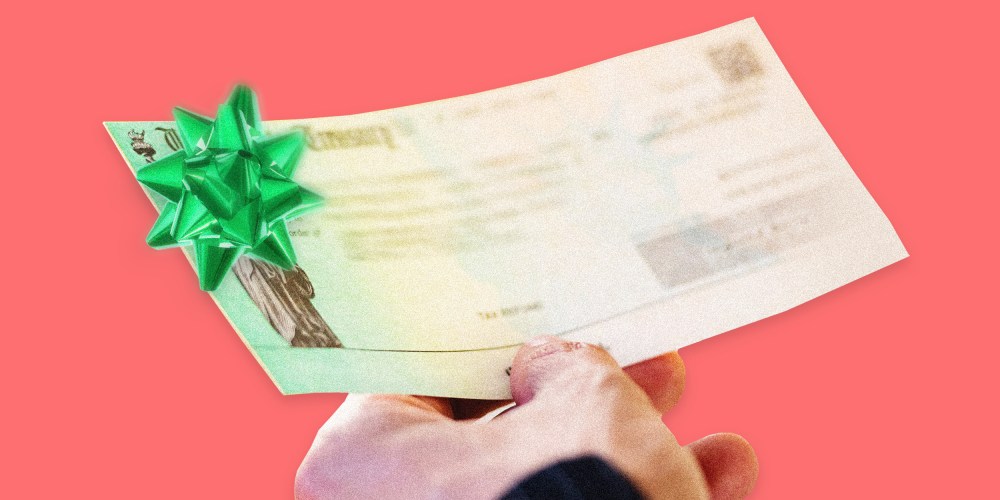
Another round of individual checks would be going out, one of the last items agreed to in the negotiations, but these would be halved, too. The checks that would go out to Americans making $75,000 or less would be a relief for many. We shouldn’t pretend that $600 is a true lifeline, though, for people who have been unemployed for months or are working reduced hours as the restaurant or the retail store where they work teetered on the edge of failure.


congrats on your $600 stimulus, pick one item from the bottom case pic.twitter.com/vaw1baZpFl
— ꧁Madimoiselle꧂ (@drivingmemadi) December 20, 2020
Compare that to European countries, most of which have subsidized workers’ salaries rather than let people lose their jobs, as The Washington Post explained in October:
The basic model of the European programs, sometimes called short-time work, is that struggling employers can place their workers on either full or partial furloughs, while the government takes over most of the cost of their idled time. The aims are to keep paychecks flowing to anxious citizens, prevent otherwise sound businesses from going under, and avoid the need to hire and train new workers after a crisis recedes.
Democrats, who for months pushed back against Republican measures that they felt would unfairly benefit businesses at the expense of workers, are spinning this deal as both a major win and just the first of several major packages.
“We have now reached agreement on a bill that will crush the virus and put money in the pockets of working families who are struggling,” House Speaker Nancy Pelosi, D-Calif., wrote in a letter to her caucus Sunday, calling the bill “an important initial step.”
I don’t know whether I would go so far as “crush the virus” — that ship seems to have sailed a long time ago, without the kind of direct payments this deal comes nowhere close to providing. But framing it as an “initial step” is important messaging, one the Democrats clearly hope tamps down on some of the disappointment.

President-elect Joe Biden is expected to push for another package in the new Congress come January. Accordingly, Democrats have started reminding voters just what the deal could have looked like if they’d only had control of the Senate. Cue the reminders that Georgia’s twin Senate runoff elections are in less than a month.
If Democrats controlled the Senate:
— Chris Murphy (@ChrisMurphyCT) December 21, 2020
– the cash payments would be $1200 not $600
– there would be $175 billion, not $25 billion, to help people pay the rent
– there would be flexible money for states and cities and bonus checks for frontline workers
Let’s win Georgia.
There’s a lot in this package that would stanch some of the bleeding since this summer. So sure, hand out that $600. But should we be grateful that this is what we get after waiting for so long? I’m not sure that’s the word for how Americans are feeling right now.

Hayes Brown is a writer and editor for MS NOW. He focuses on politics and policymaking at the federal level, including Congress and the White House.