




Even being a world-class athlete won’t shield you from having to deal with misogynist crap.
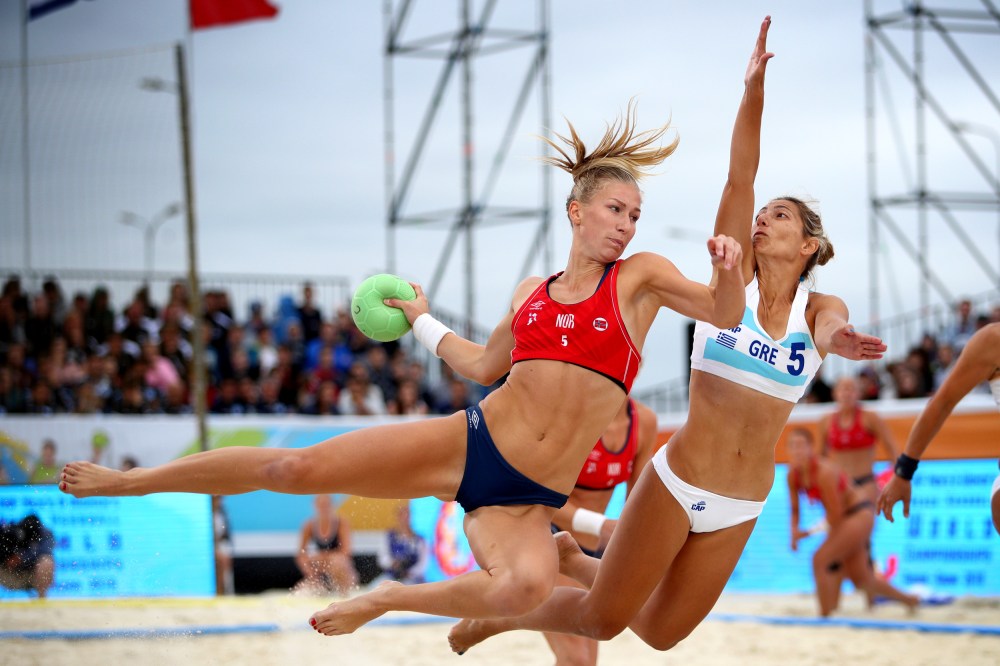
This week, the Norwegian women’s beach handball team was fined 1,500 euro (about $1,765) by the European Handball Federation. Their transgression? Wearing spandex shorts instead of bikini bottoms during the team’s bronze medal match at the European Beach Handball Championships.
International Handball Federation regulations stipulate that female athletes must wear bikini bottoms “with a close fit and cut on an upward angle toward the top of the leg,” and “the side width must be of a maximum of 10 centimeters,” or about 4 inches. However, their male counterparts are allowed to wear shorts, as long as they clear 10 centimeters above the kneecap.
The Norwegian players knew that they would be flouting International Handball Federation guidelines, but chose to move forward with the uniform change anyway, as a form of public protest against archaic rules that prioritize hypersexualization over the comfort of the athletes. The Norwegian Handball Federation supported the players and agreed to pay the fines on their behalf.
Team captain Katinka Haltvik told Norwegian public broadcasting company NRK that she and her teammates had made a “spontaneous” decision to switch out their black bikini bottoms for blue bike-style shorts to spur conversation, and hopefully, rule changes.
The Norwegian players knew that they would be flouting International Handball Federation guidelines, but chose to move forward with the uniform change anyway.
“I hope we get a breakthrough for this and that next summer we play in what we want,” she told NRK. “People cheered on us for going in front of several teams and taking the brunt. Not all teams can afford to pay such fines.” She also added that beach handball “should be an inclusive sport, not an exclusive one.”
Beach handball isn’t the first professional sport to attract controversy due to skimpy uniform requirements. Until 2012, female Olympic beach volleyball players were required to wear bikinis (although you could wear a bodysuit underneath). For the last decade, the teams have had a choice. The change was made to increase both individual comfort and collective cultural inclusivity. (For example, at the 2016 Olympics, the Egyptian team competed in pants and long sleeves.)


Obviously, there is nothing inherently harmful about a bikini, in sports or otherwise. And as beach volleyball superstar Kerri Walsh Jennings told HuffPost in 2016, “When it comes to beach volleyball, we’re playing in 100-degree-plus weather.” However, when required athletic uniforms are dictated by gender norms rather than the needs of the athletic activity, therein lies the problem — and the deeply embedded sexism.
To pretend that the way athletes are costumed has no bearing on the way they are perceived would be naïve. There is a reason that Olympic beach volleyball players are often photographed in parts rather than as whole humans: close-ups of butts and torsos and chests rather than as living, breathing, moving marvels. To force female athletes to wear outfits they feel fundamentally limited by or uncomfortable in only serves to perpetuate the idea that they exist, first and foremost, to be consumed. The men can play. The women are putting on a show.
There is a tendency to put a premium on pre-existing rules simply because they exist, a veneer of legitimacy that is lent to norms and regulations within the sports arena, even when those norms and regulations were instituted within a specific, often harmful cultural context. This is why the run-up to the Tokyo Olympics has spurred difficult but important conversations about things like the racism built into marijuana-specific drug policies or the refusal of FINA (swimming’s main international regulatory body) to approve a swim cap designed specifically for natural hair.
No law, regulation or rule is infallible. Guidelines are made to be updated, to evolve with the times and to correct past harms. Ostensibly, in sports, rules exist to make sure that there is as much parity among competitors as possible, to ensure that the terms of the game are known before it starts. The width of a bikini band has no bearing on these terms.
At the end of the day, the focus should be on the physical abilities of beach handball players, not the number of centimeters the seams of their uniforms are from their vulvas. If the athletes who play beach handball are demanding change, ignoring them sends the message that the ability of the public to leer at female bodies is more important than the sport itself.

Emma Gray
Emma Gray, a freelance journalist focused on the intersection of gender, culture and politics, is the author of "A Girl's Guide to Joining the Resistance." She is a co-host of the podcast “Love to See It” and a co-author of the newsletter “Rich Text,” and she has spent the last 10 years as a senior reporter and editor at HuffPost.