




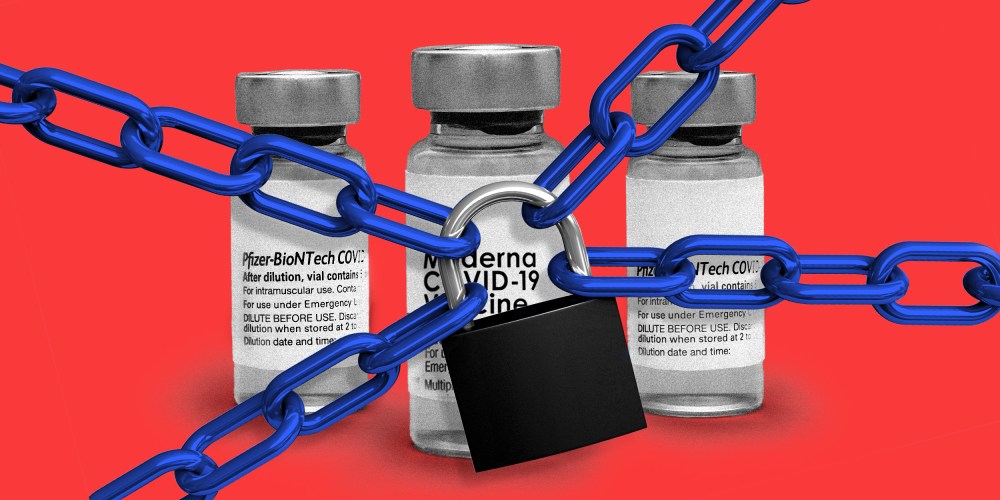
Pfizer is a bully.
That, in a nutshell, is the message conveyed in an Oct. 19 Public Citizen report on the drug company’s hardball approach to negotiating government deals for the mRNA Covid-19 vaccine it developed in partnership with German company BioNTech. The report, which builds on an earlier Bureau of Investigative Journalism report on Pfizer’s negotiating practices, is based on a number of unredacted Pfizer government contracts.
Some of the company’s deals ban governments from accepting donations of Pfizer vaccines or even buying them from anywhere else.
Public Citizen said the contracts show some of the company’s deals ban governments from accepting donations of Pfizer vaccines or even buying them from anywhere else, prohibit those governments from donating vaccines without Pfizer’s permission and require them to settle disagreements before an arbitration panel, rather than in local courts.
The contracts illustrate a company that had the upper hand in negotiations taking advantage of its upper hand to insulate itself from risk. The report said Pfizer required some governments to waive sovereign immunity, meaning the company could, in theory, go after state assets if, after a disagreement, an arbitrator ruled in Pfizer’s favor. And, in many cases, Pfizer apparently has sole say over any changes to its delivery schedule.
All that may be unsavory, but in the grand scheme of the Covid pandemic, the behavior the Public Citizen report documented isn’t that important. Yes, Pfizer could have acted less imperiously in its negotiations with developing countries, although, to be fair, Pfizer is also charging low- and middle-income countries lower prices for the vaccine.
But the Public Citizen report is ultimately a distraction from the real problem.
That problem isn’t Pfizer’s bullying countries that want to buy from them. The problem is that Pfizer and Moderna, the other company with an mRNA vaccine, don’t have enough vaccines to sell because they’ve maintained tight control over production.
Most of the hundreds of millions of doses Pfizer and Moderna have produced have gone to Western countries, most notably the U.S., which signed huge advance purchase contracts even before the vaccines received emergency use authorization from the Food and Drug Administration. The companies insist they’re producing vaccines as fast as possible and will be on pace to churn out billions of doses a year by 2022. But the reality is that most of the world’s citizens have had no access to mRNA vaccines, the most effective of the Covid vaccines, while low-income countries have had almost no access to any vaccines at all.
There are some signs of limited progress on this front. Pfizer’s partner, BioNTech, just announced it has signed a deal with Senegal and Rwanda to set up its first vaccine factories in Africa, and Moderna has announced it will be building a factory in Africa as well. Even so, there’s little question at this point that the desire to protect their patents and technology has led Pfizer and Moderna to limit licensing and be leery of attempts to transfer their technology to vaccine producers around the world.


BioNTech just announced it has signed a deal with Senegal and Rwanda to set up its first vaccine factories in Africa, and Moderna has announced it will be building a factory in Africa as well.
That desire is understandable. Pfizer, in particular, invested a lot of money in its vaccine and wants to reap the benefits. But the companies’ current strategies are at odds with what the world needs: more vaccines, as soon as possible.
There are a range of ways to solve this problem. The most-discussed option is a so-called TRIPS waiver of the intellectual property rights connected to the vaccines, which, in theory, would allow countries to make generic versions of the mRNA vaccines. But while the U.S. government has expressed support for a TRIPS waiver, many European countries oppose it. And it’s not clear, in any case, whether a TRIPS waiver would work without Pfizer and Moderna agreeing to help transfer their technology to firms in other countries.
While Public Citizen has called on the U.S. government to use to the Defense Production Act to compel Pfizer to transfer its technology, that’s unlikely to happen under any circumstances, and it’s exceedingly unlikely given that the goal is to make vaccines to be distributed to developing countries and not the U.S.

The good news is that vaccine production can be increased even without dismantling the existing system of intellectual property protection because the U.S. government co-owns a vaccine patent that’s crucial to the technology at the heart of Moderna’s vaccine, the development of which was also heavily subsidized by the U.S. government. This gives the U.S. considerable power it could use to push Moderna to license its technology to expand production. There are also efforts underway in Africa to reverse engineer the Moderna vaccine and put it into production. The U.S. should ensure the company does nothing to interfere with that project.
More ambitiously, the U.S. could pursue a strategy outlined by the organization PrEP4All, which argued that the government should build its own massive mRNA manufacturing facility and then license Moderna’s vaccine. PrEP4All claimed that if the U.S. were to do this, it could build a facility capable of making enough doses to vaccinate the whole world and then produce those doses for just $12.5 billion. Even if such a project ended up costing three times as much, it would still be cheap, given the enormous economic and social benefits of vaccinating the world.
Vaccine manufacturers have done an enormous amount of good for the world in the past year. But it’s time for them to do what’s necessary to boost production. And if they continue to drag their feet, the U.S. should just take a page out of the companies’ playbook. Just as they’ve used their leverage to drive hard bargains with governments, the U.S. can use its leverage to drive a hard bargain of its own.

James Surowiecki
James Surowiecki is the author of "The Wisdom of Crowds." His work has appeared in The New Yorker, The New York Times, Wired and Fortune, among others.