




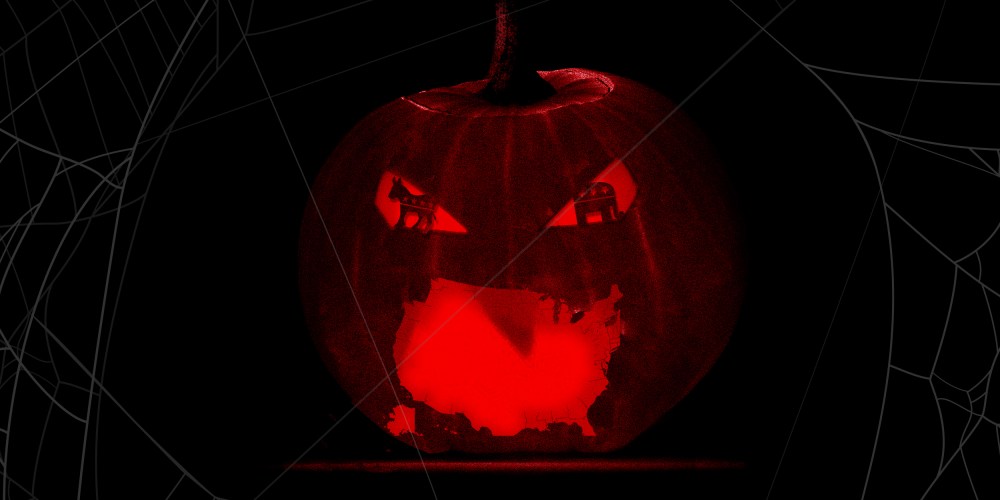
It’s Halloween weekend, and with Election Day looming on the other side, there’s a certain added degree of fear and anxiety in the air. It’s time to talk to you about the gremlin lurking on the wing, the eldritch horror waiting in the night, the chance that you may be living in the worst of all worlds. Submitted for the approval of the Midnight Society: “The Tale of the Multiverse’s Madness.”
Do you ever feel like there’s something otherworldly lurking just out of your line of sight? You catch it out of the corner of your eye, a flash, a glimpse. And then it’s gone — or is it?
That feeling in your spine says otherwise. Something is not right. You open your laptop to check, as you have every day for the last month, to make sure that the numbers still suggest a Biden victory in the Electoral College. A sigh escapes your lips: The national polls are, on average, showing a bigger lead for former Vice President Joe Biden than for any other candidate at this point in the race in the last 20 years. All is well — or so it seems.
A thought comes to you, unbidden: We all learned in 2016 that state polling is where the real danger lurks. A scan of RealClearPolitics’ average of results in top battleground states seems to show Biden with a lead in most of them. But something compels you to look elsewhere, drawing you into the underlying polls themselves. And as you do, a number stands out, one that’s all too often overlooked, cursing you with the burden of knowledge: the margin of error.
According to the Pew Research Center, “A margin of error of plus or minus 3 percentage points at the 95 percent confidence level means that if we fielded the same survey 100 times, we would expect the result to be within 3 percentage points of the true population value 95 of those times.”
And in that moment, the picture shifts. Like Roddy Piper’s nameless main character in “They Live” wearing his special sunglasses to reveal the aliens around him, the true nightmare of reality has snapped into focus. The margins are close — feeling the warmth from an exhaled breath on the back of your neck close. Your stomach begins to twist as your doubts begin to climb.
You frantically look for some shred of certainty. Instead you get Pew Research Center’s director, Courtney Kennedy, who explained in August that the margins of error that are reported may actually be too generous in their certainty, accounting for just one of four possible errors in poll results. “Several recent studies show that the average error in a poll estimate may be closer to 6 percentage points, not the 3 points implied by a typical margin of error,” Kennedy wrote. “While polls remain useful in showing whether the public tends to favor or oppose key policies, this hidden error underscores the fact that polls are not precise enough to call the winner in a close election.”

With that knowledge, the floor shifts under your feet. Looking at NBC News’ battleground polling, all you can see now is how close the polls could be if the margin is applied. In Florida, the latest NBC News/Marist poll shows Biden up 51 percent to 47 percent against President Donald Trump. The margin of error — 4.4 percent — could result in the exact opposite. A 5-point lead for Biden in Wisconsin transforms into a Trump victory before your eyes. What once seemed like a likely win has now metamorphosed into a tie in survey after survey — a flip of the coin seems more likely to predict the winner.


There’s a school of thought that suggests that the universe we live in is one of an infinite number of universes and that each event on the quantum scales forms a new one. That’s been expanded into the “multiple worlds” theory, with some science fiction writers even taking the concept up to the macroscale, positing that every choice that’s made forms a new timeline.
In its third season, the TV show “Community” explored this concept in the episode “Remedial Chaos Theory.” With a toss of the dice to determine who has to grab a delivery from downstairs, six new timelines are created. Each pocket universe has the characters’ interactions affected by the missing member’s absence, with the consequences mostly small and interpersonal. But one — known as the darkest timeline — spawns mass chaos.
So, the question is which timeline are we in? Where do the dice land this time the survey is run? Is this the nightmare world where it’s 2016 forever and the polls are wrong? You can feel your grip on this reality become more tenuous, your psyche unmoored. The probability of recovery — marginal.

Reader, the good news is that — much like Edward Allan Poe’s lover in “The Raven” — the rising dread you’re feeling in this moment is a projection. There’s no real way of knowing how the dice will land until all of the votes are counted after Election Day. And as we’ve been repeatedly told since 2016, polls are just snapshots of a moment, not windows into the future. As you frighten yourselves this weekend with scary movies and beat back the nightmares of a horrifying future, beware the margin of error — but don’t let it send you spiraling into the darkest timeline.
While you stop shivering from the intensely scary story you’ve just read, have some morning links:
null- NBC News: Secretary of State Mike Pompeo is under investigation for allegations of multiple ethics violations, but the emails that NBC News’ Josh Lederman obtained show how readily his family blurred the line between the personal and the professional.
- CJR: Steve Doocy has been the lead anchor on “Fox and Friends” for its entire run, and this profile from Mark Oppenheimer shows that he’s not exactly who anyone thinks he is?
- BuzzFeed News: One of the plotters who allegedly planned to kidnap Michigan Gov. Gretchen Whitmer was in contact with extremists around the country and had also wanted to kidnap the leaders of North AND South Carolina.
- The New York Times: This piece has everything: Trump placing his businesses interests over everything, multiple Cabinet secretaries interfering in a criminal case, a foreign autocrat successfully pressuring an American president, and Turkish banking!
- NBC News: And finally, the latest Trumpworld attacks on Hunter Biden were preceded by a fabricated dossier of information about him, which itself was distributed by fake persona.

Hayes Brown is a writer and editor for MS NOW. He focuses on politics and policymaking at the federal level, including Congress and the White House.