




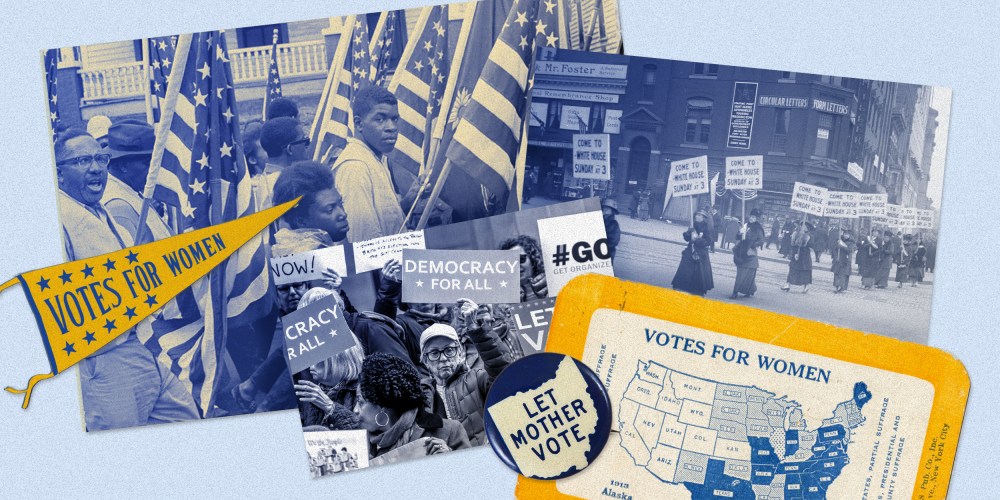
Tuesday’s election looks like it’s set to break voter turnout records around the country, even in the middle of a worsening pandemic. Signs thus far indicate that the election should be a victory for democratic norms after they’ve taken a battering the last half-decade. Instead, no matter which candidate wins, Election Day will be just Day One in what’s sure to be a yearslong battle, a war of attrition over whether the U.S. will ever allow every citizen the right to vote.
It’s not partisan to say the Republican Party is the aggressor in this conflagration — it is a fact. This can’t be dismissed as the work of individual conservatives who just happen to be Republicans. We are talking about President Donald Trump atop the ticket, the Republican National Committee and the state parties coordinating an all-out assault against counting every ballot cast.
Before we continue, let the record show that I’m not exactly a fan of using war as a metaphor for politics, no matter what Herr Clausewitz said in his classic “On War.” It cheapens war and all of its attendant tragedies; it transforms minor political disagreements into lengthy sieges and campaigns into crusades. Transferring that kind of thinking into electoral politics encourages, with yet another apology to Clausewitz, politics by other — often violent — means.
It’s not partisan to say the Republican Party is the aggressor in this conflagration — it is a fact.
So when I tell you that nothing else accurately captures the importance of the next few years for the right to vote in America, please understand that it’s not my preference. But how else do you describe a concerted campaign to limit access to the ballot box by any means necessary? It’s a war being fought in several theaters at once, in all three branches of government and in every jurisdiction, from the local to the federal.
The GOP’s motives aren’t secret. Trump put it pretty well during an appearance on “Fox & Friends” in March. “They had levels of voting that if you ever agreed to it you’d never have a Republican elected in this country again,” the president said in response to Democratic proposals to make it easier and safer for the election to be held despite the coronavirus outbreak — proposals he ultimately rejected.
Trump openly admitting if we made voting easier in America, Republicans wouldn’t win elections
— Lis Power (@LisPower1) March 30, 2020
Trump: “The things they had in there were crazy. They had levels of voting, that if you ever agreed to it you’d never have a Republican elected in this country again.” pic.twitter.com/x5HmX6uogo
He doubled down on that stance months later when he admitted that he was keeping the U.S. Postal Service underfunded to hamper mail-in voting efforts, claiming without evidence that the practice is rife with fraud. Now, the day before Election Day, another slowdown in postal deliveries is occurring in swing states. In between, Trump has said mail-in balloting is another term for fraud while encouraging his own voters in safely red states to vote early.
Trump knows that he lost the popular vote in 2016 and that an increase of votes from Democrats could prevent a repeat of his much-fetishized winning electoral map. Throughout the rest of the party, there’s a similar acknowledgment that greater participation — especially by Black and Hispanic voters — means a dilution of its (also much-fetishized) shrinking pool of white voters.
If their motives are on display, their methods are lit up like Times Square, especially in these recent weeks. Across the country, the need to prevent “voter fraud” serves as justification for the GOP’s attempted crackdown. But Republican election lawyer Benjamin Ginsberg recently admitted that it’s all a myth. “Proof of systematic fraud has become the Loch Ness Monster of the Republican Party,” Ginsberg wrote in a Washington Post op-ed. “People have spent a lot of time looking for it, but it doesn’t exist.”
The New York Times last week detailed a half-dozen of the more egregious instances when state Republican parties or the Trump campaign have asked the courts to count fewer ballots. Wisconsin’s Republican-dominated Supreme Court ruled Oct. 26 that rather than have to be postmarked by Election Day, ballots now have to arrive at election offices by 8 p.m. Tuesday for election officials to count them, no matter when they were dropped in the mail. A federal appeals court ruled similarly in a Minnesota case, just days before the election. The federal judges warned Minnesotans to find an alternative way to vote for now — they still haven’t decided whether any ballots that come in the mail after Election Day will be considered legal.
The Texas GOP has been particularly brazen, refusing to expand limited access to mail-in voting ballots for the general population and restricting each of Texas’s 254 counties to only one mail-in ballot drop-off point. That hasn’t kept Harris County — home to Houston — from being a model for easing access to voting this year. The fourth-largest city in the U.S. had already topped its total of votes cast in 2016 by Thursday, thanks to options like drive-thru voting and keeping early voting centers open late.
The Texas GOP and the Harris County branch of the party tried to get the drive-thru voting centers shut down — the all-Republican Supreme Court rejected the lawsuit without issuing an order or an opinion on Oct. 22. But U.S. District Judge Andrew Hanen has ordered the plaintiffs to appear in an emergency hearing Monday to present their arguments in a lawsuit to throw out more that 100,000 ballots that Houstonites cast at the drive-thru centers. The state Supreme Court tossed out the case, as well, on Sunday, and former Texas House Speaker Joe Straus has denounced it, but who knows how Hanen, who has a history of partisan rulings, will decide?
Republicans have reason to feel confident that their arguments, no matter how specious, will play well before the federal bench. Senate Majority Leader Mitch McConnell, R-Ky., has spent the Trump administration loading the courts with conservative judges — 220 of them, according to The Washington Post’s count, including three Supreme Court justices, “53 circuit court judges, 162 district court judges and two to the U.S. Court of International Trade.” The investment is paying off: The Post also found that federal judges whom Trump has nominated have ruled against efforts to make voting easier in “nearly three out of four opinions issued in federal voting-related cases.”

The Supreme Court isn’t immune, with several justices threatening to intervene in numerous states’ vote-counting processes. Justice Brett Kavanaugh’s concurring opinion in the court’s denial of an expansion of Wisconsin’s window to count absentee ballots raised eyebrows for its mention of the Supreme Court’s 2000 election decision, Bush v. Gore, claiming federal courts should step in during some state electoral disputes. (Normally, that’s left up to state supreme courts, given that states set their own election laws.)
Aside from being riddled with errors, Kavanaugh’s opinion also gave a legal veneer to the president’s unfounded claims of widespread voter fraud through the Postal Service, claiming, without data, that “chaos and suspicions of impropriety” can ensue if mail-in ballots in particular are counted after Election Day. He also echoed Trump in his belief that, contra history, states should “be able to definitively announce the results of the election on election night, or as soon as possible thereafter.”
Insane rhetoric from Kavanaugh decrying “chaos & suspicions of impropriety that can ensue if thousands of absentee ballots flow in after election day and potentially flip the results of an election”
— Ari Berman (@AriBerman) October 27, 2020
This comes on some night Trump tweets winner of election must be announced Nov 3 pic.twitter.com/Y9iZcBGOGy
Kavanaugh’s colleague Samuel Alito, meanwhile, has said the Supreme Court may have to examine whether ballots that arrive after Election Day in Pennsylvania should be counted. The court, in a 4-4 split, rejected hearing a case seeking to overturn the state Supreme Court’s decision allowing ballots that arrive as late as Friday to count. Alito authored a dissent saying that he and Justices Neil Gorsuch and Clarence Thomas all view the Pennsylvania Republican Party’s petition as still on the docket, giving the court another chance to invalidate any latecomers.


The same people who pushed the reshaping of the courts are also providing a backbone for Republican efforts to count fewer votes and shrink voter rolls. At the center of this effort is Leonard Leo, one of the architects of the current federal judiciary. Leo is a former executive vice president of the Federalist Society, the conservative and libertarian law organization that has worked for decades to place its members into seats in the judiciary.
“Alongside lawyers who also work for the Republican National Committee, during this election cycle Leo and his team have teed up lawsuits about voter rolls, run ads and filed court briefs to support litigation against mail-in voting,” NBC News reported Sunday. “Leo is also on the advisory board of Lawyers for Trump, which is recruiting a battalion of attorneys ready to go to court in the wake of the election.”
These litigative efforts perfectly sync with previous anti-voting tactics in a strategy that has played out for decades. From the North Carolina Republican Party’s blatantly racist gerrymandering efforts to the campaign for strict voter ID laws, it’s all part and parcel of reducing the number of people who can vote.
Republicans have also consciously negated efforts to correct these limits. Florida’s electorate voted in 2018 to amend the state Constitution to allow former felons to vote, offering restored rights to hundreds of thousands of people. State Republican lawmakers in response passed a law requiring that these new potential voters pay off any fines and court fees they’d built up to become eligible to vote. The law was ruled unconstitutional — a federal judge rightly called the move a “poll tax” — before it was reinstated by the conservative 11th U.S. Circuit Court of Appeals. ProPublica reported in October that as a result, “fewer than 8 percent of Florida’s felons have registered to vote since Amendment 4 passed. That’s a much lower rate, though over a shorter time frame, than in other states that have restored their voting rights.”
So far, these are all methods to legally keep people from voting — but as Election Day approaches, the fear of violence from state and nonstate actors is on the rise. Trump’s campaign has recruited an army of “poll watchers,” raising fears of intimidation directed at minority voters. He also expressed support for members of a caravan that surrounded a Biden campaign bus in Texas, forcing an event to be canceled. Beyond Trump himself, police in North Carolina’s Alamance County deployed pepper spray Saturday against people marching to the polls. And in Michigan, the Democratic secretary of state, Jocelyn Benson, is appealing a judge’s decision to allow firearms at polling places.
Election Day will be cathartic, acting as a collective release of breath held for months. But as encouraging as the 24-hour voting sites and predictions of record youth turnout are, this battle won’t end in the days or weeks after the election is — eventually — called. None of these systems that the Republicans have put into place will automatically vanish, and as we’ve seen, there’s no telling how long past Tuesday their onslaught will last. But the results of the election will set the rules for the next 10 years, allowing Democrats a chance to change the tide of the conflict.
Election Day will be cathartic, acting as a collective release of breath held for months.
State legislatures will be at the vanguard of this effort. Democrats are heading into Election Day riding the wind in former Vice President Joe Biden’s sails with a stronger focus on down-ballot races than they have had in years. They’re hoping to flip 10 state legislative chambers, NBC News reports, sweeping both houses in Arizona, Pennsylvania and North Carolina. Democrats also have their sights on the Michigan, Texas and Iowa Houses and on capturing the Minnesota Senate.
Those and other lawmakers — or at least those who haven’t delegated the process to nonpartisan panels — will have the task in 2021 of translating the 2020 census into new congressional districts at the state and federal levels. State legislators could then turn their attention to voting reforms, locking in the changes laid out during the pandemic to enfranchise more voters, and passing the sort of election security measures that should have passed in 2016.
Should Biden be elected along with a Democratic-controlled Senate, they should move quickly to shore up efforts at the federal level by finally passing a renewed Voting Rights Act. Republicans have blocked any and all efforts to do so since the Supreme Court gutted the core of the 1965 law in 2013.
And honestly, to win this battle once and for all, cementing the right to vote for every American, Democrats will need to be creative. As New York Times columnist Jamelle Bouie has noted, the Constitution — especially the Reconstruction amendments — offers Congress sweeping powers to ensure equality, powers that have been viewed too narrowly in the past. If they come up the victors Tuesday, be it in the White House, Congress or statehouses, Democrats should take up the weapons they have before them once the dust settles. For too long, they’ve been on defense, trying to prevent Republicans from whittling away at the concept of democracy and its tenets of majority rule. One side wants fewer people to vote; one side wants more people to be able to participate. It’s time for the latter to go on the offense.

Hayes Brown is a writer and editor for MS NOW. He focuses on politics and policymaking at the federal level, including Congress and the White House.