




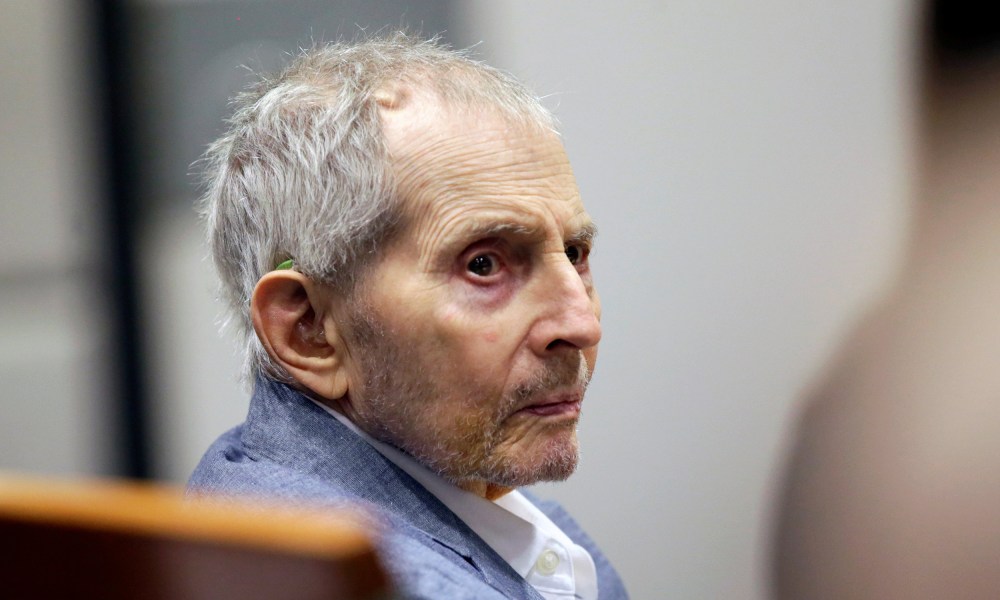
UPDATE (09/17/2021 7:25 p.m. E.T.): A Los Angeles jury on Friday convicted Robert Durst of first-degree murder for killing his friend, Susan Berman.
In an unusual and unprecedented twist, Robert Durst, the multimillionaire real estate heir charged with the murder of his close friend, returned to the courtroom after a 14-month delay. The murder trial began in March 2020, but due to the pandemic it was — like so many other life events of the past year — suspended. So this week Durst, along with the original jurors, heard the prosecution complete its opening statement … again.
We usually see documentaries released after the trial has concluded.
Last year, the trial managed to progress through jury selection, opening statements (for which the prosecution alone took three days) and 10 witnesses before the coronavirus pandemic caused the judicial system to take a longer-than-expected hiatus.
If you’ve heard of Durst, chances are you’ve watched the 2015 HBO documentary series “The Jinx: The Life and Deaths of Robert Durst.” Its documentary publicity is only part of what makes this case so complicated; one of the original alternate jurors was dismissed after she advised that she had reviewed an article about the trial. This occurred after the judge brought in each juror individually to ask if they had watched TV programs about the case or read about the facts of the case or if they had discussed the case with others.
Durst is charged with first-degree murder for the December 2000 shooting death of Susan Berman, his longtime confidante and close friend. The prosecution’s theory is that Durst killed Berman to ensure she never implicated him in the alleged 1982 murder of his first wife, Kathleen Durst. The state intends to prove Durst confessed to Berman that he killed his wife and that he feared she would tell law enforcement what she knew. (Durst has not been charged with killing his wife and has denied having a role in her disappearance.)
Although he denied it for 20 years, Durst has now admitted that he discovered Berman’s dead body, panicked and fled, but he denies killing Berman. He also admitted that he authored an anonymous letter to the police advising that there was a “cadaver” at Berman’s home. The defense continues to claim there is zero forensic evidence tying Durst to Berman’s murder.
Last year, counsel for Durst also advised jurors that Durst would take the stand and testify in his defense. It is exceptionally rare for a criminal defendant to testify at trial. The Fifth Amendment states that no person “shall be compelled in any criminal case to be a witness against himself,” so Durst has no obligation to testify. To do so exposes a defendant to what is likely to be a withering and brutal cross-examination by the prosecutor. And someone like Durst, with his eccentricities and reports of bizarre behavior, could be unpredictable on the witness stand.
The prosecution’s theory is that Durst killed Berman to ensure she never implicated him in the alleged 1982 murder of his first wife, Kathleen Durst.
Regardless, in the event that Durst changes his mind and decides not to testify, the prosecution will already have plenty of evidence to present to the jury — from Durst’s own mouth. In 2015, Durst was interviewed by L.A. County Deputy District Attorney John Lewin for almost three hours. That very same deputy district attorney is the trial attorney on behalf of the state of California, and he intends to introduce into evidence portions of that interview, as well as hundreds of phone calls made by Durst from inside of jail. Lewin also has declared that he will call 100 witnesses to testify in the state’s case.
But the most damning evidence that Lewin has in his arsenal are words infamously uttered by Durst himself, while being interviewed for “The Jinx.” According to the documentary filmmakers, Durst asked to use the restroom when the crew was packing up their equipment. He reportedly failed to remove his wireless microphone, which remained on and recording. In reviewing footage later, the filmmakers discovered audio that ended up being used in the final moments of the documentary, during which Durst says, “What the hell did I do? Killed them all, of course.”
In 2019, The New York Times published a transcript of the unedited audio that shows that the two sentences were taken from a much longer speech and edited together in reverse order. The defense has alleged the documentary was “deviously misleading and heavily edited” and that the recording of Durst was “manipulated” to make it sound more compelling and entertaining.


Thus far, the prosecution has been able to use Durst’s words against him during the trial because the Fourth Amendment of the U.S. Constitution prohibits the search and seizure of a person’s private space where that person has a “reasonable expectation of privacy.” The question of whether Durst had a “reasonable expectation of privacy” when he was inside of the restroom has been answered by the court, at least for now, with a “no.”
In 2019, The New York Times published a transcript of the unedited audio that shows that the two sentences were taken from a much longer speech and edited together in reverse order.
The defense has claimed Durst was alone when he was in the restroom and that he should have been able to use the bathroom without any expectation that he was being recorded, but the judge has allowed the deputy DA to use the recording during the trial.
If the defense can successfully convince the jury that Durst’s words were unfairly taken out of context, then jurors can choose to put no value on that evidence. The prosecution, however, still has more than 20 hours of interviews recorded during the making of that documentary from which to pick and choose evidence to present to the jury. The jury has also already viewed excerpts of the documentary during the prosecution’s opening statements on Tuesday.
If a determination is reached that the audio was intentionally edited to implicate Durst, this could reflect poorly on the prosecution, as it would be viewed as the state attempting to influence the jury’s verdict by what has been found to be manipulated evidence. But as the filmmakers were not law enforcement or agents acting on behalf of the state of California when the recordings were made, there likely wouldn’t be consequences for their editing or manipulation of the audio.
This would not be the first time a documentary has been created based upon a high-profile defendant or case. However, we usually see documentaries released after the trial has concluded, and a criminal defendant is usually cautioned by his defense attorney not to speak about the facts of an investigation or a case out of the (very reasonable) fear that he might incriminate himself. Durst’s willingness to speak to documentary filmmakers, let alone the deputy DA prosecuting his case, seems to show he has little regard for the possible consequences.
Durst has already been acquitted of one death after claiming he fired a gun in self-defense in 2001, killing his neighbor, who he then dismembered. Will he be able to pull off another acquittal this time around? And will it be his own recorded words that seal his fate? The trial is anticipated to take a number of weeks to conclude — so we will have to wait and see.

Katie S. Phang
Katie S. Phang is the host of "The Katie Phang Show," which airs Saturdays at 12 p.m. ET on MSNBC. She is a legal contributor for NBC News and MSNBC based in Miami. She leverages her significant trial attorney experience to provide analysis and commentary on the latest legal issues.