




At the end of August, if all goes according to schedule, the final American troops will depart Afghanistan, almost 20 years after the U.S. war there began. And if current military trends are any indication, the Taliban may soon be back in control.
A massive explosion rocked Kabul, the capital city, on Tuesday, shaking the “Green Zone” that houses the presidential palace and foreign embassies. The Taliban later claimed credit for the apparent attempted assassination in an interview with NBC News.
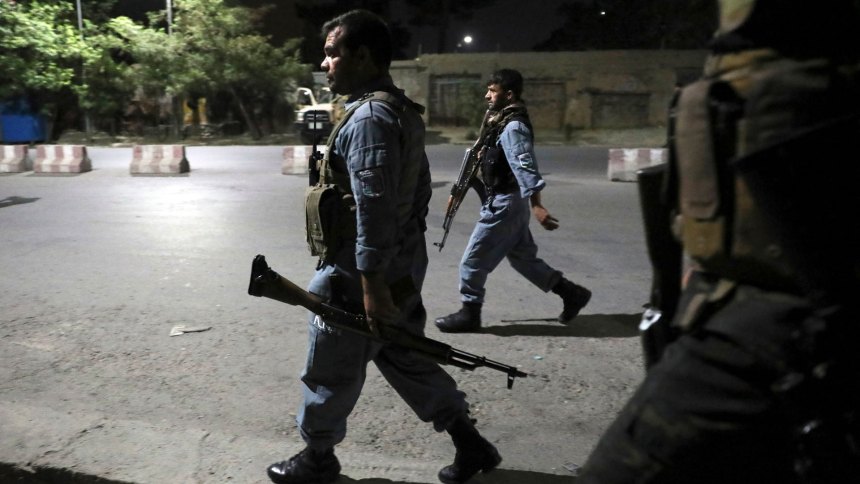
The insurgent force is now estimated to control approximately half of the country. The group is on the verge of seizing its first provincial capital in Helmand, a longtime stronghold and where hundreds of U.S. soldiers have been killed in the line of duty. Others may follow soon, and to many observers, it’s a question of when, not if, Kabul joins them.
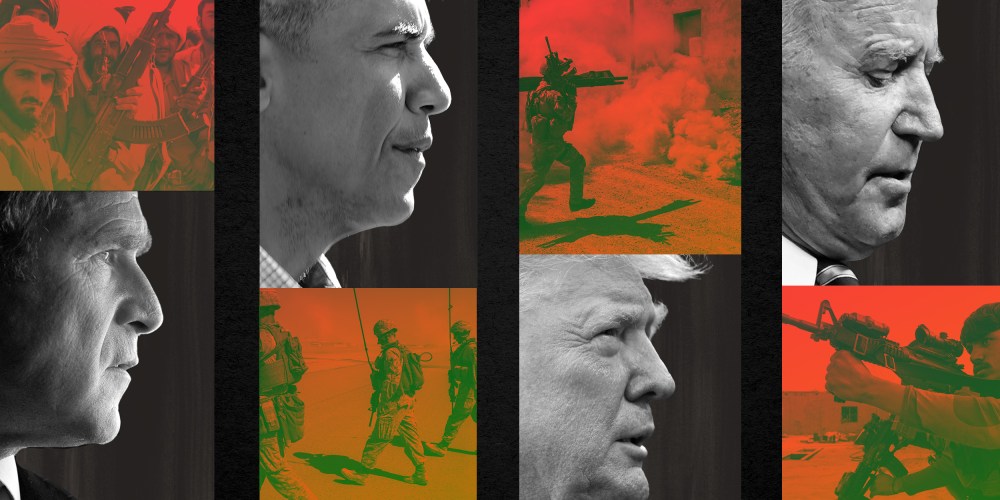
If that happens, we are likely to see a reprise of the 70-year-old “Who lost China?” debate. This time the blame will likely be hung around the neck of President Joe Biden. But that blame would be misplaced. The U.S. “defeat” in Afghanistan is not the fault of one party or one president. Rather, it is a quintessentially American failure — a collective one 20 years in the making, the result of American hubris and a misguided belief in what U.S. power can achieve.
When the Taliban refused to end its support for Al Qaeda and hand over its leader, Osama bin Laden, after the Sept. 11 attacks, the U.S. threw its military weight behind the rebel Northern Alliance. Backed by American airpower, the rebels swiftly routed the Taliban from power.
It’s clear that Afghanistan is today in a better place than it was then, particularly for Afghan women, who lived in near captivity under Taliban rule. But there’s also no doubt that for two decades the U.S. made one disastrous policy decision after another that today have put all these gains at risk.
These bad choices began before the initial phase of the war even ended. At Tora Bora, the U.S. turned the final battle against Al Qaeda over to Afghan militias, who allowed the terrorist group’s leaders, including bin Laden, to slip away into Pakistan. It continued with the disastrous Bonn Conference in 2001, which gathered well-meaning diplomats with little experience in Afghan affairs and members of the Afghan elite to draft a new constitution. The result was a highly centralized federal system that ran counter to years of decentralized Afghan governance.
But it was the exclusion of the Taliban from having any political role in Afghanistan’s future that is perhaps most disastrous, as many commentators have argued for years. In the wake of their defeat in 2001, the Taliban was a spent force and many of its foot soldiers (and leaders) simply wanted to surrender and return home. But the Bush administration refused to countenance any political role for terrorists. With its attention soon diverted by the war in Iraq, the U.S. largely ignored the deteriorating situation in Afghanistan and the Taliban’s resurrection.
Rather than look for a political settlement that might allow Afghanistan to find long-term reconciliation — and extricate American forces — the U.S. and its NATO allies continued to pursue a military solution in Afghanistan. It was a mistake that spanned presidential administrations.
From the beginning, the U.S. war in Afghanistan was grounded in hubris and a profound misunderstanding of Afghan history, politics and culture.
In late 2009, under enormous pressure from military leaders, President Barack Obama agreed to surge 30,000 troops to Afghanistan. Publicly, he justified the decision as a way to weaken Al Qaeda — even though the terrorist group presented little threat to the U.S. and hadn’t operated in Afghanistan since 2002. With no clear political strategy for ending the conflict, the Obama administration basically ceded the war to the generals.
Obsessed with the doctrine of counterinsurgency, the military convinced itself it could stand up the Afghan government, “out-govern” the Taliban and win over the hearts and minds of the Afghan people all the while weakening the insurgency. But there was little reason for local Afghan civilians to trust the American military or the government in Kabul, which many Afghans viewed as deeply corrupt and untrustworthy. Even among those who deplored the Taliban’s extremist beliefs, there was sympathy for the group’s calls to rid the nation of foreign, non-Muslim troops.


From the beginning, the U.S. war in Afghanistan was grounded in hubris and a profound misunderstanding of Afghan history, politics and culture. But Obama’s surge was the nadir of America’s flawed strategy. When that effort predictably failed, the military went back to old habits, escalating air strikes and trying to win by force. The Trump administration kicked up that effort, prompting a massive increase in civilian causalities in the process. But with a safe haven available across the border in Pakistan, the U.S. military could never hope to deal the Taliban a crushing blow.
The Trump administration, to the extent it had an actual policy in Afghanistan, had few options to reverse the Taliban’s gains and in its obvious desire to bring American troops home encouraged the insurgents to simply bide their time until a U.S. withdrawal.

For two decades, American policymakers failed to grasp that Afghanistan, despite its natural beauty and resourceful people, is a failed state. Wracked by more than 40 years of civil war, landlocked and defined by harsh and unforgivable terrain, it is a nation that can barely survive without outside support. While the country is freer and defined by greater opportunity than it was before 2001, it is hardly a Jeffersonian democracy — and likely never will be.
Indeed, U.S. support for the Kabul government fed the country’s endemic corruption that pushed so many Afghans into the arms of the Taliban. American leaders chose to believe the allure of democracy and freedom would win over the Afghan people, ignoring the role that ethnicity and regionalism plays in Afghan society. Even the development of the Afghan National Security Forces followed the model of the U.S. military without the necessary resources and training essential for success. Today, the ANSF is seemingly no match for the ragtag Taliban.
For two decades, American policymakers failed to grasp that Afghanistan, despite its natural beauty and resourceful people, is a failed state.
Rather than seeing Afghanistan for what it is, American policymakers chased a mirage. Rather than recognizing the limitations of American military and diplomatic power, the U.S. continued to push solutions for Afghanistan that made more sense at the Pentagon, State Department and White House than they did in the Hindu Kush.
The irony of all this is that this final collapse will take place during the watch of the one U.S. policymaker who always seemed to understand that U.S. strategy in Afghanistan was fundamentally misguided: Joe Biden.
The then-vice president opposed escalating in Afghanistan in 2009, reminding Obama that foreign interventions in Afghanistan usually fail and that the war effort should be focused on Al Qaeda. Sending more troops and expanding the U.S. mission to counterinsurgency, Biden told the president at the time, would just be “prolonging failure.”
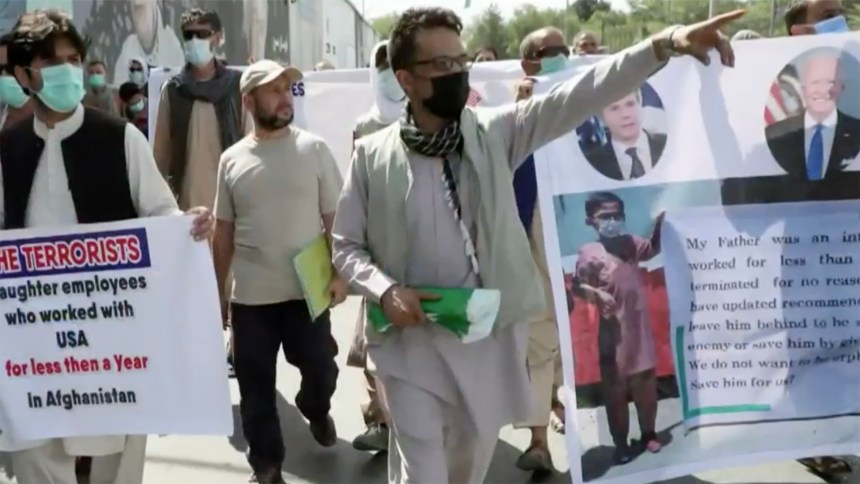
He was right then, as he is right today to bring American troops home. The difference, however, is that in 2009 the potential to put Afghanistan on a better path still existed. It doesn’t today. That failure will be put squarely on Biden, as the man who finally pulled the plug on the U.S. misadventure in Afghanistan. In reality, the U.S. war in Afghanistan is truly a shared national tragedy — but one whose ultimate price will be borne by the Afghan people.

Michael Cohen is an MS NOW columnist. He is also the publisher of the newsletter Truth and Consequences and hosts the weekly podcast That ‘70s Movie Podcast.