




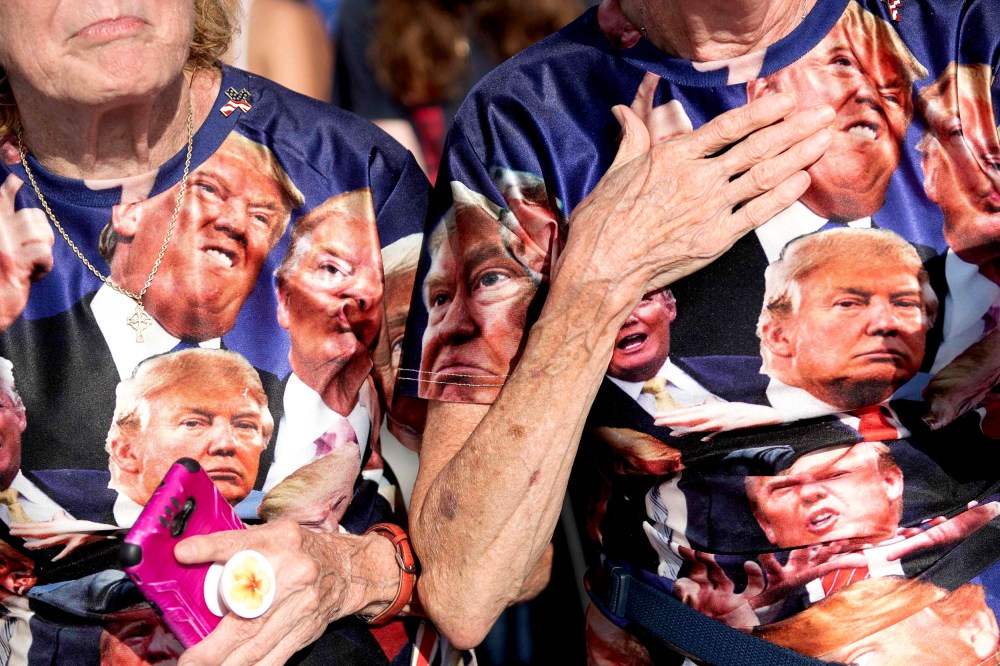
Two weeks out from the election, what was once considered President Donald Trump’s greatest strength among his base — his tendency to “say what he thinks” — has become perhaps his biggest liability.
After having been waylaid by Covid-19 this month, Trump is imploring his re-election campaign staffers to book more rallies for him — as many as five a day, he said in a conference call Monday. But in this crucial stretch, it’s looking like what voters would actually love to hear from the president, if at all possible, is less.
It’s a message that worried down-ballot candidates have been trying to telegraph to the president in recent weeks, fearing a “Republican bloodbath” on Nov. 3. But the “let Trump be Trump” energy remains strong, even as it’s clear that letting him talk about whatever is on his mind instead of focusing on the economy or contrasting himself with Joe Biden isn’t working out too well.
The clearest way we’ve seen this demonstrated so far is in suburban women’s shift away from the president over the last four years. They now favor Biden by 23 percentage points in battleground states, according to a recent poll from The New York Times and Siena College. It’s something that Trump seems well aware of himself — “Suburban women, will you please like me?” Trump, never one to leave something as subtext when it could be neon text, instead, begged at a rally in Pennsylvania on Oct. 13.
But the troubles run deeper for him. Politico Magazine’s Tim Alberta, who has adroitly chronicled Republicans’ relationship with Trump these last few years, noted Tuesday that people are actually pretty dang tired of being in constant digital contact with the president. And that includes those who should be some of his biggest supporters. Here’s how Alberta put it:


Whatever appeal his unfiltered thoughts once held has now worn off. Americans are tired of having beers with Trump. His own supporters are tired of having beers with Trump. In hundreds of interviews this year with MAGA loyalists, I have noted only a handful in which the person did not, unsolicited, point to the president’s behavior as exhausting and inappropriate. Strip away all the policy fights, all the administrative action (or inaction) and all the culture war politics, and the decision for many people comes down to a basic conclusion: They just don’t approve of the president as a human being.
Trump, by most accounts, needs to expand upon his base pool of voters if he has a shot of winning against Biden on Nov. 3, especially in swing states like Michigan and Wisconsin. If members of Trump’s own party are wary of his tone and demeanor, though, it’s not a great sign for pulling in the ever-dwindling number of undecideds and people whose support remains shaky.
As good as Alberta’s sample size is, I can hear you say that’s still pretty anecdotal. But the data support his point. After the first debate, The New York Times’ polling found that voters in Pennsylvania and Florida — two states Trump needs to win — were put off by the president’s constant interrupting and general temperament. Diving into the cross tabs, 14 percent of Republicans polled said they were less likely to support Trump after watching that virtuoso performance of Trumpian qualities. That’s twice the percentage of Democrats who were asked the same question about Biden.
Trump’s performances at rallies draw headlines but risk drowning out a broader message right as his supporters need one to cut through. The Pew Research Center released the results of a survey Monday, part of its American News Pathways project, that looks into voters’ news consumption as the election approaches. What they found was that as Election Day approaches, people are paying closer and closer attention to the race. That’s no huge surprise. But here’s where things get interesting. A majority of both Trump’s supporters and people backing Biden feel worn out from keeping up with the news, but there’s a clear split based on people’s preference:
One area of difference is in the level of weariness brought on by keeping up with the news. About two-thirds of Trump supporters (65 percent) say they are worn out by so much coverage. That compares to just over half of Biden supporters (54 percent) who are worn out, while 44 percent say they like a lot of attention on the election.
And finally, longtime GOP pollster Frank Luntz said something during last week’s dueling town halls that stuck with me. Soon after Trump concluded, Luntz tweeted that his focus group of 15 undecided voters “say that the more Trump speaks, the worse he looks.” Later, on CNBC’s “Squawk Box,” he added that those voters remained undecided because they’re “nervous about Trump’s persona and they are nervous about Joe Biden’s policies, and that’s what is holding them back.” And yet, Trump’s persona is what remains front and center, and that’s not likely to change in these last 14 days.
The president’s blunt talk is off-putting in the Republican-friendly suburbs, where he needs to perform well to overcome Biden’s votes in large urban areas; his staunchest fans are oversaturated with his mien and constant presence in their lives; his supporters are feeling more overwhelmed than Biden’s in trying to keep up with all the news of the race, which is dominated by Trump’s latest gripes instead of his policies compared to Biden’s; and the few undecided voters out there think that the more Trump talks, the less they like him.

Hayes Brown is a writer and editor for MS NOW. He focuses on politics and policymaking at the federal level, including Congress and the White House.