




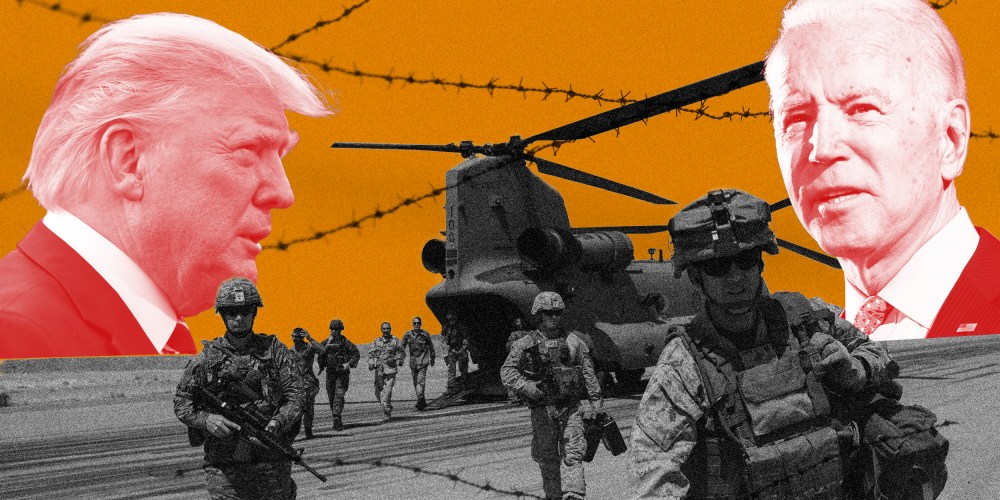
It looks like President Donald Trump has had enough of Afghanistan. After days of news reports hinting at it, acting Defense Secretary Christopher Miller announced Tuesday that the number of U.S. forces in Afghanistan will drop by about half by the last days of Trump’s term, to about 2,500, the lowest it has been since the war began in 2001.
National security adviser Robert O’Brien added that it’s Trump’s hope that all the remaining forces stationed in Afghanistan will be home by May. President-elect Joe Biden’s administration will therefore be left with a decision: restore the cuts Trump has ordered or follow through on his last-minute withdrawal, with all the risks that entails?
After almost 20 years with U.S. military forces in Afghanistan, the choices U.S. leaders have range between bad and worse. The only real difference is which side you think is which.

Biden has expressed a preference for staying in Afghanistan with a smaller, counterterrorism-focused footprint, the same stance he had as vice president during President Barack Obama’s review of the war in 2009. But almost 12 years later, does it make sense to remain in place as an expensive antiterrorist unit? The budget request for U.S. forces in Afghanistan for fiscal year 2021 was $14 billion, the lowest in a decade, down from $17 billion for fiscal year 2020. But those funds get added onto an existing price tag of $778 billion in U.S. military expenditures since the start to September 2019.
After almost 20 years with U.S. military forces in Afghanistan, the choices U.S. leaders have range between bad and worse.
The arguments for staying are focused on the need for U.S. military muscle to prevent a total takeover of the country by the Taliban — or, worse, the Islamic State militant group. But that only further punts on answering the so-far unanswerable question: “When is the job done?” As it stands, the country is still in a stalemate. The Taliban can’t take over the big cities and other places with higher populations; the Afghan military can’t keep the peace in rural areas. Peace talks between the Afghan government and the Taliban have accordingly stalled.
On the flip side, a withdrawal from an unstable Afghanistan could invite accusations that the U.S. is abandoning the women, minorities and pro-democracy advocates whom we’ve spent a generation promising we’d protect. Gunmen killed 19 people in an attack on Kabul University on Nov. 2. ISIS’s Afghan offshoot claimed credit for the attack, highlighting the insecurity the country would continue to face after the last U.S. service member departs.
Meanwhile, Trump’s drawdown is occurring even as the terms of the U.S.-Taliban deal brokered in February remain unfulfilled — the Taliban was supposed to break its ties with Al Qaeda and ISIS before the 8,600 troops in place in June were to begin leaving the country. The safety guarantees that were core to the initial reasoning for invading and overthrowing the Taliban still haven’t been fulfilled.
For the last decade and a half, we’ve tried to split the difference between going and staying, unable to commit to either. The Obama administration’s review led to a surge in troops that saw a peak of over 100,000 before they were drawn down again. Not much has changed since then. Obama’s early pledges to end the endless wars ended with his leaving office after two terms with U.S. forces still fighting the Taliban.
Trump campaigned on ending America’s overseas follies, too. For all his yelling and his current rush for the exit, Trump ended up escalating the air campaign in Afghanistan, dropping more bombs on the country in 2018 than any year since 2011. That in turn resulted in an increase in civilian casualties — the U.N. mission in Afghanistan reported in 2019 that “pro-government forces,” which includes the U.S., had killed more Afghan civilians in the third quarter of 2019 than the Taliban and other “anti-government forces.” It’s a war left idling in neutral, always ready for either a new acceleration or a tap on the brakes. Trump, in a deviation for him, defended deciding to stay in Afghanistan as his listening to his advisers. “We’re there because virtually every expert that I have and speak to say if we don’t go there, they’re going to be fighting over here,” he said in a 2018 Washington Post interview. “And I’ve heard it over and over again.” And yet in the two debates between Biden and Trump this fall, there was zero mention of Afghanistan. It’s a war left idling in neutral, always ready for either a new acceleration or a tap on the brakes. Hopefully, whatever happens, and however Biden’s team feels, we can have an actual national debate. Congress should be involved in the decision-making after having been AWOL for years — and so should we, the American people. If we leave Afghanistan, are we willing to accept the idea of being less safe and leaving its civilians in harm’s way? If we stay, are we willing to accept the cost and the deaths of the very civilians we’re trying to protect in the name of their safety and ours? It’s not an easy choice. Neither option is a good one. But we’re finally at a place where we can’t hedge anymore: Are we in or out?
Hayes Brown is a writer and editor for MS NOW. He focuses on politics and policymaking at the federal level, including Congress and the White House. 

