




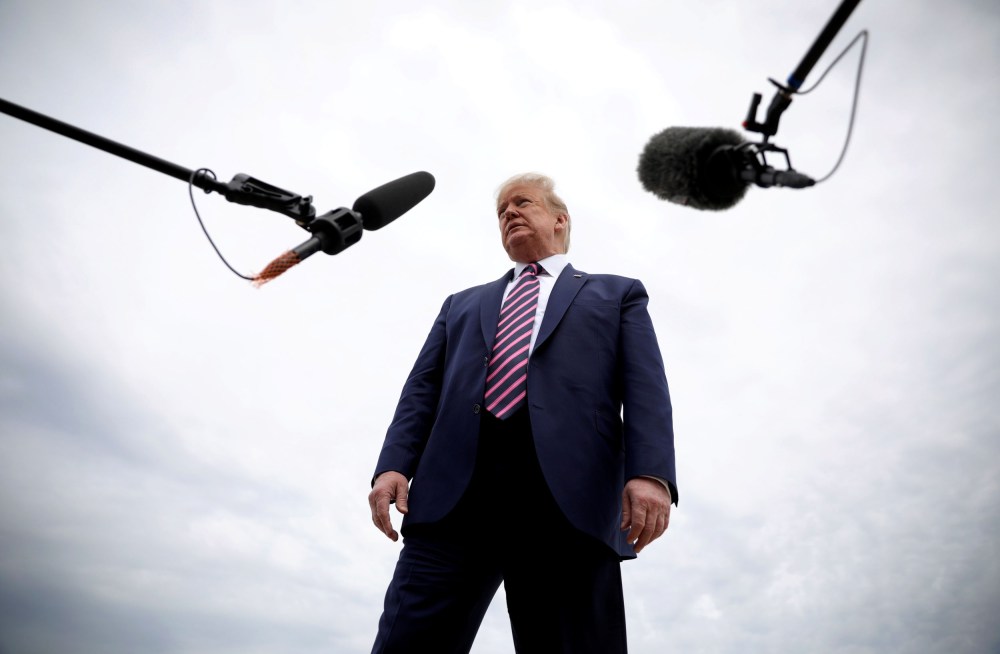
Former President Donald Trump’s legal antics continue, but this time it could cost his party millions of dollars and potentially its ability to regain control of the House and the Senate.
It may be that the Republican Party needs Trump more than he needs the Republican Party.
Trump is apparently still smarting because 10 Republicans in the House voted to impeach him and seven Republicans in the Senate voted to convict him based on his involvement with the attack on the U.S. Capitol on Jan. 6.
This was made abundantly clear when he sent a cease-and-desist letter ordering the Republican National Committee and other GOP campaign committees to stop using his name or likeness in fundraising materials, including emails and merchandise. In essence, Trump told the three biggest fundraising arms of the Republican Party and some additional committees to stop referring to him when asking for campaign donations.

The RNC responded that it is well within its legal rights to use Trump’s identity in fundraising materials. The committee argued that a request for a political donation is considered political speech and that the RNC and other campaign committees have the right to mention Trump, a public figure and arguably the standard-bearer of the party, as part of its political speech. Put another way, the RNC suggested that Trump shouldn’t be able to trample on its First Amendment rights to mention him when raising money. Oh, the irony.
The RNC very likely has the better legal argument here. Trump, as the former president, is a public figure to end all public figures. This limits his ability to prevent people from using his name or likeness. Furthermore, he is almost by definition newsworthy, and therefore mentions of him will typically be protected under the First Amendment. In other words, it’s hard to see how Trump can wrest away the RNC’s First Amendment right to refer to him in fundraising materials.
In the end, while Trump’s cease and desist letter is unlikely to be legally successful, it may already be a political win, at least for him.
While Trump seems not terribly concerned with the First Amendment rights of the RNC, he will use the First Amendment as a defense in the two civil cases pending against him for his role in inciting the Jan. 6 riot. Reps. Bennie Thompson, D-Miss., and Eric Swalwell, D-Calif., have sued Trump for his involvement in the events of Jan. 6 — yes, the same event that led to his second impeachment. And yes, the same impeachment that garnered some Republican support and apparently led Trump to tell the RNC to stop using his name for fundraising.
Trump’s approach to the First Amendment and whom it protects may be inconsistent, but his desire to control his name, likeness or brand is consistent with actions he has taken for years to zealously guard control over his identity.


Trump has a pattern of licensing the use of his name or brand for his own benefit; there is nothing improper about that, but the Republican Party isn’t a hotel looking to cash in on his name. Technically it is looking to cash in on Trump’s name, but as a political party, it’s for different purposes. A hotel wants customers. The Republican Party wants money to help bolster its candidates. We can’t treat those two situations as similar.

Given all this strife, will the union between the Republican Party and Trump survive? It was just last year that they jointly raised more than $350 million in the 2020 election. It may be that the Republican Party needs Trump more than he needs the Republican Party. Trump remains popular among Republican voters. And while at least in pandemic years it may feel like the midterms are eons away, the time to start fundraising is yesterday.
Trump is well aware of the time constraints when it comes to fundraising and how popular he continues to be with certain donors. Just recently, when he spoke at the Conservative Political Action Conference, he told attendees that the only way to support Republicans who support him is through his political action committee, Save America.
Given all this strife, will the union between the Republican Party and Trump survive?
The Save America PAC has more than $80 million in the bank. Trump’s calls to donate only to an entity controlled by him, and not to the traditional Republican Party committees, could divert millions to him in the lead-up to the 2022 midterm elections. In addition, the PAC allows Trump to raise unlimited sums and use that money to donate to other political activities or candidates. The PAC is, in other words, a flexible tool for Trump, and it gives him more control than if that money were given to the RNC.
In the end, while Trump’s cease-and-desist letter is unlikely to be legally successful, it may already be a political win, at least for him. Trump has now put himself and his PAC front and center in the minds of would-be political donors. The publicity is likely to serve him well as he continues to raise money and exert his control over the Republican Party.

Jessica Levinson is a Loyola Law School professor and MS NOW columnist.