




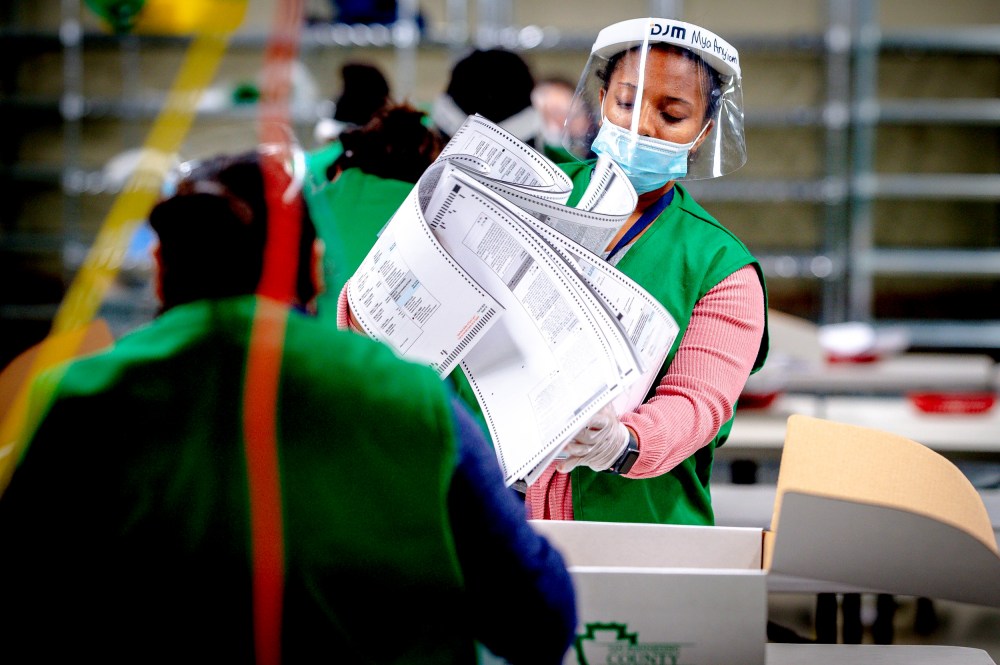
We are in the weeds now with this election, counting the ballots as they come in for the remaining counties and states. But as we focus on the numbers, the ups and downs, and the ultimate winners, we should not lose sight of the philosophy that has animated the president and his supporters in this election cycle so far, which is to try and keep the ballots cast by people who vote against them from being counted.
Trump seems to have so dulled our national sensibilities that we are unable to muster much collective outrage over even the most undemocratic behavior.
Voter suppression has been a consistent strategy of the Trump administration. What’s new is that it’s explicit and it’s coming direct from the Oval Office. That in itself should be shocking and people of all political stripes who are committed to our form of representative government should be outraged. But Trump seems to have so dulled our national sensibilities that we are unable to muster much collective outrage over even the most undemocratic behaviors.
A president who seems to claim the ability to select his voters instead of letting the voters choose him should not have even a pretense of legitimacy. But Trump has run a campaign grounded in keeping ballots from being cast and counted. He came out and acknowledged it in late March when he reacted to a proposal that would have provided resources for absentee and mail-in voting during the pandemic by saying that if you had high levels of Democratic voting “you’d never have a Republican elected in this country again.”
The strategy of voter suppression was apparent in a spate of cases brought by Republicans ahead of the election to challenge common-sense safety accommodations designed to make voting safer during the pandemic, in an effort to prevent ballots from counting.
Where Democrats sought additional days for ballots to be received in the mail when Postal delivery slowed, Republicans went to court to try and block the new rules, arguing ballots received after Election Day shouldn’t count. Provisions for drive-thru voting were challenged as well. With Election Day behind us, Republicans now seem prepared to continue this effort to keep Democrats’ votes from counting, seeking to challenge each individual ballot instead of statewide rules in some cases.
Where Democrats sought additional days for ballots to be received in the mail, Republicans went to court to try and block the new rules being put in place to make it easier to vote during the pandemic.
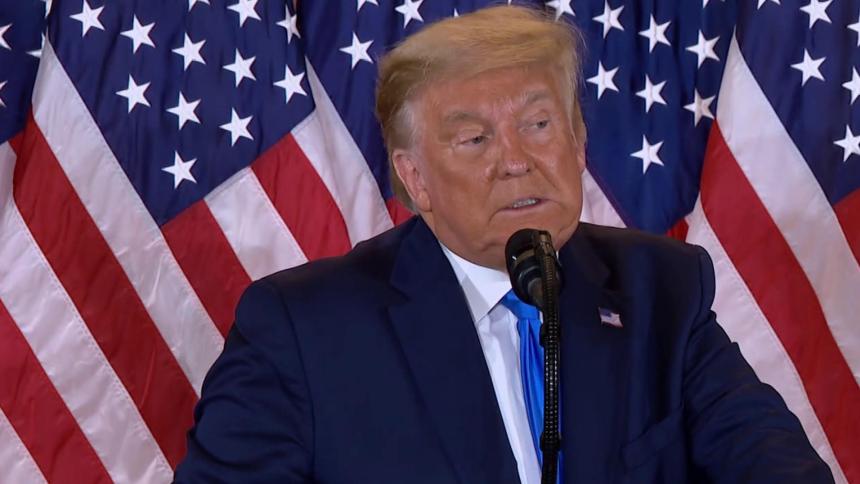
Before the election, there were already reports that Trump intended to claim victory on election night before all of the votes could be counted. So, it came as no surprise that, moments after former Vice President Joe Biden counseled Americans to have patience and keep the faith as state vote counts continued, Trump tweeted: “I will be making a statement tonight. A big WIN!” Hours later, he subsequently took to the White House’s flag-encrusted podium to claim victory, falsely insisting he had won states where all of the votes were yet to be counted, according to the states’ election officials.
I will be making a statement tonight. A big WIN!
— Donald J. Trump (@realDonaldTrump) November 4, 2020
That shameless lie is reprehensible. What makes it worse is the context. Trump has often worked harder to make sure ballots from Biden supporters weren’t counted than he has to win over people to vote for his policies and his leadership. That fundamentally flawed approach, which erodes Americans’ fundamental right to vote, is one more norm unacceptably shattered by Trump.
Voter suppression has been a long-term problem in America, but having a president publicly invoke it is something altogether unprecedented.
Voter suppression is not typically a strategy that 21st century politicians have explicitly embraced. Democrats and people in the civil rights community denounced and fought against it — such is the legacy of John Lewis and Selma — and while politicians who engaged in questionable practices have defended themselves by saying they were using legitimate techniques to prevent voter fraud, they never openly embraced the suppression of votes. That’s a new development with Trump, who has openly advocated for it. Any post-election litigation on his behalf should be evaluated in light of this context and rejected, hopefully by both the courts and by the country.

A look at Wisconsin, where the race seems likely to come down to mail-in ballots, tells this story. Ahead of the election, Republicans challenged a federal court’s decision allowing additional days after the election for mailed-in ballots to be received. That decision was based on evidence that Justice Elena Kagan noted established “unusually” slow mail delivery meant as many as 100,000 voters who had fully complied with the rules would be disenfranchised. And yet, when Trump made remarks in the early morning hours after the polls had closed, he charged that the continued counting of votes was in some way disenfranchising people who had voted for him, charging that the continued counting of votes that had arrived in the mail amounted to stealing the election from him.
Wisconsin is now very close. Justice Kagan pointed out that without extra time for ballots, which USPS was handling unusually slowly, to be received in the mail, as many as 100,000 voters who had fully complied with the rules could be disenfranchised. https://t.co/LO56yjCgnR Republicans are also challenging the “management and monitoring” of ballot drop-boxes in Michigan, Minnesota, Pennsylvania, and Wisconsin, demanding that those ballots be separated so they can be challenged after election results are in. In Nevada, the Trump campaign filed an emergency motion to try and prevent mail-in ballots from being counted and are prosecuting an appeal to permit them to review signatures. There are other lawsuits in these states where votes are critical to the outcome of the election, designed to prevent American’s ballots from being counted, because the president doesn’t want them to have any say. Moreover, a federal judge in Washington, D.C., has set a hearing for Wednesday after the Postal Service, which was previously found to be engaging in deliberate conduct to slow delivery of ballots, declined to comply with a court order that would have put those ballots in election officials’ hands before the close of Election Day. A reported 300,000 ballots that were entrusted to the Post Office lacked a scan showing they had been delivered and states including Arizona, Florida, Georgia, Michigan, North Carolina, Ohio, and Pennsylvania fall within the court’s order. The suppression has been widespread and at least partially successful. Trump has often worked harder to make sure ballots from Biden supporters weren’t counted than he has to win over voters of his own. It is worth pointing out that this is not an issue where both sides of the political divide are equally deserving of criticism. While the Republican party has tried to narrow the number of eligible voters who get to vote — whether by restricting registration, requiring identification or limiting voting days — Democrats and their allies in the civil rights community have sought to expand opportunities for eligible voters. They have sued and advocated for policies that make it easier to register and to vote, while pushing back against a false narrative of voter fraud that the president has pushed to try to restrict those who can exercise the franchise. Republicans have tried to impose one-sided restrictions that favor their base. Democrats have advocated for measures that open up the vote to all qualified citizens. Achieving full voting rights in this country continues to be an aspirational goal. But permitting a president to call, without opposition, for Americans to lose their right to vote to ensure his re-election is unacceptable. There is something unsavory about an official who is supposed to serve the people waging a war to keep some of them from voting. Trump thinks that only his supporters deserve to vote, and Republican strategies bear that out. We’re at risk of becoming a country that works that way, in the tradition of other banana republics, if he’s not stopped.

