



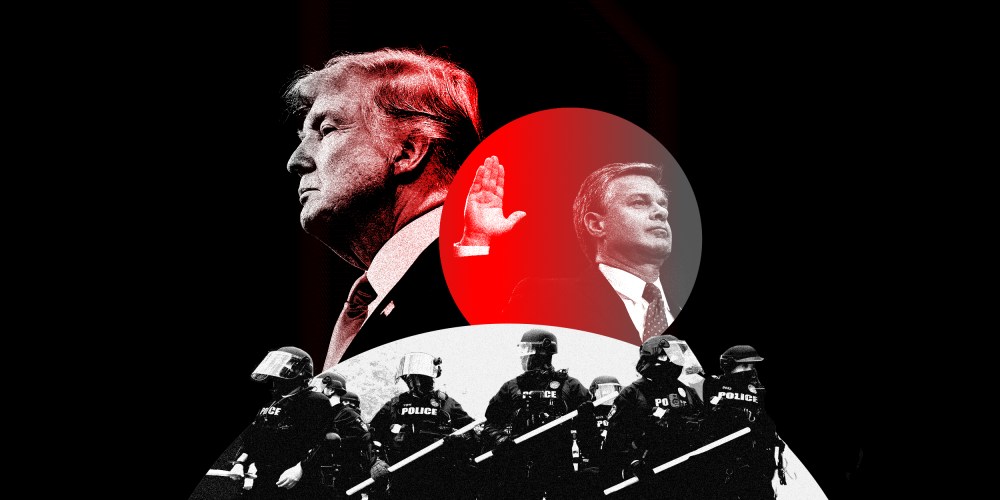
The week before Election Day, we learned that if President Donald Trump wins re-election, he reportedly plans to immediately fire FBI Director Christopher Wray, along with the heads of two other agencies. If this sounds familiar, it’s because Trump also fired the previous FBI director, James Comey, when he drew the president’s ire after declining to pledge his loyalty to Trump and then revealing in public congressional testimony that the FBI was investigating the Trump campaign for allegedly colluding with Russia.
Wow, just learned in the Failing New York Times that the corrupt former leaders of the FBI, almost all fired or forced to leave the agency for some very bad reasons, opened up an investigation on me, for no reason & with no proof, after I fired Lyin’ James Comey, a total sleaze!
— Donald J. Trump (@realDonaldTrump) January 12, 2019
As with Comey, Wray’s actions, as well as actions he appears unwilling to take in the service of Trump, have placed him high on the list of potential presidential pink slips. In other words, since the head of the FBI refuses to bend the truth, Trump plans to break the FBI as punishment.
As with Comey, Wray’s actions, as well as what he appears unwilling to do in the service of Trump, have placed him high on the list for potential presidential pink slips.
In September, Wray publicly testified to facts that contravene false Trump narratives in three key areas: the ongoing Russian threat to the November election; which groups are really behind much of the violence in America’s streets; and the lack of historical evidence of mail-in ballot fraud. But the president’s firing of one FBI director and his threats to fire another (his own appointed replacement) for lawfully testifying against him gets at an even larger problem: The president is politicizing the police.

While the president’s son Donald Trump Jr. claimed on Fox News that his father must break up FBI leadership and that the bureau’s rank-and-file “door kickers love us,” the truth is that the FBI career employees are fed up with the politicization of their agency.
A very animated Don Jr. is on Fox whining out the same talking points that got his father dunked on during the debate pic.twitter.com/aZoxENeqxJ
— Acyn Torabi (@Acyn) October 23, 2020
On Oct. 28, the FBI Agents Association issued a letter to Trump and former Vice President Joe Biden asserting their support for Wray and for allowing him to serve out his 10-year term, a tenure deliberately established to avoid partisan policing.
While Trump may appear to be penalizing the FBI and praising law enforcement as two separate measures, his institutional attack on the FBI is in fact an attack on the police officers he purports to rally behind. Largely as a result of the 9/11 terrorism attacks and the growing threat of domestic terrorism and violence, the FBI is connected with local, county, state and federal police agencies more than ever before.

To walk through an FBI field office is to bear witness to progressive police-FBI partnerships in action. Whether it’s the Crimes Against Children squad, the Organized Crime program, the Public Corruption team, or the Joint Terrorism Task Force, chances are that you wouldn’t be able to distinguish between FBI agents and city police detectives, the county sheriff’s deputy or the state patrol sergeant. Working elbow to elbow with those officers are agents from the Department of Homeland Security, U.S. Marshals Service, IRS, Postal Inspectors, ATF and more — all under one roof. According to the FBI, the bureau leads 86 Child Exploitation and Human Trafficking Task Forces, including over 850 task force officers representing more than 400 state and local police agencies. There are Joint Terrorism Task Forces in each of the 56 FBI field offices with over 4,000 investigators working both international and domestic terrorism cases.
When an officer is willing to risk his job or paycheck out of allegiance to a politician, that’s what detectives call a “clue” that something is amiss.
This also comes down to a money trail that Trump should know better than to infringe on. FBI task forces come with federal money. Overtime pay for the local police team members flows through the FBI. The bureau picks up the tab for costly undercover, surveillance and wiretap operations, and those initiatives dismantle gangs, terror cells and child trafficking rings. When the president fires and threatens to terminate consecutive FBI directors for not doing his political bidding, he doesn’t erode only one agency’s credibility and trust, he jeopardizes the public perception of American law enforcement writ large — an offense of which Trump and his administration have accused Democrats.

If the president will fire a director who won’t take a partisan approach to law enforcement, it’s logical to assume that he’ll pick a replacement who will. Would a Trump lackey installed as FBI director permit a field officer to investigate a corrupt Republican or friend of the president? Will a director who is pressured to please the president launch unmerited inquiries into the president’s opponents? Might a political partisan at the bureau’s helm decide not to pursue evidence of Russian wrongdoing because it would make the president look bad? And for all those local, county and state police, would their investigations and related federal funding be stymied in what the president calls “Democrat cities”?


Police chiefs and sheriffs understand the critical role that a non-partisan, politically neutral FBI plays in securing their communities and the funding that allows them to function.
Police chiefs and sheriffs understand the critical role that a nonpartisan, politically neutral FBI plays in securing their communities and the funding that allows them to function. As one senior FBI official confirmed to me, “Major law enforcement associations representing current and former FBI agents as well as police and sheriff’s departments across the country have consistently expressed their full support of Director Wray’s leadership of the bureau.” On Oct. 21, the International Association of Chiefs of Police, the world’s largest professional association of police leaders, with over 30,000 members, held its annual conference. Wray was invited to speak, and it’s no surprise that the theme of his address was partnership.
Police partners are already dealing with the Trump administration’s unwanted attempts to co-opt cops and turn them into a band of politically driven loyalists. Armed officers with the power of arrest who become blindly allegiant to a personality aren’t just unprofessional, they’re dangerous to our democracy.
When an officer is willing to risk his job or paycheck out of allegiance to a politician, that’s what detectives call a “clue” that something is amiss. This past weekend, an NYPD patrol officer was captured on video proclaiming “Trump 2020” from over the loudspeaker in his cruiser.
How the NYPD rolling up in Black communities these days (on my block): “Trump 2020. Put it on YouTube. Put it on Facebook…”
— Brandon K Hines (@thumpio) October 25, 2020
Aight MFers… it’s on TWITTER TOO! BI-DEN! 👋🏿😂#Vote #nypdfinest #bidenharris2020 pic.twitter.com/hmXdY8ivbM
While he was promptly suspended for violating standards requiring officers to be politically neutral in performance of their duties, Trump has called for that officer to return to work. In San Antonio, officers faced discipline for wearing MAGA hats while in uniform, and a Minneapolis police lieutenant praised Trump at a campaign rally while wearing a “Trump for Cops” shirt.
At his August speech accepting his party’s nomination, Trump acknowledged the attendance of a group of Border Patrol union members who cheered wildly in the back of the White House lawn crowd.
This luring of law enforcement away from their oath to preserve and protect everybody in their communities, regardless of politics, isn’t just happenstance; it’s part of a formal effort. “Cops for Trump” is an official Trump campaign initiative. All over the country, well-attended Cops for Trump rallies are staged, often led by Vice President Mike Pence. A political ploy for police is troubling enough, but the fact that police are falling for it should concern us all because of the damage it’s doing to the legitimacy of law enforcement. Recruiting cops into a cult-like club that undermines their public service mission increases the chance that they will be emboldened to do the wrong thing. And threatening to fire yet another FBI director decreases the odds that we’ll have a top cop who is empowered to do the right thing.
