




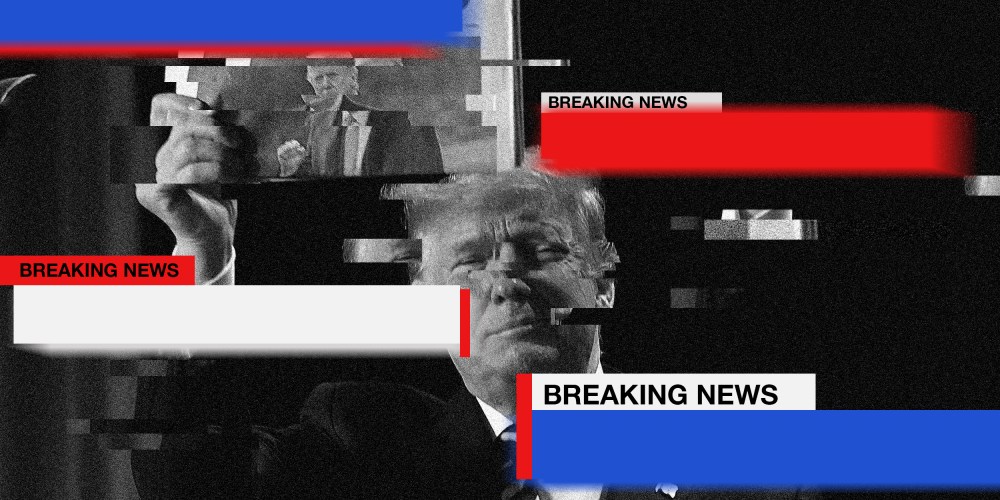
Richard Grenell, the former acting director of national intelligence, former ambassador to Germany and current Trumpist agitator, offered some sage advice to reporters Thursday: “The journalism industry will improve when there is Truth in labeling its reporting.”
I think that’s true. Which is why, Ric, I also think it’s important for the media to call what President Donald Trump’s campaign has tried to set in motion these past few weeks an attempted coup. Trump tried to instigate an “autogolpe” (also known as a self-coup). This particular label is terrifying and hard to fathom, but it is also the more accurate way to describe what has happened. As of this writing, the Trump campaign’s putative putsch failed, with almost comical ineptness. But it also marked a predictably dangerous turn for an autocratic president who can’t admit to losing, fair and square.
The Daily Beast cannot continue to call Sam a reporter.
— Richard Grenell (@RichardGrenell) November 19, 2020
He is a partisan activist and his blogs should be labeled that way.
The journalism industry will improve its credibility when there is Truth in labeling its reporting. https://t.co/XnDdTTeDWV
Here’s how Reuters described the situation on Thursday: “A senior Trump campaign official told Reuters the plan was to cast enough doubt on the results in crucial states to persuade Republican legislators to step in and appoint their own slates of electors.”
This reporting is backed up by a series of events in states like Michigan, where Trump tried to cajole and pressure state officials into investigating and hopefully overturning the results. Monday, after Michigan did finally certify its result, the administrator of the General Services Administration informed President-elect Joe Biden’s campaign in a defensive letter that the agency would order federal agencies to cooperate with a presidential transition.

Reporting is an involved process that aggregates dozens of voices and sorts through motives and intent. Giving the president the benefit of the doubt here would be more biased than just reporting the facts as we know them.
Even so, I know that “coup” is a big word that carries a lot of historical baggage. It shouldn’t be used without deliberation. Can there be a coup that doesn’t involve a news blackout or tanks in the streets or people cowering in their homes? Perhaps movie coups aren’t the best archetypes. Instead, let’s evaluate some of the clearer objections.
Provocatively, Indi Samarajiva argues that even when a coup is doomed to fail — and especially when everyone knows that the coup will fail in advance — it can still do damage. Samarajiva lived through what she calls a “student coup” in Sri Lanka, and she writes that America is strong enough to withstand Trump, this time.
But Samarajiva also notes that our democracy encourages bad-faith actors to maximize their power. She is right. We need to establish precedents and laws stronger and deeper than the polite norms we ask presidents to abide by today. We must also re-evaluate our language and narrative; the word here is “coup,” and the narrative here is “a coup that did not succeed.” Because if the election were closer — if, say, the election came down to only one state — we might have a totally different situation on our hands. And that’s scary.
Elsewhere, Trump sympathizer Jay Whig argues that it’s unfair to call this a coup because Trump may not even understand what he’s doing — he may genuinely believe he won the election. But whether Trump is or isn’t knowingly committing sedition doesn’t matter. Motive matters far less than intention and consequence. The election was fair; to even try to subvert it while fomenting a demonstrably false conspiracy is a consequence that demands an explanation.
Others, like political scientist Erica de Bruin, argued early on that Trump hadn’t actually violated any laws. I concede that this continues to be more or less true. It’s true that Trump’s lawyers have seemed unwilling to lie in court in the same way that they have in the media. But it is a felony to tamper with the results of a certified election. (Georgia’s Republican secretary of state, Brad Raffensperger, certainly seemed to feel he was being pressured by Sen. Lindsey Graham, R-S.C., to tamper with the certification.) It is also a felony to offer state legislators or presidential electors a thing of value to influence an official decision. Several election law experts wrote Monday that the conduct of Trump’s attorneys is grounds for disbarment. Taken in aggregate, this is a political crime — the type that should trigger an impeachment — and an offense against the system itself.


Taken in aggregate, this is a political crime — the type that should trigger an impeachment — and an offense against the system itself.
The journalism professor within me, who came of age during a time when accusations of media bias carried more weight, thinks the press should be careful with the word “coup” because it could seem overly partisan. Won’t the press lose credibility with Republicans if it gangs up on Trump’s post-election machinations? But my wizened self disagrees with my former self.
The press already finds it hard to communicate with people who have personalized politics, who, in the words of Republican never-Trumper Tim Miller, “have been trained to believe that the left is evil incarnate.” The conspiracy “sounds so preposterous to everyone else that Republican elected officials can avoid engaging on the merits while they accuse The Media of being mean to them for asking about it and mock liberals for panicking over this subversion of our democracy.”
Biden understands that the press’s new moral grammar — the president lies; the president cheats on his taxes; the president stokes racial animosity — is a healthy development for journalism in its role as an institutional guardrail against authoritarianism.
He also understands that the media’s good instincts can amplify Trump’s bad ones. With Trump, a hunch can turn into a tweet, which can turn into a strategy, which can turn into a fait accompli in the space of several minutes. To win, which for Trump means to be the center of attention, is to have an enemy that is suggesting something horrible about you.

Biden wants to draw Trump away from the center of attention. He wants Americans who voted for Trump to focus on his message, mien and mindful transition. The more amped up the rhetoric, the harder Biden’s job will become. It will also complicate his informal efforts to reach out to Republican lawmakers.
And yet, the press must not apply a coat of sugar in service of a politician’s agenda. Establishing a line here is a critical function of the media. This is how we build those guardrails we like to talk about; we point out what is, and what is not, acceptable in a democracy. In American elections, there is an implicit trust that people in power will cede their positions when they lose, but a lot of that trust is based on actors’ proceeding in good faith and being responsive to political cues. Calling out bad-faith politicians who do bad things using executive power is an essential journalistic mission.

Marc Ambinder
Marc Ambinder is a senior fellow at the USC Annenberg Center for Communication Leadership and Policy. A former White House correspondent and political reporter, he is the author of several books about national security, including “The Brink: President Reagan and the Nuclear War Scare of 1983.” He is a consultant for Spycraft Entertainment and lives in Los Angeles.