



In the midst of all the impromptu jubilation Saturday, it hit me just how much of our brain space we’re going to be able to recover when the Trump administration finally concludes. No more sitting around wondering what President Donald Trump will do or say, or type, next. For four years, we haven’t known true peace of mind so long as the world’s most important iPhone remained in the hands of the most dangerous tweeter, a man with the impulse control of a 3-year-old.
Imagine it: a world where Trump tweets — and nothing happens. The tweet just hangs there in the digital ether before being lost to the endless churn of the timeline.
For four years, we haven’t known true peace of mind so long as the world’s most important iPhone remained in the hands of the most dangerous tweeter.
It felt like punishment for my hubris when Trump went ahead and punctured that lovely daydream Monday afternoon when, as predicted, he tweeted out that Defense Secretary Mark Esper was being booted from the Pentagon. Esper will be replaced not by the deputy secretary of defense but by Christopher C. Miller, “the highly respected director of the National Counterterrorism Center,” Trump announced.
…Chris will do a GREAT job! Mark Esper has been terminated. I would like to thank him for his service.
— Donald J. Trump (@realDonaldTrump) November 9, 2020
Esper joins a long list of top officials who’ve been fired in 280 or fewer characters. Secretary of State Rex Tillerson was the first high-ranking staffer to learn about his removal from Twitter. Veterans Affairs Secretary David Shulkin, White House counsel Don McGahn, Homeland Security Secretary Kirstjen Nielsen, national security adviser John Bolton — all of them saw the end of their service plastered online before it appeared anywhere else.
For now, let’s set aside the particulars of Esper’s tenure — including this exit interview with Military Times that serves as a mea culpa, CYA exercise and middle finger to the administration all at once. Instead, let’s focus on how good it will feel when Trump’s Twitter feed is no longer something that can move markets and alter the course of geopolitics.
Trump and his Twitter feed are a single organism in a way that’s true for no other major politician, except maybe — maybe — Rep. Alexandria Ocasio-Cortez. Most professional political accounts are run by staffers or at least have a few barriers between the principle’s brain and the Twittersphere, often in the form of some kind of communications strategy.
Trump, though, has resisted any attempt to hamstring his direct access to his 88 million hangers-on to his every tweet. The closest anyone has come is his social media director, Dan Scavino, who is reported to have access to Trump’s account and is the best at approximating his boss’s unique stylings.
Like many of my peers, I was a Twitter skeptic in its earliest days. I changed my mind and joined in 2009 when the Green Movement swept Iran. Over the next half-decade, it became a life-changing way to meet people and gave me my start as a journalist. I even argued for years that social media was clearly a net good for governments, allowing them to more directly connect with constituents.


But after four years of being chained to the site to keep track of the president’s whims (I have a TweetDeck column solely for monitoring his feed, the only person for whom this is the case), the idea of blessed, blissful freedom is creeping up on me. Already in the hours after NBC News called the election for President-elect Joe Biden, I found myself spending hours less of my day on Twitter. I even … read a book!
Even in his post-election rampage, with nearly a dozen tweets hidden from the public for their misleading nature, Trump is still being handled with kid gloves.
I’m not alone. “I have a confession to make about the Trump tweets,” ABC News correspondent Jon Karl said Sunday on CNN’s “Reliable Sources.” “I have turned off the notification on my phone for Trump tweets. … They’re less effective when there are so many and when they are filled with so much disinformation.” Host Brian Stelter joined him in doing so, live on air.
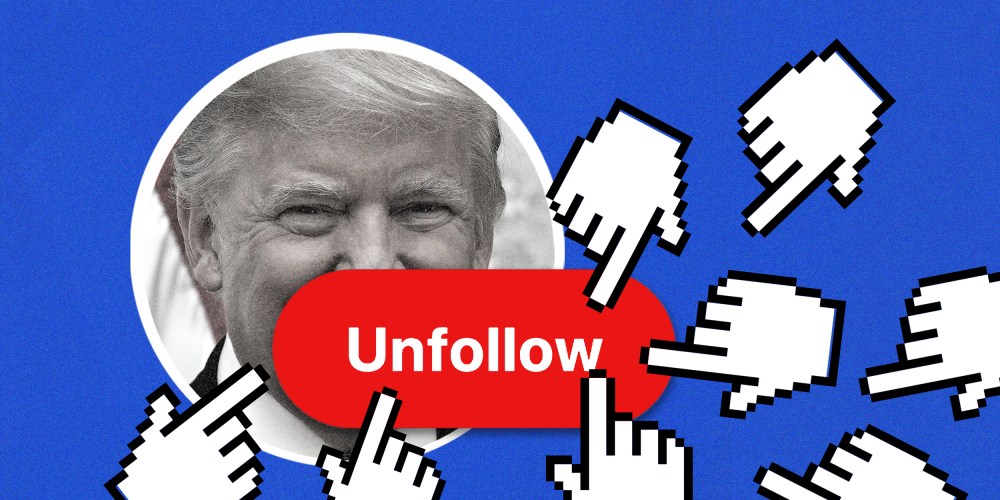
For years, Trump’s been allowed to say almost anything he wants in his feed. Twitter has bent and twisted itself in knots to justify this special treatment, falling back on the “newsworthy” nature of the president’s outbursts. He is, after all, the head of state of the world’s most powerful country. As the election approached, and with Covid-19 misinformation flowing, Twitter and Facebook began putting warning labels on his most outlandish tweets, but they still very rarely removed his posts.
Even in his post-election rampage, with nearly a dozen tweets hidden from the public for their misleading nature, Trump is still being handled with kid gloves — no suspension, no Twitter jail, nothing. But come January, Bloomberg News reported Wednesday, that will no longer be the case. Instead, Trump could be put on notice for breaking the rules, which “would increase the severity of punishment issued from the company, and could lead to temporary account freezes, suspensions or even a permanent ban.” As a spokesperson told Reuters, the company’s policy on world leaders “applies to current world leaders and candidates for office, and not private citizens when they no longer hold these positions.”
If Trump and his acolytes are screaming about media censorship now, just wait until his Twitter account is permanently deleted in what can only be described as a victory against misinformation and a salve for the country’s frazzled nerves. Who knows? Maybe he’ll find a happier home on Parler, the “pro-free speech” app that conservatives have flocked to since Election Day.

Hayes Brown is a writer and editor for MS NOW. He focuses on politics and policymaking at the federal level, including Congress and the White House.