




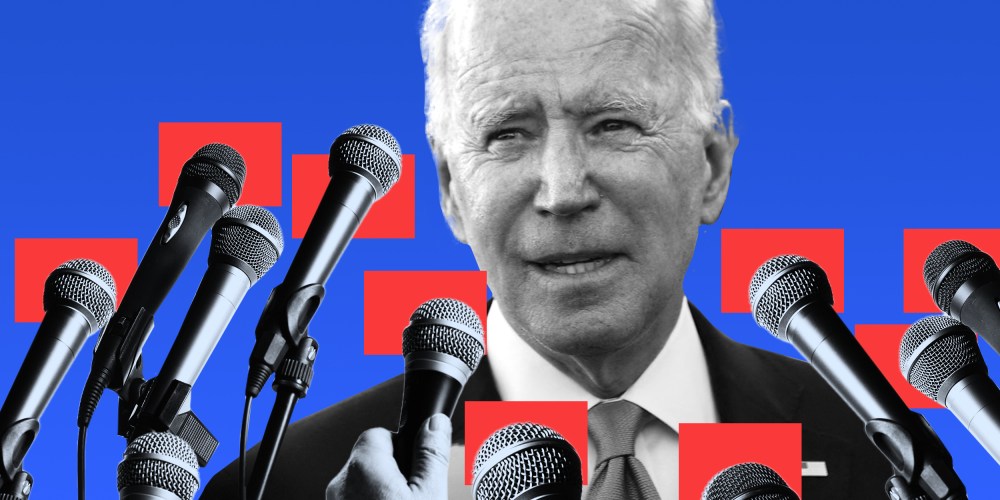
President Joe Biden had a moment at the end of his news conference Tuesday. His snap at a CNN reporter drew immediate comparisons on Twitter to former President Donald Trump’s frequent denigration of the media. That’s not entirely fair, of course, but it was a glimpse at a side of Biden that appears only in flashes, one that goes against the amiable demeanor he’s cultivated before the American public.
I’ve never been a politician or an actor or anyone else whose life is held under a microscope daily. I am, like the vast majority of people, the observer on the other side.
I’ve never been a famous person. I’ve never been a politician or an actor or anyone else whose life is held under a microscope daily. I am, like the vast majority of people, the observer on the other side.But unlike a lot of people, I spend day after day with my eye on the lens, watching for faint changes in behavior, scrutinizing what it could all mean.
It seems to me like it would be a terrible thing to have that light shining on you all the time, unable to dim it. The thought of being so observed, so constantly seen, makes my skin crawl, if I’m being honest. I can see how there are people who seek out that warm glow, only to shrink from it over time. More confusing are the ones who will do everything in their power to stay in focus, daring the watcher to look away.

I can’t quite tell where Biden falls on that spectrum. He’s been in public office longer than I’ve been alive. His on-camera appearances spliced together in a single cut would probably take months to watch. And yet on Wednesday, as he was leaving Geneva, an hourslong meeting with Russian President Vladimir Putin and a subsequent news conference behind him, he seemed to rapidly grow exhausted with the ordeal of being seen.
There was nothing objectionable about the question from CNN’s Kaitlin Collins as Biden made his way away from the podium — “Why are you so confident he’ll change his behavior, Mr. President?”
“I’m not confident I’m going to change his behavior. What the hell? What do you do all the time? When did I say I was confident?” Biden was clearly agitated as he made his way back to the microphones.
Collins: “You said in the next six months we’ll be able to determine—” Biden: “What I said was … let’s get it straight. What I said was what will change their behavior is if the rest of the world reacts to them and it diminishes their standing in the world. I’m not confident of anything. I’m just stating the facts.” Collins: “But given his past behavior has not changed and in that press conference after sitting down with you for several hours, he denied any involvement in cyberattacks, he downplayed human rights abuses, he even refused to say Alexei Navalny’s name, so how does that count to a constructive meeting as President Putin framed it?” Biden: “If you don’t understand that, you’re in the wrong business.”
It was a petty parting shot from someone lashing out in frustration. Either he or someone on his staff quickly realized it was a bad look. A little over half an hour later, on the tarmac getting ready to board Air Force One for the long trans-Atlantic flight home, Biden apologized.
“I owe my last questioner an apology,” Biden said. “I shouldn’t have been such a wise guy with the last answer I gave.” But as he spoke with the media again and got another question — again about his meeting with Putin and what concrete evidence he has that there’s room for progress with Russia — he again gave a mini-seminar in journalistic conduct:
Look, to be a good reporter, you’ve got to be negative. You’ve got to have a negative view of life, OK. It seems to me — the way you all — you never ask a positive question. The thing that amazes me about the questions — and I apologize for having been short about this before — I think if you’re in my position would you just say: ‘Well, I don’t think anything’s going to happen. Man, I think it’s going to be really rough. It’s going to be really bad.’ You guarantee nothing happens. There’s a value to being realistic and put on an optimistic front — an optimistic face.
It was a moment of honesty, essentially conceding that sometimes in politics a positive spin in hopes of a long-shot outcome can help nudge the universe in that direction. Biden knows there are hard times ahead between the U.S. and Russia — but at this stage of the game it’s not in America’s interest to play up those looming confrontations. The real danger comes when that spin becomes dogma, crossing the line from optimism into delusion, which doesn’t appear to be the case here.
It was also an answer that acknowledges the artifice of the relationship at times between observed and observer.
It was also an answer that acknowledges the artifice of the relationship at times between observed and observer. The former puts on a front, a smile and a song and dance. The latter tries to dig deeper into the reality, looking at the subject, not the shadows projected on the wall.
It’s a dynamic that’s in near-constant tension, at least if it’s done right. While even the best journalist can fall prey to charm and razzle-dazzle, the instinct to prod and poke is core to the business. On the flip side, even the most honest and forthright subject is still aware of the observation, a macro-scale mirror of the quantum principle demonstrated by Schrödinger’s metaphorical cat: In being observed, the experiment is affected.


Which brings us back to the comparisons between Biden’s outburst and Trump’s. Unlike Biden, Trump is clearly a character who feeds on attention, the type who feels unsure of what remains of himself trapped alone in that box, the particles bombarding him formed from his own thoughts and doubts. It figures into his constant need to be seen and praised — a need that the press corps was, by and large, unwilling to afford him.

Likewise, Putin cannot handle the sting of criticism — his vulnerabilities are too deep-seated and threatening to sit comfortably with. For those flaws, those weaknesses, to be exposed is to provoke revenge much more potent than a scathing remark. Putin’s poisonous retorts are no metaphor.
Putin has isolated himself from criticism, kept safe and untouchable with the full violence of the state at his whim. It’s during moments on the world stage, his weapons and armor out of reach, that he falters the most. Earlier in the day, before Biden’s news conference, he’d taken questions of his own from reporters. ABC News’ Rachel Scott used her time well:
President Biden has said he will respond if cyberattacks from Russia do not stop. I’m curious, what did he tell you? Did he make any threats? And a quick follow-up if I may, sir. The list of your political opponents who are dead, imprisoned or jailed is long. Alexei Navalny’s organization calls for free and fair elections, an end to corruption, but Russia has outlawed that organization, calling it extremist. And you now have prevented anyone who supports him to run for office. So my question is, Mr. President: What are you so afraid of?
Putin dissembled and, in classic former Soviet fashion, tried to blame the U.S. for his actions, all but saying Russia doesn’t want the “disorder and destruction” in the wake of Black Lives Matter to materialize in Russia. “Fear has nothing to do with anything,” he said through his translator.
.@ABC News’ @rachelvscott to Russian Pres. Putin: “The list of your political opponents who are dead, imprisoned or jailed is long…and you have now prevented anyone who supports [Alexey Navalny] to run for office.
— ABC News (@ABC) June 16, 2021
“So my question is, Mr. President: what are you so afraid of?” pic.twitter.com/EMNnaRLLbO
Scott followed up: “You didn’t answer my question, sir. If all of your political opponents are dead or in prison, poisoned, doesn’t that send a message that you do not want a fair political fight?” Again, Putin deployed whataboutism, drawing equivalencies between Navalny’s supporters in the streets of Russia and the attackers of the U.S. Capitol on Jan. 6. It was a poor mask — there was no need to dig deeper to see through the lies.
After Biden had departed, Collins appeared on CNN, where she acknowledged Biden’s apology but said it was “completely unnecessary.” She added: “Asking the president a question does not mean it has a negative slant or a positive slant. It is simply a way to get into the president’s mindset of how he is viewing something.”
Her eye to the lens, Collins did what the best reporters do, prodded the president in hope of a reaction. In doing so, she affected the result of the experiment — under the glare of the light shining down on him, Biden responded. And thanks to Collins’ questioning, and thanks to her “negativity,” we got that view into Biden that he otherwise would have withheld.

Hayes Brown is a writer and editor for MS NOW. He focuses on politics and policymaking at the federal level, including Congress and the White House.