




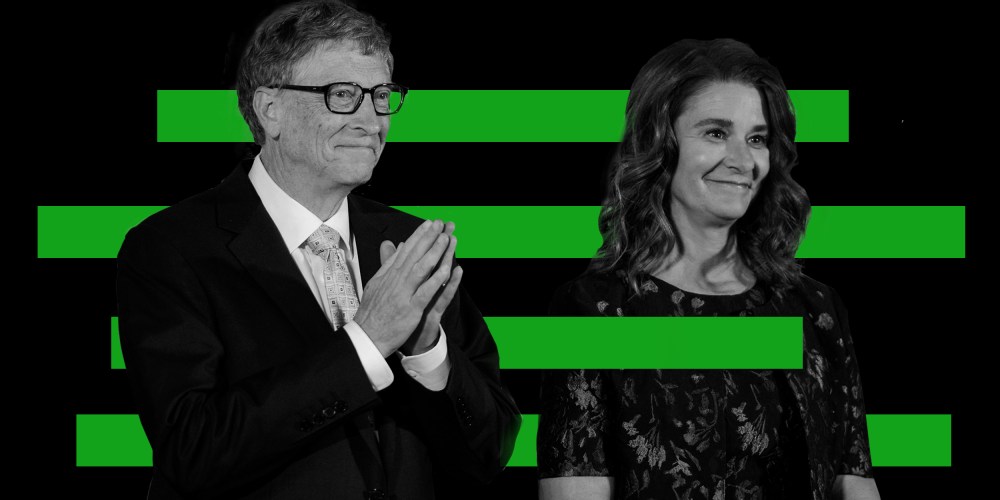
So Bill and Melinda Gates are getting divorced. The most interesting thing about this story, so it would seem, is that we’re so interested in it. After all, this appears to be the most boring kind of divorce imaginable: Two people who have been married for a long time grow apart over the years and part amicably. There’s no gossip, no salacious details. Yet this story is important enough, and people are fascinated enough by it, that it is front-page news.
For most of the 20th century, CEOs were seen not as larger-than-life heroes (or villains) but as bland corporate managers.
More than anything, what that testifies to is the dramatic change in the role of business leaders in American life over the past few decades. CEOs like Bill Gates are now celebrities (even after they retire). And some of them are so monumentally wealthy (the Gates’ combined fortune is worth something like $125 billion) that what happens to their marriages can actually have a meaningful impact on the rest of society. So how can we not care when they get divorced?
This is, it’s worth recognizing, a new phenomenon. Stories of corporate executives getting divorced made headlines in the past. In the 1980s, CEOs divorcing their first wives to marry younger women who were literally labeled “trophy wives” became enough of a trend that Fortune did a cover story on the subject entitled “The CEO’s Second Wife.”
But the divorces that garnered attention typically involved some sort of scandal — like William Agee, CEO of Bendix, leaving his wife to marry Mary Cunningham, an up-and-coming executive at the company — or bitter courtroom fights over money. Amicable separations might have earned a mention on the business page at best.

So what changed? First, CEOs became superstars and celebrities. It’s hard to remember now, at a time when business figures like Elon Musk and Jeff Bezos and Mark Zuckerberg (and, even long after his retirement, Gates himself) suck up so much cultural oxygen and attention, but for most of the 20th century, CEOs were seen not as larger-than-life heroes (or villains) but as bland corporate managers. There was the occasional flashy figure — like the car executive John DeLorean — but they stood out precisely because they were so unusual. CEOs were well-paid bureaucrats, not stars.
That changed in the 1980s, thanks in large part to Chrysler CEO Lee Iacocca, who, in helping resurrect the company (with a lot of help from the U.S. government), made himself the face of Chrysler. He starred in a series of what became legendary TV ads, each of which ended with him speaking directly to the camera. Iacocca was a self-promotional genius, and he tapped into a Reagan-era hunger for American heroes. His book, tellingly called “Iacocca,” became a bestseller and helped give birth to the idea of the celebrity CEO.
The boom in deal-making on Wall Street made people like Michael Milken legendary antiheroes.
Other trends also helped fuel the ascent of the CEO into celebrity status. The boom in deal-making on Wall Street made people like Michael Milken legendary antiheroes, while a new set of media moguls, exemplified by Rupert Murdoch, emerged for the first time since the death of William Randolph Hearst.
Then the personal-computing boom and, eventually, the internet boom, both of which were driven by relatively young companies typically run by their founders, reshaped the image of CEOs. They weren’t buttoned-down bureaucrats anymore. They were entrepreneurial risk-takers and oddballs, like Gates, and, of course, Steve Jobs.


This is very different from how things once were. CEOs have always been well paid, but they typically owned a tiny fraction, at most, of stock in the companies they ran. Over the last 50 years, though, there’s been a precipitous rise in CEO pay; the stock market’s value has exploded; and increasingly the people who founded companies have kept running them and have held on to big ownership stakes.

The most valuable companies in the world today were all started in the last 50 years, and they all had founders who, with one exception — Jobs — held on to a big chunk of the company’s stock. (And Apple gave Jobs a huge chunk of company stock when he came back to run the company in 1997). That’s made the people who started these companies mindbogglingly rich.
This matters because it means when someone like Gates or Bezos gets divorced, it can have a massive impact on people all over the world — simply by changing how all that money gets spent. Last year, for instance, MacKenzie Scott — Bezos’ former wife, who is now worth roughly $60 billion — gave away more than $4 billion, including big donations to historically Black colleges and universities. Those donations in some cases about doubled the endowments of these schools. So the Bezos divorce will have, quite literally, changed the lives of HBCU students for many years to come.
The Gateses seem to generally be on the same page when it comes to philanthropy: They’ve both been closely involved with the Gates Foundation and have said there’s no plans for that to change. But it would be surprising if the divorce doesn’t lead to a shift in how at least some of the Gateses’ billions are spent. So it’s not an exaggeration to say this divorce could have a meaningful impact in fields like public health and education.
In other words, we’re treating this divorce as important not just because Bill Gates is a celebrity or because the numbers involved are so big but because this divorce actually is important. And that, it has to be said, is very strange. Of course, we know philanthropy ultimately depends on individual choices and, much of the time, on the whims of rich people.
But there is still something deeply odd — and troubling — about the idea that the marital troubles of one couple can end up having a material impact on the future of the world. In that sense, the Gateses’ divorce isn’t just their business. It’s everyone’s.

James Surowiecki
James Surowiecki is the author of "The Wisdom of Crowds." His work has appeared in The New Yorker, The New York Times, Wired and Fortune, among others.