




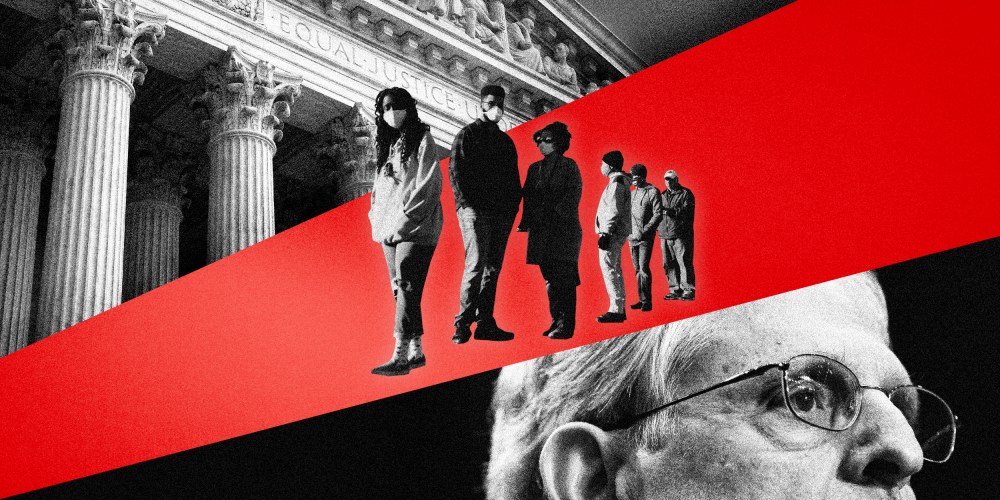
Attorney General Merrick Garland announced Friday that the Department of Justice would be suing the state of Georgia over its recent voting rights changes. While the case is obviously directed at the Georgia lawmakers who passed the new restrictions and the governor who signed them into law, a broader challenge was also quietly being announced by the judge-turned-attorney general.
Garland, who spent more than two decades as a federal appellate judge, made it clear that he is preparing to mount a national challenge in defense of “the central pillars of our democracy” to his old bosses: the justices of the Supreme Court.

Among the provisions being challenged is one barring provisional ballots from people voting in the wrong precinct (except for those cast after 5 p.m. on Election Day) from being counted. It and other areas of the law in question will be “disproportionately burdensome for Black voters,” the lawsuit details, alleging that “all of the challenged provisions will have a cumulative negative effect on the ability of Black Georgians to participate in the political process”
The out-of-precinct claim’s appearance in DOJ’s Georgia complaint is notable because it is similar to a claim in one of the remaining cases before the Supreme Court, due to be decided in coming days. An Arizona law barring the counting of out-of-precinct ballots was struck down by a federal appeals court, but backers of the provision are fighting at the Supreme Court to uphold it and one aimed at preventing what the law’s fans refer to as “ballot harvesting” efforts.
Some conservatives — including former members of the Trump administration — are hoping that the justices do more than simply uphold the Arizona restricting
Some conservatives — including former members of the Trump administration — are hoping the justices do more than simply uphold the Arizona restriction and instead use the case to limit the use of Section 2 of the Voting Rights Act, the portion of the law being used to challenge both the Arizona and Georgia laws.
This is where recent Supreme Court history comes into play. Before 2013, Section 5 of the Voting Rights Act was the most efficient tool for protecting minority voters’ interests. Section 5 required certain jurisdictions to get “preclearance” for voting changes — to show the Justice Department before implementing changes that they would not harm minority voters. The Supreme Court effectively gutted that provision in 2013, invalidating the formula used to determine which states and counties required preclearance.
That’s led to an increase in the use of Section 2, which shifts the burden, requiring those challenging a piece of legislation — in this case the DOJ — to prove that it “prevents protected minority voters from equally participating in the political process and electing representatives of their choice,” as law professor Rick Hasen described it recently.
Despite the more difficult standard, as “one of the strongest voting rights tools in the United States,” Section 2 has taken center stage since the 2013 case.


Now, as we await the Supreme Court’s decision on what to do in the Arizona case, Garland and his Justice Department are establishing that they intend to aggressively use Section 2 litigation to challenge the proliferation of Republican-drafted voting restrictions passed in the aftermath of the 2020 election. With two of the senior officials at Friday’s news conference, Associate Attorney General Vanita Gupta and Assistant Attorney General Kristen Clarke, coming from a background of strong voting rights advocacy, Garland is well-positioned to press the legal case to the Supreme Court that robust Section 2 enforcement remains essential and the policy case to Congress (and, if successful, to the courts) that renewed Section 5 preclearance authority is necessary as well.
That’s not all, either. Garland also announced that DOJ does not intend to allow the lack of any Section 5 preclearance requirement to prevent the department from playing a role in redistricting over the coming year (or, more likely, years).
The DOJ “will publish new guidance to make clear the voting protections that apply to all jurisdictions as they redraw their electoral maps,” Garland stated. “These include maps used for congressional districts, state legislatures, county commissions, city councils and more.”
That will be yet another area where Garland’s DOJ will quickly be forced to choose how it will enforce that guidance as states adopt new district maps based on the latest census.
While much has been written about whether Garland is the forceful attorney general the Justice Department needs in the wake of the Trump administration, Garland is beginning to establish that on at least one front — the way the attorney general interacts with the Supreme Court — he is growing more comfortable in his role without the robe.
It’s still not clear how far Garland will go — or how he would respond to a ruling from the justices that limits the use of even Section 2 of the Voting Rights Act. But Friday gave us the strongest sign yet that, free from his judicial constraints, Merrick Garland is preparing to do what he believes is needed to protect voting rights across the country in the years ahead.

Chris Geidner
Chris Geidner is a journalist and MSNBC columnist whose Law Dork newsletter covers the Supreme Court, law and politics. His more than two decades in journalism include widely recognized coverage of LGBTQ issues, the criminal legal system and other complex legal and political questions. Geidner also contributes to Grid and Bolts and previously worked as the Supreme Court correspondent and legal editor at BuzzFeed News, as well as for The Appeal and Metro Weekly.