




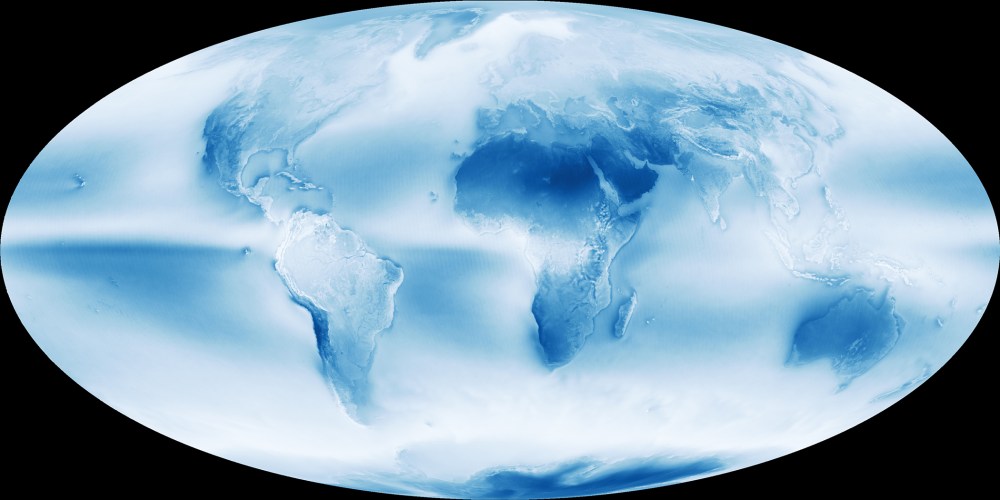
Next time you feel there are too many clouds hanging over you, you may be right. A new composite image of Earth taken by NASA’s Aqua Satellite indicates that, on average, 67 percent of our planet is covered with clouds.
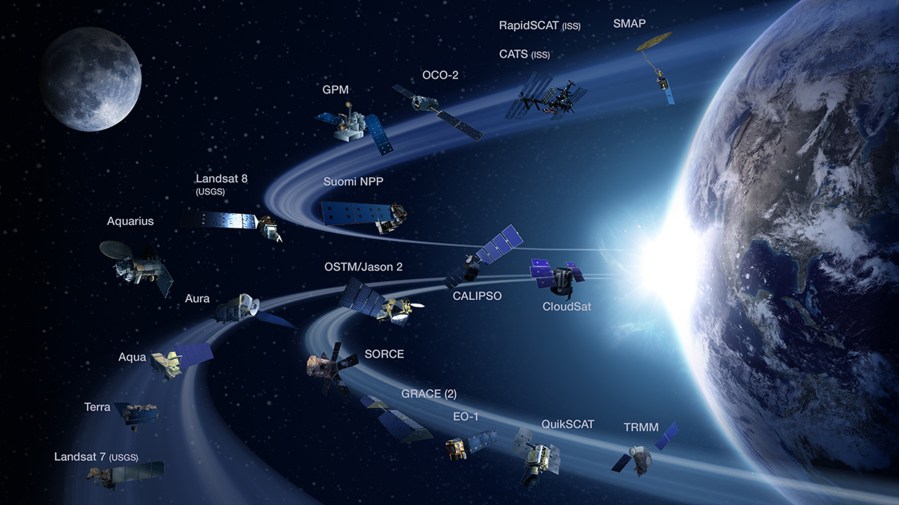
Aqua is part of NASA’s Earth Observing System (EOS), which consists of multiple satellites observing long-term global changes of land, atmosphere and oceans. Aqua’s mission focuses on our planet’s water cycle: evaporation, precipitation, ice and snow cover, etc. Aqua has a Moderate Resolution Imaging Spectroradiometer (MODIS) instrument aboard that collected the data the latest cloud map. That data was averaged over 10 years of cloud observations from July 2002 to April 2015.
It’s fascinating how easily you can see where clouds gather and where they don’t. Look at the striking lack of clouds in Australia, the Sahara, the Middle East and central Antarctica versus the cloud belts along the Equator and the mid-latitudes. This new data shows that on average, only 10 percent of the ocean and 30 percent of the land are cloudless at any given time. For more details on how the effects of circulation patterns in our oceans and atmospheres are illuminated by this beautiful image, check out Phil Plait’s take.
Here’s some geek from the week to brighten all those cloudy days:
- Some rivers in Italy contain both eels and cocaine, not a good mixture.
- As if velociraptors weren’t terrifying enough, they may have had an even scarier cousin.
- Developmental biologists are exploring the genes that may have given birds their beaks.
- New evidence suggests that DNA goes through seasonal changes. No word yet if it likes spring better than fall.
- The earthquake in Nepal lowered the height of the Himalayans by up to three feet in some places.
- How the invention of portable electric lights changed baseball history.
- Taking an astronaut’s temperature in space is not an easy task.
- MUST SEE: this artist recreates the Aurora Borealis in a studio with fabric and fans. [VIDEO]
- What does the stratosphere sound like? These recordings from a high-altitude balloon give some idea. [AUDIO]
- NASA’s Kepler spacecraft detects monster sunspots and superflares on other sun-like stars in our galaxy.
- These mathematical GIFS by Dave Whyte are beautiful and hypnotizing, and beautifully hypnotizing.
Keep on geeking!
@Summer_Ash, In-house Astrophysicist

Summer Ash