





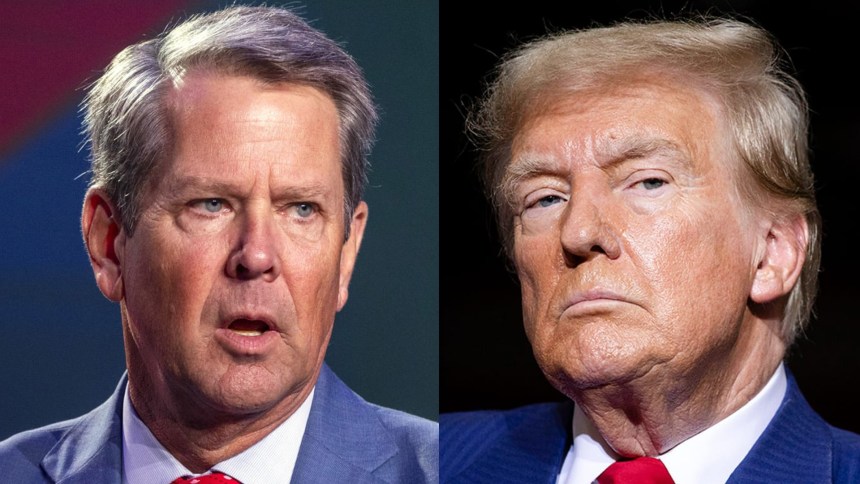

Sen. Jon Ossoff of Georgia is widely seen as one of the most vulnerable Democratic incumbents in the 2026 elections, but the latest Atlanta Journal-Constitution poll found him in a relatively strong position. In fact, in hypothetical matchups, only one Republican — two-term Gov. Brian Kemp — polled close to Ossoff among Georgia voters. (Click the link for more information on the poll’s methodology and margin of error.)
The survey was a timely reminder of why GOP officials have invested so much time and energy trying to convince the governor to run in next year’s midterm cycle, with Sen. Tim Scott of South Carolina, the current chair of the National Republican Senatorial Committee, describing Kemp as the party’s “No. 1 recruit.” As NBC News reported, however, the party’s lobbying efforts didn’t work.
Georgia Gov. Brian Kemp has decided not to run for the Senate next year, dealing a blow to Republicans who viewed him as a top recruit. The state is a major target for Republicans as they look to expand their three-seat Senate majority. Georgia is one of two states, along with Michigan, where Democrats are defending a seat in a state that President Donald Trump won in November. Democratic Sen. Jon Ossoff is running for re-election in Georgia, while Sen. Gary Peters is retiring in Michigan.
The governor’s announcement came roughly a month after former Gov. Chris Sununu announced that he, too, was rejecting pressure from GOP leaders and passing on New Hampshire’s open U.S. Senate race.
The Bulwark had a good report on this, noting, “In a not-so-distant past, governors would be much more inclined to launch bids for the United States Senate, seeing it as a logical next step in the accumulation of political power. But this year, the current is flowing in the opposite direction,” as governors pass on Senate campaigns, and senators prepare to leave the Senate to run gubernatorial campaigns.
If all of this sounds at all familiar, it’s not your imagination. Ahead of the 2022 election cycle, Republican leaders approached a variety of incumbent and former governors — Arizona’s Doug Ducey, Maryland’s Larry Hogan, New Hampshire’s Sununu and Vermont’s Phil Scott — to launch Senate campaigns, but to no avail: They all said no.
To be sure, there are competing explanations for this. It’s certainly possible, for example, that Republicans such as Kemp and Sununu expect 2026 to be a good year for Democrats, so they’ve bowed out after acknowledging the direction of the prevailing winds. Similarly, it’s easy to believe that governors are looking at what’s become of Congress, and they’re not finding a place they’re eager to spend the next several years.
Whatever the explanation, for GOP officials desperate to recruit top-tier talent in competitive races, it’s back to the drawing board.
This is not to say that the 2026 map is favorable for Democrats — it most certainly is not — but the party has reason to be a bit more optimistic than it was before Kemp’s announcement.
