





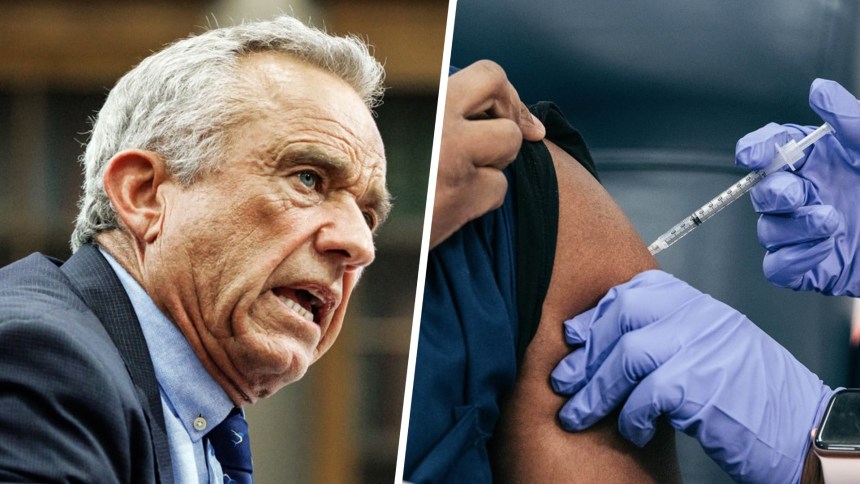

Vaccine advisers to the Centers for Disease Control and Prevention reportedly prepared a presentation this week that included a dubious claim: An animal study, the presentation said, found that a vaccine preservative can have “long-term consequences in the brain.”
As CNN reported, the study in question “doesn’t appear to exist.”
Lyn Redwood, a former leader of Children’s Health Defense, an anti-vaccine group that lists US Health and Human Services Secretary Robert F. Kennedy Jr. as a founder, is scheduled to give the presentation Thursday at a meeting of the CDC’s Advisory Committee on Immunization Practices. The slides, posted online Tuesday, cite a 2008 study in the journal Neurotoxicology by ‘Berman RF, et al,’ called ‘Low-level neonatal thimerosal exposure: Long-term consequences in the brain.’ The presentation claimed that results from a study in newborn rats suggest long-term ‘neuroimmune effects’ from the vaccine preservative.
CNN’s report, which has not been independently verified by MSNBC or NBC News, noted that the citation appeared to refer to Dr. Robert F. Berman, a professor emeritus at the University of California Davis, who told the network that the research included in the presentation, as far as he knows, “does not exist.”
If this problem sounds familiar, it’s not your imagination.
About a month ago, Donald Trump and Heath and Human Services Secretary Robert F. Kennedy Jr. unveiled “The MAHA Report: Making Our Children Healthy Again,” and almost immediately problems emerged. The Washington Post reported, for example, that some of the report’s suggestions “stretched the limits of science” and offered “misleading representations” of scientific research.
A week later, a devastating report published by NOTUS advanced the underlying story considerably, highlighting the unambiguous fact that the MAHA document “misinterprets some studies and cites others that don’t exist, according to the listed authors.” Soon after, The New York Times identified “additional faulty references” in the report, including instances in which the document’s authors pointed to “fictitious studies.”
Two weeks later, officials at the Department of Heath and Human Services removed the identified false information — while adding new false information.
A week later, NPR reported that an HHS document sent to Congress cited “scientific studies that are unpublished or under dispute and mischaracterizes others.” The report quoted one health expert on the record who called the document “willful medical disinformation” about the safety of vaccines.
A great many people here and around the world — physicians, researchers, international public health agencies, the public at large, et al. — need to be able to rely on federal health officials from the United States. That’s becoming increasingly difficult.
