





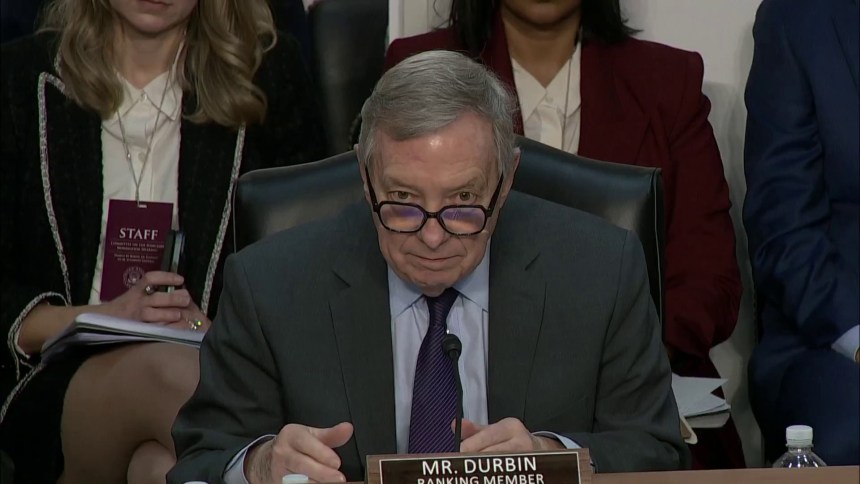

Day 1 of the confirmation hearings for Pam Bondi, President-elect Donald Trump’s pick for attorney general, was marked by relative civility compared with the one Trump defense secretary pick Pete Hegseth sat for on Tuesday.
Senate Judiciary Committee Democrats appeared to accept that Bondi will be confirmed despite their objections, with Dick Durbin of Illinois, the top Democrat on the panel, telling the nominee that it’s neither her “competence” nor her “experience” that’s at issue but her “ability to say no.”
Though Bondi’s confirmation may be as good as sealed, it doesn’t mean committee members’ questions were unimportant. On the contrary, this was Democrats’ opportunity to showcase Bondi’s history of election denialism and willingness to excuse Jan. 6 offenders, as well as the limits, if any, to her fidelity to her former client, Trump, whom she defended in his first impeachment trial. Many of those Democratic senators, including Richard Blumenthal of Connecticut, Sheldon Whitehouse of Rhode Island and Amy Klobuchar of Minnesota, are themselves experienced former federal and/or state prosecutors. And all but one of the committee Democrats met privately with Bondi in advance of Wednesday’s hearing, giving them a preview of where she might be purposefully evasive.
Yet sadly, through questions that would make courtroom veterans and young prosecutors alike cringe, some committee members allowed a prepared Bondi to elude clear statements about many of those concerns.
One of the most glaring examples came when Durbin, the committee’s former chair, engaged Bondi about whether Trump lost the 2020 election. A smooth Bondi offered many of the right bromides, saying that she “accept[s] the results” of that election and that Joe Biden is our president. But she stumbled in acknowledging her own post-election “advocacy” in Philadelphia, where she accompanied then-Trump lawyer Rudy Giuliani and where, she said, she “saw so much,” appearing to suggest she witnessed questionable activity that threatened the election’s integrity. That was a moment disserved by Durbin’s insistence on yes-or-no answers (and that of Sen. Alex Padilla of California, who grew so combative in demanding a yes-or-no in a similar series of questions that Bondi, unable to get out more than a handful of words, fired back, “I’m not here to be bullied.”)
Why not ask Bondi to share, in her words, what she saw and whether her observations caused her to believe then — and now — that Biden’s victory was illegitimate? I suspect Bondi didn’t observe any irregularities in Philadelphia that she could detail with any precision, much less substantiate — or justify as the basis for her efforts to help Trump overturn the 2020 election.
Whitehouse, the committee’s sharpest observer of legal ethics (or lack thereof), similarly stumbled in asking Bondi to pledge the Justice Department would never have, much less enforce, the sort of enemies list FBI nominee Kash Patel has boasted of on TV. Sure, Whitehouse got Bondi’s assurance that, if she is confirmed, she would never have a so-called enemies list. But his insistence on form obscures a larger problem: Neither Trump nor anyone else in his administration needs an actual list to exact retribution by prosecution.
His question about the Justice Department‘s “contacts policy,“ which limits who within the department can speak to White House personnel, up to and including the president and the vice president, and in what circumstances, was just as sloppy. In the abstract, it’s likely that any nominee of either party, even in the Trump 2.0 era, would agree to comply with that policy. The devil, of course, is in the details.
For example, the most recent iteration of the policy, a 2021 memo from Attorney General Merrick Garland, states (and I’m adding italics here for emphasis), “The Justice Department will not advise the White House concerning pending or contemplated criminal or civil law enforcement investigations or cases unless doing so is important for the performance of the President’s duties and appropriate from a law enforcement perspective.”
The policy also expressly aims to protect Justice Department personnel, even political appointees, from “inappropriate influences” by mandating that “initial communications between the Department and the White House concerning pending or contemplated law enforcement investigations or cases will involve only the Attorney General or Deputy Attorney General, and the Counsel or Deputy Counsel to the President (or the President or Vice President).”
In other words, the head of the civil rights unit, for instance, is supposed to be insulated from calls from, say, a White House deputy chief of staff about an existing case — but the policy doesn’t forbid the president from reaching out to the attorney general directly, or vice versa.
Asking Bondi how she interprets these mandates, and/or for examples of situations in which she believes communicating with the White House about pending or contemplated cases or investigations would and wouldn’t be justified, would have been far more elucidating than extracting her simple promise to abide by the policy.
On the whole, forcing Bondi, a former Florida attorney general, to explain herself would have been a better strategy. Because for all of her polish, she has revealed flickers of her worldview, one that doesn’t just have a foothold in MAGA think but lives there permanently.
When Sen. Ted Cruz, R-Texas., in a diatribe against the so-called “weaponization” of the Justice Department, noted that Trump has been “indicted and prosecuted, not once, not twice, not three times, but four separate times,” Bondi jumped in to add, “And two assassination attempts!” as if there is a through line from the legitimate, thoroughly investigated and well-founded criminal charges against Trump and the deranged attempts to kill him.
What makes Bondi think those horrific incidents bear any semblance to the cases brought by former special counsel Jack Smith and two local prosecutors? That’s a question I wish someone had asked before the hearing gaveled out.
