





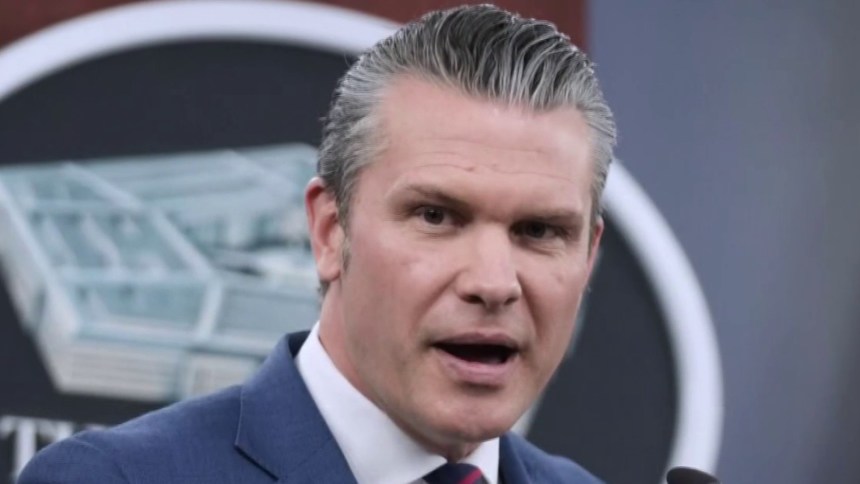

When Defense Secretary Pete Hegseth spoke in the Pentagon briefing room on the third day of the war in Iran, he was an unfamiliar sight: It was the first time the former Fox News host had appeared in the room since June. Not surprisingly, media photographers took a barrage of pictures of the secretary at the briefing.
That ordinarily wouldn’t be especially notable, except in this instance, the developments led the Defense Department to make some unexpected changes. The Washington Post reported that the Pentagon has barred press photographers from war briefings after Hegseth’s staff deemed published images of the secretary “unflattering.” From the article:
Several outlets including the Associated Press, Reuters and Getty Images sent photographers to the briefing from Hegseth and Gen. Dan Caine, chairman of the Joint Chiefs of Staff.
But after they published photos — which have broad reach because they are licensed by publications globally — members of Hegseth’s staff told colleagues that they did not like the way that the secretary looked. Hegseth’s aides decided to shut out photographers from the two subsequent briefings at the Pentagon, on March 4 and March 10, according to the two people familiar with the decision.
While the Post’s report hasn’t been independently verified by MS NOW, the Pentagon’s spokesperson confirmed the new restrictions on the record. National Press Club President Mark Schoeff Jr. formally denounced the developments in a written statement on Wednesday afternoon.
If the developments sound familiar, there’s a good reason: Hegseth has taken a series of steps over the course of the past year to undermine journalists who cover the Pentagon. In September, he told news organizations that reporters won’t be allowed to cover the department unless they agree only to report information, including unclassified information, authorized for release by the administration.
Outlets that refused to agree to his absurd terms, Hegseth added, would lose access and have their press badges confiscated.
Practically every major news organization refused, including MS NOW (my employer) and Fox News (Hegseth’s former employer). The result was an exodus of Pentagon correspondents, each of whom refused to accept the administrative restrictions, exiting the Pentagon en masse in a display of unity. (Hegseth’s team eventually announced the “next generation” of “correspondents,” featuring assorted far-right activists, influencers and media personalities who did accept the administration’s journalistic limits.)
But the shift on photographers pushes the broader effort to a new and more embarrassing level: The Defense Department isn’t just concerned about substance, it now seems to be focused on appearances.
For all of Hegseth’s rhetoric about the importance of “lethality,” the secretary and his team continue to indulge in an endless parade of distractions. In the days leading up to the U.S. military offensive in Iran, Hegseth spent his time distancing the Defense Department from some of the nation’s leading universities while whining about “wokeness,” feuding with Anthropic over artificial intelligence safeguards, and forcing Scouting America to abandon programs and policies aimed at promoting diversity.
Now, while the Pentagon is ostensibly focused on ongoing operations in the Middle East, he and his team are taking time for reprisals against photographers over “unflattering” images of the secretary.
The gap between Hegseth’s tough-guy posturing and his real-world efforts is large and growing. Whether Hegseth realizes this or not, it’s not photographers who are making him look bad. He’s managing to do that all on his own.
This post updates our related earlier coverage.
