





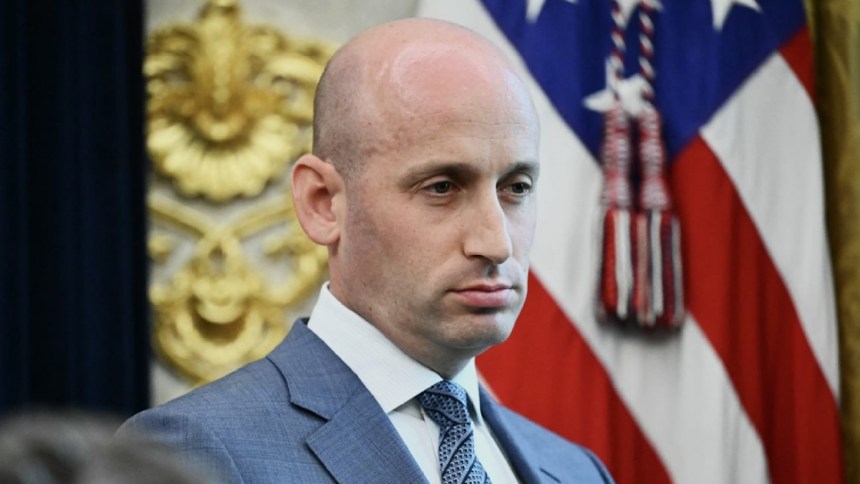

A couple of months ago, Stephen Miller, Donald Trump’s notorious deputy chief of staff, offered an unsubtle assessment of the political opposition. “The Democrat [sic] Party is not a political party,” he said in August. “It is a domestic extremist organization.”
The comments were unsettling for a variety of reasons, not the least of which was the unstated implications: If one of the president’s right-hand men sees his political opposition not as legitimate but as a public threat, that would necessarily justify a radical response. After all, domestic extremist organizations are, as a matter of course, subjected to all kinds of special scrutiny, including surveillance and criminal investigation.
On Saturday afternoon, Miller took additional steps down the same right-wing path. “The Democrat [sic] Party has filled our legal and judicial system with radicals who protect leftwing terrorists,” the White House official wrote online. “This is a very real and dire crisis for our Republican form of government.”
Less than an hour later, he kept going, publishing this related missive:
The issue before is [sic] now is very simple and clear. There is a large and growing movement of leftwing terrorism in this country. It is well organized and funded. And it is shielded by far-left Democrat [sic] judges, prosecutors and attorneys general. The only remedy is to use legitimate state power to dismantle terrorism and terror networks.
To the extent that reality still has any meaning, none of this was true. There is no “large and growing movement of leftwing terrorism in this country,” and in recent decades, most acts of political violence in the U.S. came from the right. The nonexistent problem is also neither well “organized” nor well “funded.”
Similarly, there is no secret cabal of judges, prosecutors and state attorneys general conspiring in the shadows. Indeed, though the White House likes to pretend otherwise, several of the judges who’ve ruled against Trump in recent months have been Republican-appointed jurists — including some chosen by Trump himself.
But don’t overlook that last sentence in his missive: The “only” remedy, Miller claimed, is to use the power of the federal government to “dismantle” the cabal that he believes exists, reality notwithstanding.
Hours later, after another Trump-appointed judge blocked the president from deploying Guard troops to Oregon to deal with an imaginary crisis, Miller’s stance took a hysterical turn. “Legal insurrection,” he wrote, condemning the ruling. He proceeded to reference “an organized terrorist attack on the federal government” that warrants a robust administration response, despite the fact that it’s only underway in the overactive imaginations of Miller and his allies.
A day later, according to an NBC News tally, Miller used the word “insurrection” at least 12 times over the course of Monday.
“The essence of post-liberalism is the rejection of the notion that some neutral standards of conduct apply to all parties,” The Atlantic’s Jon Chait explained in his latest column. “Miller, like Trump, appears to believe his side stands for what is right and good, and his opponents stand for what is evil. Any methods used by Trump are ipso facto justified, and any methods used against him illegitimate.”
There might be a temptation to shrug this off, but that would be a mistake. There’s a growing body of evidence that suggests Miller isn’t just a hyper-partisan anti-immigration zealot, he also appears to be a leading White House official with a decision-making role related to military resources.
The deputy chief of staff’s vision of a vast left-wing conspiracy is obviously weird and fantastical, but that doesn’t mean it’s irrelevant.
