





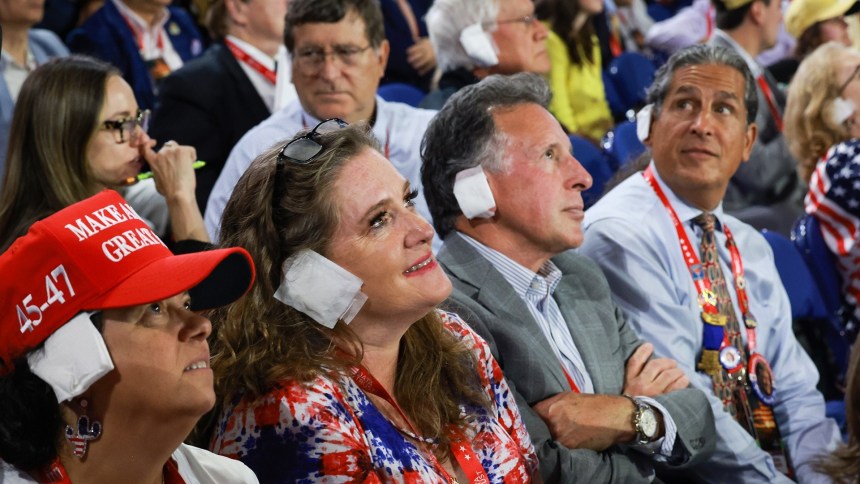

For the first several days after a gunman attempted to assassinate Donald Trump, the former president and his political operation had surprisingly little to say about the medical care he’d received. What’s more, it wasn’t at all clear why they’d be tight-lipped about this.
An Associated Press report noted last week that the public was “still in the dark over the extent of his injuries, what treatment the Republican presidential nominee received in the hospital, and whether there may be any long-term effects on his health. Trump’s campaign has refused to discuss his condition, release a medical report or records, or make the doctors who treated him available, leaving information to dribble out from Trump, his friends and family.”
CNN’s Dr. Sanjay Gupta also had a good piece along these lines last week, noting that a full public assessment of Trump’s injuries “is necessary,” adding: “The concern is that gunshot blasts near the head can cause injuries that aren’t immediately noticeable, such as bleeding in or on the brain, damage to the inner ear or even psychological trauma. As a trauma neurosurgeon, I have seen how a thorough evaluation after any kind of gunshot wound can provide a complete picture and lead to a speedier recovery.”
Since I wrote about this a few days ago, it seemed only fair to note that Team Trump did, in fact, eventually provide some additional information — at least, sort of. The Washington Post reported:
Republican presidential nominee Donald Trump shared a letter signed by Rep. Ronny Jackson (R-Tex.) on Saturday detailing the care he has received since last weekend’s assassination attempt at a campaign rally in Pennsylvania. … Jackson stated that Trump sustained a 2 cm wide wound from the track of a bullet “that extended down the cartilaginous surface of the ear.” No sutures were required for Trump’s wound, Jackson said, but “there is still intermittent bleeding requiring a dressing to be in place.”
To be sure, some transparency is better than no transparency, and it’s good to know that the former president is recovering well in the wake of the shooting nine days ago.
But this doesn’t put the matter entirely to rest.
Under normal circumstances, we’d expect to receive information from the physicians who actually treated Trump after the incident. There might even be a news conference or two.
Instead, Team Trump waited a week before issuing a letter from a member of Congress — issued on Jackson’s congressional letterhead — who acknowledged two years ago that he had allowed his medical license in Florida to expire. (Jackson’s medical license remains in “military active” status until early next year.)
This is the same Jackson who was slammed by the Pentagon’s inspector general’s office, which concluded in 2021 that Jackson engaged in “inappropriate conduct” while serving as Trump’s White House doctor, adding that the congressman “drank alcohol, made sexual comments to subordinates, and took the sedative Ambien while working as White House physician.” The watchdog also found that Jackson mistreated subordinates and “disparaged, belittled, bullied and humiliated them.”
In 2022, the Navy demoted Jackson from admiral to captain as a consequence of his misconduct. The Washington Post’s report added: “Jackson worked in the White House medical unit under three presidents but drew scrutiny in a Pentagon inspector general’s report, which states that he provided prescription drugs without proper paperwork — a habit that allegedly earned him the nickname ‘Candyman.‘ Jackson has denied the report’s claims, describing them as politically motivated.”
He was nevertheless elected to Congress, where Jackson ran into ethics troubles.
Between Jackson’s record and Trump’s long-standing record of problematic medical disclosures, Saturday’s statement didn’t exactly resolve the larger concern.
This post updates our related earlier coverage.
