





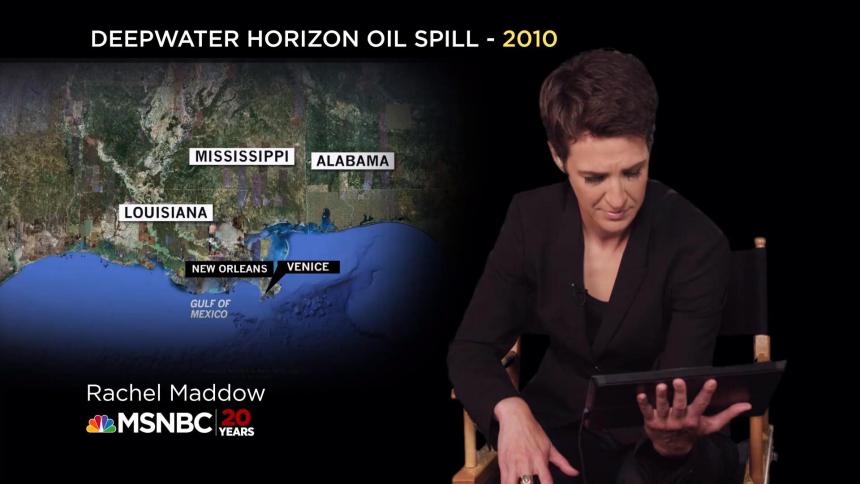

This is an adapted excerpt from the March 16 episode of “The Rachel Maddow Show.”
Remember that gigantic oil spill in 2010? It was in the Gulf of Mexico, off the Louisiana coast, and it was just apocalyptic.
The explosion, the plumes of smoke, the massive fire on board the rig just 40 miles off the coast. Eleven men lost their lives in the blast before the massive rig sank to the bottom of the sea.
But that was only the start of the disaster because, as you may remember, they couldn’t stop the oil spewing out of the well. There was even a live feed from the broken wellhead where you could watch the oil spewing out from a hole in the seafloor.
For three months, millions of barrels of oil spewed into the sea, and they just had no plan for how to stop it. They tried something called junk shots, where they literally shot junk into the top of the well to try to clog it up — anything they could find: golf balls, pieces of plastic, pieces of old tires, knotted up hunks of rope.
For three months, millions of barrels of oil spewed into the sea, and they just had no plan for how to stop it.
That was the level of technological prowess that one of the most profitable industries on earth was bringing to bear on the ongoing disaster that they had caused and couldn’t stop.
So the company changed the language it was using to talk about it. It stopped talking about the junk shots and instead used something it called the “top kill” method, which sounds way cooler and way less desperate and random, but it was still the same result.
Then it decided it would just dump tons of chemicals in the water. At the time, the company wouldn’t say what the chemicals were; it called them “dispersants.” The idea was to dump these mystery chemicals into the ocean to try to make the oil disperse.
But that didn’t work, either. It was disgusting and toxic. It wreaked havoc on not just everything in the ocean, but the whole fishery of those coastal Louisiana towns.
I remember reporting down there in 2010 and being nauseous from breathing the sea breeze, which is a thing that will mess up your head both in the moment and for a long time after.
Now, there was supposed to be a blowout preventer to prevent this underwater blowout, but the blowout preventer didn’t work.
There was supposed to be a bulletproof, foolproof, multiple-redundancy emergency response plan in case of any type of accident, but it was ridiculous. This was in the Gulf of Mexico, and the emergency response plan for a spill at that site called for things like rescuing the walruses — but there are no walruses in Louisiana. The emergency response call list also included people who had died years prior.
It was just an utter failure.
The Deepwater Horizon disaster happened in 5,000 feet of water, where the pressure and the temperatures are incredible. We as humans have basically as little experience operating in that kind of an extreme environment as we do operating in space.
Deepwater Horizon was sort of living proof — living, terrifying, toxic proof — that even though the oil companies say they’re great at doing stuff like that, they’re actually not.
You may remember that the company that botched that 5,000-foot drilling project — which killed 11 people, ravaged the coast of Louisiana for three months and made us very thankful that then-President Barack Obama had Nobel Prize-winning physicist Steven Chu as his energy secretary — was BP.
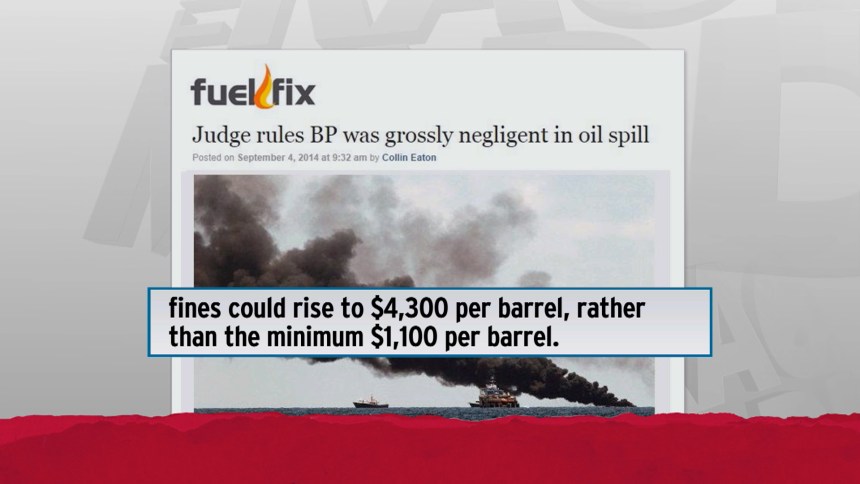
In the end, the overall cleanup and compensation costs for Deepwater Horizon topped out at around $65 billion. BP was held responsible for the disaster not only in court but also in Congress, where it basically had to prostrate itself and apologize for all it had done.
Now fast-forward to Friday, when late in the day, very quietly, the Trump administration announced that it had approved a new, ultra-deep-water drilling project in the Gulf of Mexico. Unlike the rig at the center of Deepwater Horizon, which was at 5,000 feet, this project will be nearly 6,000 feet.
But don’t worry, the company behind this project, which has now been permitted to do its ultra-deep-water drilling in the same place as the worst oil spill in U.S. history, is none other than the company responsible for that 2010 disaster: BP.
As The New York Times notes, the emergency plan this time from BP is still basically the same as it was more than 15 years ago; it proposes “using chemical dispersants to break oil into tiny droplets and push it underwater.”
No word yet on whether they’re still going to focus on finding tropical walruses or trying to call dead guys as their emergency contacts.
The other reason not to worry, of course, is that this time, instead of Obama and his administration running point for the response, this time, it’s Donald Trump and his administration. Needless to say, the energy secretary is not a Nobel Prize-winning physicist.
In the end, the overall cleanup and compensation costs for Deepwater Horizon topped out at around $65 billion.
This time, it’s Chris Wright, who last week announced on social media that the Navy had started escorting oil tankers through the Strait of Hormuz amid Trump’s war in Iran. The markets rallied in response to Wright’s post until it was revealed that the Navy was absolutely not doing that, and the markets went down and the oil price went up.
Also on Friday, Wright announced that, thanks to the emergency powers invoked by Trump to deal with the oil crisis resulting from his war, the administration has ordered the restarting of a particular pipeline in Southern California, which has not been operational for more than a decade.
Why has it not been operational for more than a decade? Because the last time it was operational, it broke open and spewed oil uncontrollably in one of the worst California oil spills of all time, affecting roughly 100 miles of the state’s coastline.
So, they’re trying to force the reopening of the pipeline that, the last time it was in operation, barfed oil all over Southern California — they say it’s fully repaired now; we’ll see — and they have just told BP, of all the companies, to go ahead with a new, ultra-deep-water drilling project, because apparently no one remembers what happened last time, right?
That is the level of genius and competence we’re dealing with at the helm as an arsonist, mad king president sets the world on fire.
Allison Detzel contributed.
