






For those hoping to see improvements in the U.S. economy, the latest jobs report offered a new round of discouraging news: The unemployment rate reached a four-year high, and job growth has slowed to levels unseen since the Great Recession. Given recent political history, it stood to reason that Donald Trump would blame everyone but himself for his failures.
But in an unexpected turn, the president actually did take responsibility for rising unemployment — though he did so in the clumsiest way possible.
On Friday morning, Trump published an item to his social media platform that read, “The only reason our Unemployment ticked up to 4.5% is because we are reducing the Government Workforce by numbers that have never been seen before. … I wish the Fake News would report the 4.5% correctly.”
And I wish the president could describe reality correctly. In this case, he misstated the unemployment rate (it’s 4.6%, not 4.5%), and the rate increase is not solely the result of losses in public-sector employment.
Nevertheless, the Republican apparently liked the talking point, because he repeated it later at a White House event on Friday afternoon.
On Friday evening, he kept going, again misstating the jobless rate at an event in North Carolina, before again saying that he played a direct role in making unemployment worse.
“I’m letting go of tremendous numbers of government workers,” Trump said. “In fact, we reduced the federal workforce by 270,000 jobs. That is not to be mean, that is to get them off — and they are getting jobs in the private sector.”
At this point, one could note how odd it is to see a sitting president brag about firing hundreds of thousands of Americans a few days before Christmas. One could also highlight the fact that these job losses will likely have real-world consequences for the Americans whom these employees served.
But I was especially interested in that last part: “[T]hey are getting jobs in the private sector.”
No, they’re not.
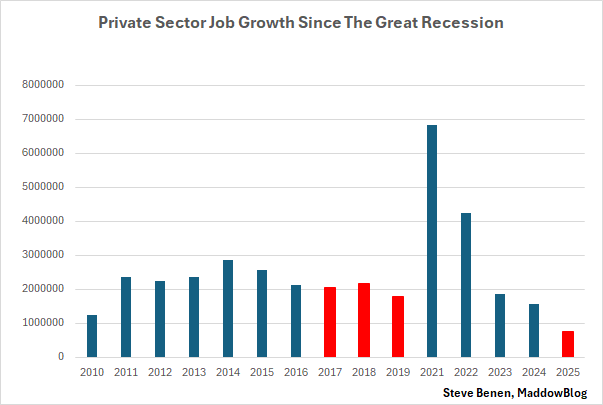
To help contextualize matters, I put together a new chart showing private-sector job growth by year since the Great Recession — excluding 2020, when the Covid-19 pandemic wreaked havoc on the job market — with data by way of the Labor Department’s Bureau of Labor Statistics. The red columns show the years in which Trump was in the White House, while the blue columns reflect Barack Obama’s and Joe Biden’s terms.
If private-sector job growth were soaring, the White House might be able to argue that the administration’s calculus was part of a coherent economic strategy, in which workers shifted from one sector to another. To be sure, this wouldn’t be a great argument — government employees are doing work that needs to be done that isn’t done by private businesses — but it would at least be worth some discussion.
But job growth in the private sector can charitably be described as anemic in 2025, and it’s been especially awful since April, after the president announced his “Liberation Day” trade tariffs.
In fact, despite Trump’s boasts about the many workers getting hired by American businesses, private-sector job growth has slowed to levels unseen since the Great Recession (excluding 2020, when the pandemic wreaked havoc on the economy).
These are details worth keeping in mind as the president inadvertently takes responsibility for the rising unemployment rate.
