






Donald Trump and his team have spent an unsettling amount of time and energy over the last year focused on, of all things, rebranding campaigns. Unsatisfied with the name of the Defense Department, for example, the White House decided to brand it. Eager to boost the president’s ego, his allies decided to rebrand the John F. Kennedy Memorial Center for the Performing Arts, too.
More recently, Trump, as part of an apparent extortion gambit, tried to force Democrats into agreeing to rebrand Penn Station and Dulles Airport, too. (This did not go well.)
But the broader campaign isn’t limited to institutions: As more of the president’s unpopular agenda faces public revulsion, more of it becomes subjected to rebranding efforts. The inaptly named “One Big Beautiful Bill Act” proved a political dud for the Republican Party, prompting the president who came up with the juvenile name to pitch an alternative.
And then there’s Trump’s mass deportation agenda, which has apparently joined the list. Axios reported this week:
White House Deputy Chief of Staff James Blair privately urged House Republicans on Tuesday to stop emphasizing ‘mass deportations’ and instead focus their messaging on removing violent criminals, according to sources in the closed-door briefing. … Blair delivered the message during a policy listening session with House Republicans at their annual retreat in Doral, Florida.
While the Axios report hasn’t been independently verified by MS NOW, The New York Times published a related report, noting that top Republican officials advised lawmakers in a private meeting this week “to stay away from discussing ‘mass deportations’ of undocumented immigrants as they campaigned for re-election.” The Washington Post also reported, “White House and top House Republican officials have told GOP members to avoid discussing ‘mass deportations’ ahead of the midterm elections, backing away from public discussion of a central campaign pledge of President Donald Trump.”
It was nearly two years ago when the party gathered for the Republican National Convention in Milwaukee, Wisconsin, where attendees waved professionally made “Mass Deportations Now” signs with great enthusiasm.
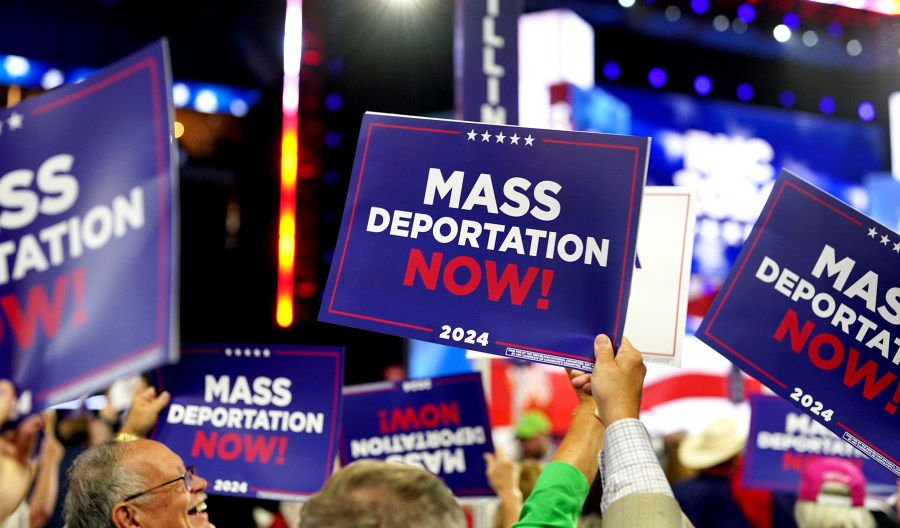
A lot can change in 20 months.
Indeed, there’s no great mystery as to why party officials want to rebrand one of the signature goals of Trump’s domestic agenda. As my MS NOW colleague Zeeshan Aleem explained, “There is plenty of data showing Trump’s immigration agenda is not popular. According to an Associated Press-NORC Center for Public Affairs Research poll conducted in January, about 6 in 10 Americans said Trump has ‘gone too far’ in sending federal immigration agents into U.S. cities, and about the same share disapproved of Trump’s overall handling of immigration. Approval of Trump’s overall handling of immigration has plunged about 10 percentage points from his first month in office, according to AP-NORC data. This pattern of decline in support for Trump’s immigration program has surfaced across many other surveys, and probably explains a good chunk of the decline in Trump’s overall approval ratings.”
There’s also the recent shifts with Latino voters, whom Republican officials thought would be part of the GOP coalition going forward, as if there had been some kind of permanent electoral realignment in 2024.
The party is quickly learning otherwise.
“We got a little hiccup with some of the Hispanic and Latino voters, for certain, because some of the immigration enforcement was viewed to be overzealous,” House Speaker Mike Johnson told NBC News this week during a House Republican conference in Miami.
The Louisiana Republican added, “You know, everybody can describe it differently. But here’s the good news: We’re in a course-correction mode right now.”
So, after Republicans ran on a platform of mass deportations, and the Trump administration pursued an agenda of mass deportations, and much of the country was left with the impression that everyone whose skin was darker than a manilla envelope was facing harassment, violence and possible arrest from federal immigration agents — now everything is fine because GOP politicians have been told not talk about “mass deportations.”
Whether the party wants to acknowledge this or not, the underlying problem is substantive, not rhetorical. Slapping new talking points on anti-immigrant extremism is unlikely to make anything better.
To make a real difference, Republicans have to change their policies, not just their phrasing. And that is a step the GOP appears unwilling to take.
