




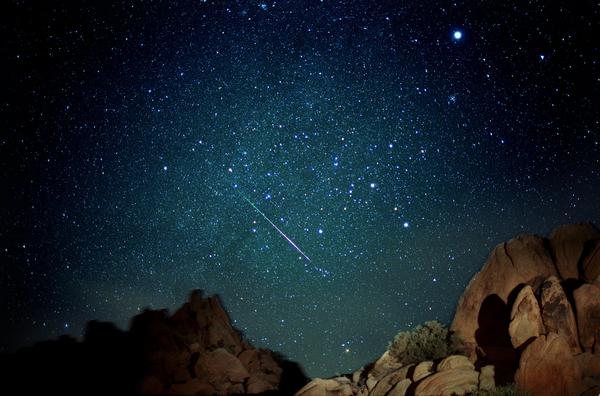
Just in case you haven’t gotten your fill of comets yet, I’ve got another one for you: Comet 55P Tempel-Tuttle, the source of the Leonids meteor shower which peaks in this Monday, November 17 (but with the best viewing in the wee hours of Tuesday morning).
Meteor showers are often associated with a comet or asteroid that has a left a trail of dust and ice particle strewn out along its orbit. When Earth passes through this trail, the particles enter our atmosphere, heat up and vaporize in a brilliant light show. The denser the trail of particles — and the faster they’re moving — the more meteors you’re likely to see. Comets shed more particles when passing through the inner solar system, where they heat up more, so the more recently the parent comet of a given meteor shower has passed by, the better the show.
Comet 55P Tempel-Tuttle completes its orbit of the Sun once every 33 years. Consequently, the
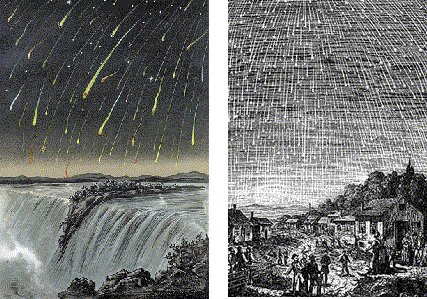
Leonids peak on the same interval. The next peak of the Leonids is not expected until 2030, but that doesn’t mean you shouldn’t still get out there this week to catch a glimpse. The predicted peak rate for the Leonids this year is roughly 15 meteors per hour, still well above the average number of meteors you could expect to see on any random night. On a historical note, the Leonids are known to produce meteor storms (over 1000 meteors per hour) from time to time with hourly rates upward of 100,000 in 1883 and 1966. NASA has a great collection of some eyewitness accounts from the latter.
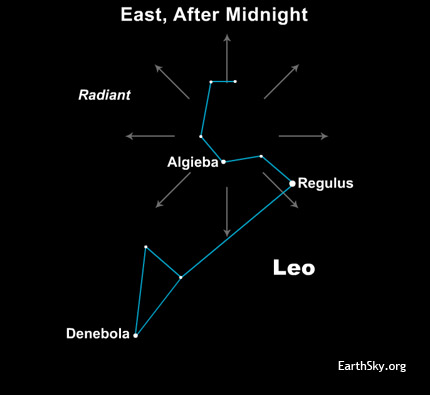
The Leonids name actually refers to the “radiant point” of the meteor shower — where they appear to be coming from in the sky. In this case, it’s the constellation Leo. You don’t need to have a clear view of Leo to see the shower. It’s almost better to look in the opposite direction since you’ll be more likely to see the full trails of the meteors as they streak across the sky. Looking directly at Leo means you’ll see the start of a lot of meteors, but not get the full effect. (At over 150,000 miles per hour, the Leonids are some of the fastest meteors ever recorded.)
So come Monday night, bundle up, make some hot chocolate, and get yourself to a dark spot!
Here’s some geek you don’t have to stay up all night to enjoy:
- Male elephants are not the loners we once thought they were.
- To protect their future young, female keel back snakes binge on poisonous toads.
- Fascinating article on how most animals that appear blue in part are not actually blue at all, but just tricking your eyes.
- Hiker in New Mexico finds 90 million year old fossilized turtle.
- What do math and Vincent Van Gogh have in common? Fluid dynamics.
- Speaking of Van Gogh, this bike lane in Netherlands is a glowing tribute to Starry Night. [WITH VIDEO]
- Russian scientists ventured down into one of those Siberian sink holes. This is what they saw.
- How accidental discoveries in chemistry led to Teflon, Gor-tex, and Prince’s wardrobe of choice. [VIDEO]
- Here’s some insight into what happened to the Philae lander as it attempted to land on Comet 67P/C-G.
- Regardless of how long Philae lasts on the surface, the images from this mission are STUNNING.
- And after Philae’s mission ends, Rosetta scientists can go back to trying to solve the mystery of this “singing” comet. [AUDIO]
Keep on geeking! @Summer_Ash

Summer Ash