




A triple whammy of national crises is shaping up to affect millions of people this week.
First is the looming government shutdown.
Congress has until Saturday to fund the government, but some House Republicans seem to be more determined than ever to jeopardize the paychecks of millions of federal workers and usher in billions of dollars in economic losses just to enlist more people in their culture wars.
A triple whammy of national crises is shaping up to impact millions of Americans this week.
House Speaker Kevin McCarthy, R-Calif., told NBC News on Sunday that members are “working through it” and that he’s in contact with Senate Minority Leader Mitch McConnell, R-Ky., and House Minority Leader Hakeem Jeffries, D-N.Y. But this gridlock is all thanks to a small but powerful minority of House Republicans whom McCarthy cannot persuade to do their constitutionally mandated job to fund the government.
Even members of McCarthy’s own party are growing frustrated.
“The arsonists have lit their house on fire, they’re whining about their house burning, they’re going to want credit for putting the fire out, and then they’re going to set up a GoFundMe to get paid for what happened,” Garrett Graves of Louisiana said after a conference call with fellow House Republicans. “This is really disingenuous. What we need to be doing now, and what we should have been doing months ago, is not blocking the appropriations bills as we saw them.”
Make no mistake: This is a Republican-driven crisis. A slim number of Republicans have expressed a willingness to work with Democrats to fund the government in the short term by passing a continuing resolution, but with each passing day a shutdown becomes more likely.
The second crisis is the fast-approaching resumption of federal student loan payments.
On the same day that government funding could run out, nearly 44 million people with federal student loans will be expected to resume payments after a three-year pause. To put that in perspective, a recent survey by Credit Karma found that more than half of federal borrowers say they will have to choose between making their loan payments or paying for necessities like rent and groceries.

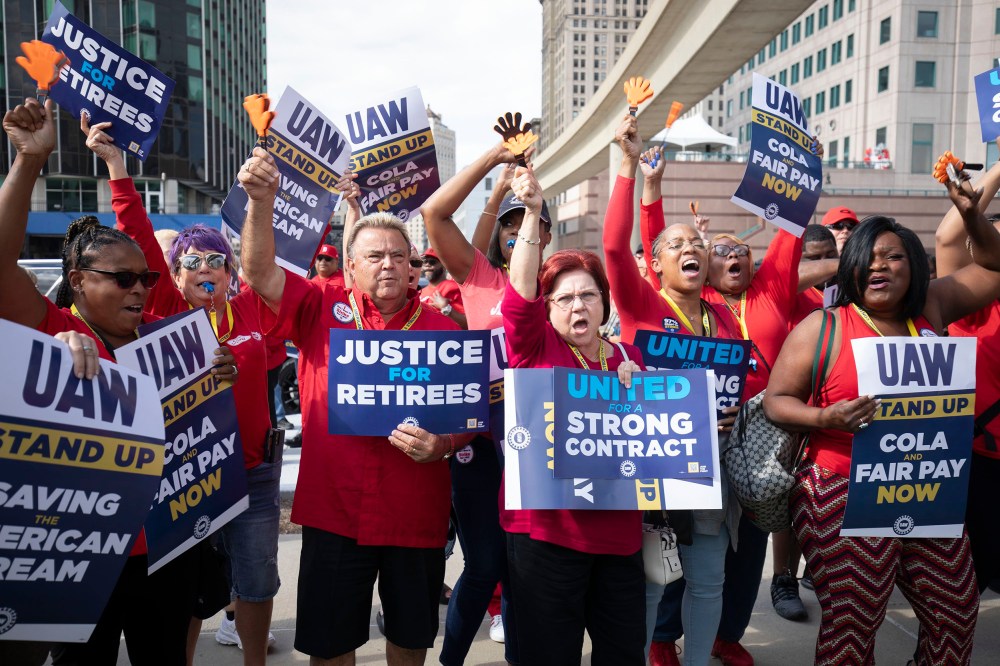
The third of the crises is the United Auto Workers strike.
The massive strike recently expanded to 38 General Motors and Stellantis facilities across 20 states. The 18,000 striking workers demand better wages and benefits and health care for retirees, and they’re sacrificing their own income to walk the picket line. That’s millions of dollars removed from the economy from striking workers alone. Right now, the strike is targeted at specific factories, but it could still expand. The Anderson Economic Group recently estimated that a full-fledged strike against the Big Three automakers would result in more than $5 billion of economic losses in just 10 days.
It’s easy to see these as three separate issues. But from the halls of Congress to college campuses to factory assembly lines, they are all connected. And if you don’t feel it now, you could soon.
This is an adapted excerpt from the Sept. 24 episode of “Symone.” Evan Brechtel contributed.

Symone D. Sanders Townsend is an author and a co-host of "The Weeknight."