




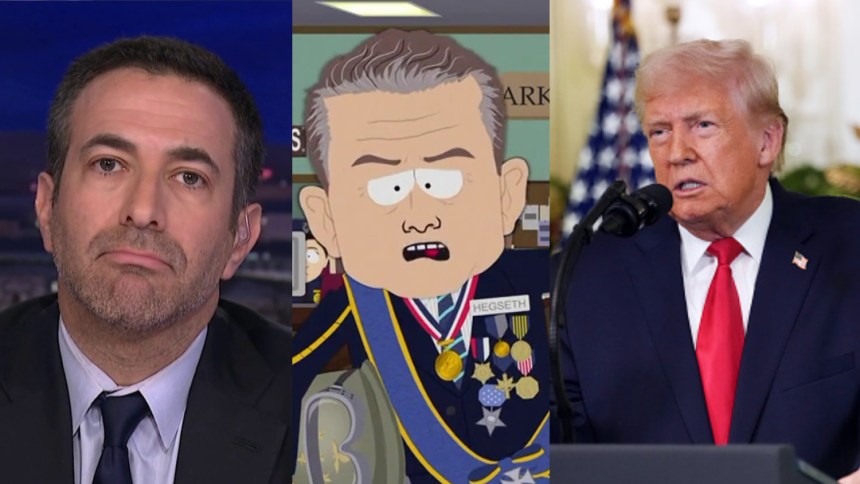
This is an adapted excerpt from the Jan. 8 episode of “The Beat with Ari Melber.”
There are many issues with Donald Trump’s Venezuela policy — from the risk of invading a country and extracting a foreign leader to claiming war powers for oil to the apparent total failure to plan for the long term.
But one of the most troubling aspects of the president’s recent actions is how he and his team seem more focused on PR and internet hype than on the actual policies they are enacting.
After the U.S. military’s operation in Venezuela, the White House wasted no time in flooding social media with photos, including one posted by Trump himself on Truth Social, showing President Nicolás Maduro bound and blindfolded aboard a ship. MS NOW has not independently verified the photo.
The photos quickly drew plenty of mockery, with some suggesting the administration’s glee reflects an interest in the spectacle over the substance and stakes.
The president also posted photos of a makeshift Situation Room. The U.S. oversees 17 different intelligence agencies, but it appears Trump’s team chose to take space away from those sources.
During the operation, which killed dozens on the ground and put American soldiers at risk, a feed of the social media app X — formerly known as Twitter and run by former White House temporary employee Elon Musk — could be seen displayed on a television in the room. The feed showed “Venezuela” in the search bar and a giant emoji of a face holding back tears.
The photos drew plenty of mockery, with some suggesting the administration’s glee reflects an interest in the spectacle over the substance and stakes.
One writer, Don Moynihan, has likened this to a “Clicktatorship.” In a piece on Substack, Moynihan wrote that the “Trump administration isn’t just using social media to shape a narrative,” but instead argued that “many of its members are deeply addicted to it.”
Homeland Security Secretary Kristi Noem’s and Defense Secretary Pete Hegseth’s social media obsessions have made them frequent targets of “South Park.” In the show, Hegseth is shown carrying around a selfie stick to film his department’s operations and urging viewers to “like and subscribe.”
The program is supposed to be a parody, but the reality isn’t too far off.
A prominent Justice Department official who runs the Civil Rights division recently posted to social media asking, “What kind of content do my folks want to see more of to like and share?”
Up top, the head of the Justice Department, Attorney General Pam Bondi, was busted for bringing notes to a Senate hearing, seemingly meant to help generate viral zingers — which senators noticed.
“Having you respond with completely irrelevant far-right internet talking points really is not very helpful here,” Sen. Sheldon Whitehouse told Bondi during her appearance in October.
It wasn’t a TV show. It was American soldiers being put in harm’s way in the pursuit of more clicks for the president and his aides.
This tendency has been on display for some time. The White House frequently uses misleading tech slop to launch offensive attacks from its taxpayer-funded account, with the goal of going viral and drawing shock.
The Department of Homeland Security has even used official accounts to compare rounding up immigrants to the “Halo” video game, in which players fight parasitic aliens.
“This process is nihilistic, and it has a dehumanizing effect,” Charlie Warzel wrote in a new piece for The Atlantic. “Stories about people or countries in conflict become abstract, buried under a pile of memes and recursive references that exist for little more than scroll-by entertainment.”
Like many of Trump’s offenses, he is not hiding it. After the Venezuela attack, the longtime reality show figure told Fox News exactly what was going through his mind when he watched the operation unfold. “I watched it literally like I was watching a television show,” he said.
But it wasn’t a TV show. It was American soldiers he had put in harm’s way in the pursuit of more clicks for the president and his aides.
Allison Detzel contributed.

Ari Melber
Ari Melber, an Emmy Award-winning journalist, writer and attorney, is the host of “The Beat with Ari Melber” airing nightly at 6 p.m. ET on MSNBC. He also serves as MSNBC’s chief legal correspondent and an NBC News legal analyst. Before joining MSNBC, Melber practiced First Amendment law and served as a legislative aide in the U.S. Senate. He received a J.D. from Cornell Law School and is a member of the New York Bar.