




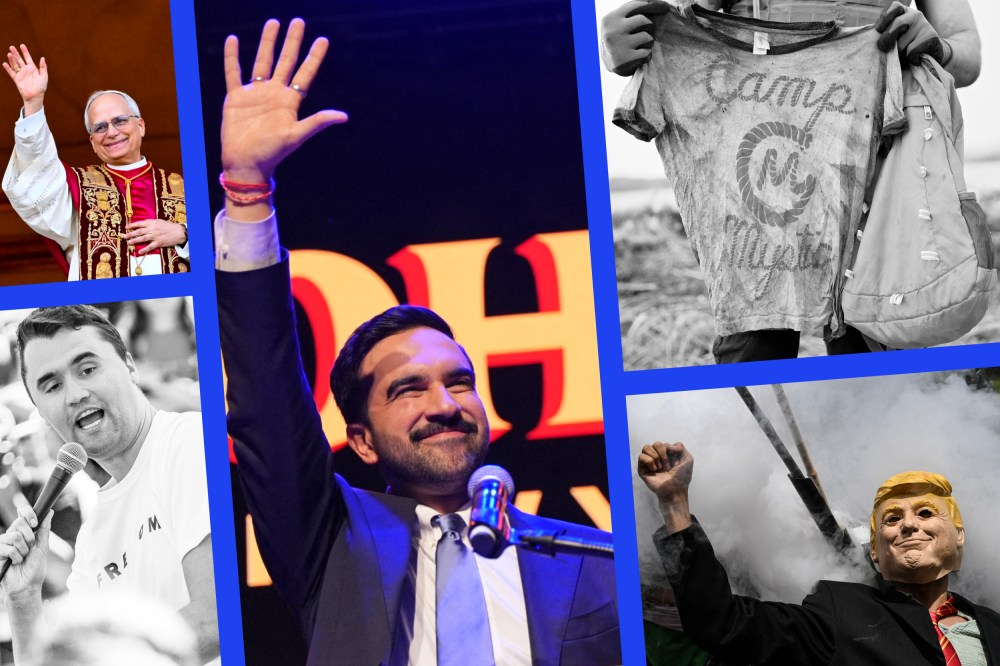
From a new president in the White House to natural disasters wreaking havoc across the country to the longest government shutdown in U.S. history, MS NOW covered all of year’s biggest stories, bringing viewers the latest breaking news, interviews with newsmakers, and sharp analysis from the network’s hosts and experts.
With 2026 sure to bring even more headlines, here are some of MS NOW’s top on-air moments of 2025:
January
From Jan. 7 to the end of the month, wildfires swept across Southern California, displacing tens of thousands, killing at least 30 people, and destroying more than 16,000 homes and businesses. Katy Tur, an Los Angeles native, reported live from outside her childhood home, which had burned to the ground. Tur shared with viewers the emotions felt by many who were affected by the fires.
On Jan. 20, Donald Trump took the oath of office and was sworn in as the 47th president of the United States. During his inauguration speech, held indoors in the Capitol Rotunda due to weather, Trump declared that “the golden age of America begins right now” and told Americans he would be a “peacemaker and unifier.”
Following that speech, MSNOW’s primetime anchors shared their reactions to the president’s vision for his second term.
On Jan. 29, a passenger jet and an Army Black Hawk helicopter collided midair over the Potomac River near Washington, D.C.’s Reagan International Airport, killing 67 people and leaving no survivors. The collision was the deadliest plane crash on American soil in more than two decades. Many of the victims aboard the American Airlines flight were young figure skaters returning home from a camp in Wichita, Kansas.
“This was a dark and excruciating night in our nation’s capital and in our nation’s history,” Trump said in remarks the following day.
February
On Feb. 11, Trump and billionaire Elon Musk held a joint appearance inside the Oval Office to discuss the newly established Department of Government Efficiency, or DOGE. The world’s richest man, then a special government employee, defended the agency, which he said would cut $2 trillion in waste, fraud and abuse. As Trump’s first year in office comes to a close and the agency has been effectively shuttered, its estimated savings stand at just $214 billion, by its own accounting; a more recent analysis by The New York Times suggested it may have cost the government more money.
“Deadline: White House” host Nicolle Wallace shared her reaction to Musk’s bizarre Oval Office display upon its launch.
Another Oval Office meeting made headlines in February, this one between Trump and Ukrainian President Volodymyr Zelenskyy. The Feb. 28 meeting, intended to mark the start of negotiations on a deal for Ukraine’s rare earth minerals, quickly devolved into a shouting match. Trump and Vice President JD Vance attacked the Ukrainian president and chastised him for not thanking the U.S. for its assistance in its war against Russia.
MS NOW’s primetime hosts gave their analysis of the acrimonious meeting.
March
On March 4, Trump delivered an address to a joint session of Congress, reflecting on his first six weeks in office and outlining his agenda for a second term. The historically long speech was full of personal attacks and false statements. Shortly after Trump concluded, Rachel Maddow set the record straight on the president’s remarks.
On March 24, The Atlantic’s Jeffrey Goldberg dropped one of the biggest political stories of the year, revealing he had been inadvertently added to a group chat on Signal in which administration officials discussed military strikes in Yemen. Officials, including Vance and Defense Secretary Pete Hegseth, participated in the chat.
Goldberg joined “Morning Joe” shortly after the story broke to discuss his reporting.
April
April kicked off with Democratic Sen. Cory Booker’s historic marathon floor speech. The New Jersey senator railed against the Trump administration in a speech that began at 7 p.m. on Monday, March 31, and and ended Tuesday night, April 1. Booker spoke for a total of 25 hours and 5 minutes, breaking a previous record held by the late Sen. Strom Thurmond of South Carolina, who filibustered for 24 hours and 18 minutes against the Civil Rights Act of 1957.
“The Last Word” host Lawrence O’Donnell said Booker’s marathon effort helped give Americans a voice against the Trump administration.
April 2 marked “Liberation Day,” when Trump unveiled his sweeping “reciprocal tariffs” on goods from more than 180 countries and territories. The plan set a 10% baseline tax across the board, with China, Vietnam and the European Union among those facing even steeper penalties.
Ali Velshi explained how the president’s tariffs would take a toll on American consumers.
May
History was made again on May 8, when Cardinal Robert Francis Prevost of the United States was elected as the pope of the Catholic Church, taking the name Leo XIV. Leo, a Chicago native, became the first American to lead the church.
His longtime friend, Father Robert Hagan, joined MS NOW’s “The Weekend: Primetime” to speak about the significance of Leo’s election.
On May 18, former President Joe Biden revealed he had been diagnosed with an aggressive form of prostate cancer. The Democrat’s announcement came a year after concerns over his health led to his withdrawal from the 2024 election. Following Biden’s announcement, Trump said he and first lady Melania Trump were “saddened to hear about” the former president’s diagnosis and wished him a “fast and successful recovery.”
Dr. Vin Gupta, an MS NOW medical contributor, reacted to Biden’s diagnosis shortly after it was announced.
On May 30, Musk’s tumultuous tenure at the White House officially came to an end. The world’s richest man received an Oval Office send-off from the president after months of ostensibly working to rein in government spending. In his final weeks in Washington, tensions rose between the tech billionaire and Trump over the president’s budget bill.
Following his departure, “All In” host Chris Hayes reflected on Musk’s legacy.
June
Protests broke out across Los Angeles on June 6 following a series of high-profile U.S. Immigration and Customs Enforcement raids in the city. The demonstrations led to a standoff between the Democratic-run state and the White House, as Trump deployed Marines and National Guard troops to quell protesters, testing the limits of executive authority.
Reporter Jacob Soboroff delivered a live report from the ground.
On June 14, the true size of the anti-Trump resistance was put into focus when Americans across all 50 states took to the streets as part of “No Kings Day.” According to organizers, more than 5 million people participated in the national day of action against authoritarianism.
Maddow explained how Trump’s efforts to suppress the protests against him backfired.
July
On July 2, a federal jury in Manhattan delivered a mixed verdict in the criminal trial of Sean “Diddy” Combs, acquitting the music mogul of the most serious charges of racketeering and sex-trafficking but finding him guilty on lesser charges. The trial attracted nationwide attention and raised questions about abuse in the music industry.
MS NOW delivered the breaking news of Combs’ conviction.
In the early hours of July 4, Central Texas was hit by catastrophic flash flooding after extremely heavy rainfall that caused the Guadalupe River to rise rapidly. The flooding was deadly and destructive, with at least 135 people killed, including children from a nearby camp.
Christian Brown, who was in a cabin with his family when the floodwaters hit, shared his story of survival with MS NOW.
Also on July 4, after weeks of intense negotiations on Capitol Hill, Trump signed the “One Big Beautiful Bill Act” into law. The legislation extended and made permanent key tax cuts that disproportionately benefit the rich and increased funding for immigration enforcement and defense, while cutting spending for social safety-net programs like Medicaid and SNAP.
Velshi explained how the bill was a major step back for America’s health care system.
August
On Aug. 11, the president declared an emergency in Washington, D.C., federalized the city’s police and ordered the deployment of National Guard troops and federal law enforcement to the city’s streets. Although Trump claimed it was an effort to combat crime, Maddow pulled back the curtain on what she suspected was the president’s true motivation.
On Aug. 15, Trump and Russian President Vladimir Putin met in Anchorage, Alaska, for high-stakes talks focused on negotiating an end to Russia’s war in Ukraine. The summit marked their first face-to-face meeting since Trump’s second term began.
Former Secretary of Defense Leon Panetta explained to MS NOW why the meeting, which ended without a ceasefire agreement, was a failure for Trump.
September
Conservative activist and Turning Point USA founder Charlie Kirk was shot in the neck and killed on Sept. 10 while speaking at an outdoor event at Utah Valley University. Kirk’s killing sparked conversations about the normalization of political violence in America.
“Politics Nation” host Rev. Al Sharpton spoke about the troubling rise of politically motivated acts of violence.
ABC suspended late-night host Jimmy Kimmel on Sept. 17, taking him off the air “indefinitely” after he quipped about the Republican reaction to the suspect in Kirk’s killing. The suspension occurred after major ABC affiliate owners, Nexstar and Sinclair, chose to preempt the show on their stations following public comments from Trump’s Federal Communications Commission chair. Kimmel’s suspension prompted a national debate over free speech and government censorship.
“The Briefing” host Jen Psaki explained how the suspension was part of Trump’s effort to reshape American media.
Former Vice President Kamala Harris sat down with Maddow on Sept. 22 for her first news interview since leaving office — and since her loss in the 2024 presidential election to Trump. During that exclusive interview, Harris gave a look behind the scenes of her 2024 campaign, shared her thoughts on the administration, and responded to speculation she may throw her hat into the ring in 2028.
October
On Oct. 1, the U.S. entered what would become the longest government shutdown in the country’s history. As a result, hundreds of thousands of federal employees were furloughed or required to work without pay. Essential services, like food assistance for American’s most vulnerable, were disrupted. After weeks of negotiations, the standoff came to an end on Nov. 12.
Furloughed Labor Department worker Imelda Avila-Thomas spoke to MS NOW about the effect the shutdown had on her and her family.
Construction crews began demolishing the East Wing of the White House to make way for Trump’s planned $400 million ballroom on Oct. 20. Work on the president’s pet project commenced despite lack of approvals from the federal agency that oversees such projects.
Psaki, who worked in the White House, described the demolition of the historic building as a “gut punch.”
November
Democratic socialist Zohran Mamdani won the New York City mayoral election on Nov. 4, defeating Democratic heavyweight and former governor Andrew Cuomo, who ran as an independent. The 34-year-old, who focused his campaign around issues of affordability, became the city’s youngest mayor in more than a century. Shortly after his victory, Mamdani traveled to Washington, D.C., for a surprisingly cordial visit with the president.
Mamdani sat down with MS NOW to discuss his chat with Trump.
Defying weeks of public pressure from the White House, the Republican-controlled House on Nov. 18 passed the Epstein Files Transparency Act, which directed the Justice Department to release all files relating to its investigation into the late disgraced financier. The measure was quickly approved by the Senate and later signed by the president.
Hayes explained how Trump was forced to back down after Republicans “staged an open revolt.”
On Nov. 28, the Trump administration’s strikes on purported drug boats in the Caribbean came under new scrutiny after The Washington Post reported that Hegseth told military officials to kill survivors of a Sept. 2 attack on a vessel off the coast of Venezuela. Hegseth denied giving the order but said he supported the additional strikes on the boat. Lawmakers on both sides of the aisle have called on the administration to release more information about their campaign in the region.
Maddow said Hegseth ought to consider resigning in the wake of the allegations.
December
On Dec. 14, actor and filmmaker Rob Reiner and his wife, Michele Singer Reiner, were found stabbed to death in their home. Reacting to the news, Trump attacked Reiner on social media, saying the prominent Democratic activist died due to “Trump Derangement Syndrome.”
“Morning Joe” co-host Joe Scarborough slammed the president for injecting politics into a tragic situation.
On Dec. 19, the Justice Department began releasing thousands of documents related to its case against Epstein, just before the deadline imposed by the Epstein Files Transparency Act. The release of the documents is intended to shed new light on powerful figures in the late sex offender’s orbit. However, the administration faced immediate backlash for withholding documents and issuing others with what some critics consider excessive redactions.
One of Epstein’s survivors, Marina Lacerda, told MS NOW she was “infuriated” by the limited release.

Allison Detzel is an editor/producer for MS NOW. She was previously a segment producer for “AYMAN” and “The Mehdi Hasan Show.”