





After months of House Republicans ducking a vote to release files tied to the Justice Department’s investigation of Jeffrey Epstein, the House almost unanimously approved legislation Tuesday that would force those documents into the open.
Lawmakers passed a bill Tuesday that would compel the Department of Justice to publish all materials involving Epstein, sending the legislation to the Senate where leaders had been cagey about whether — and when — they’d hold a vote, but now say they could pass the bill as soon as this week.
The position that the Senate would just shove the bill into a filing cabinet became almost untenable Tuesday, after the House approved the legislation 427-1, with just one Republican, Rep. Clay Higgins, R-La., opposed.

The lopsided vote marks the culmination of a months-long, bipartisan effort to release the files. The battle included a successful discharge petition, attempts to stifle that effort from President Donald Trump and Speaker Mike Johnson, R-La., and the explosion of simmering tensions within the GOP.
With dozens of Republicans prepared to break with him, Trump abruptly reversed course over the weekend and announced support for the bill. But that public position clashed with weeks of behind-the-scenes efforts by Trump and House GOP leaders to stop Republicans from signing the discharge petition needed to force the vote.
It was a tortured strategy that Republicans strained to navigate — denouncing both the petition and the legislation right up until the moment when they voted for it.
Even so, Tuesday’s vote amounts to the strongest rebuke of President Trump by members of his own party so far this term.
For weeks, House Republicans have been caught between a base demanding the release of the documents — often framed as a way to expose the “deep state” — and a president who campaigned on making the files public but moved to block their release once back in office. (Despite his public support for the bill, Trump could order the release unilaterally, and has taken steps since returning to office to attempt to block them from going public.)
Speaker Johnson spoke at length on Tuesday about his objections to the bill, incorrectly claiming the measure would release victim information and fail to protect the release of child sex abuse materials. (The bill explicitly gives the Attorney General the power to redact that sort of information.)
But Johnson said he would support the bill with the expectation that the Senate would make sure that the bill is amended.
“Having now forced the vote, none of us want to go on record and in any way be accused of not being for maximum transparency,” Johnson said.
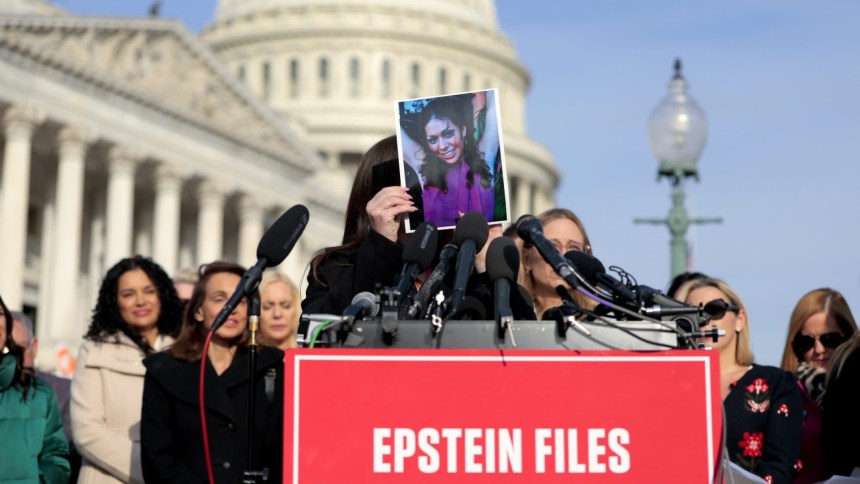
The floor debate was just as fraught. Republicans sought to explain why they had opposed the legislation for months — and why the discharge petition was flawed — while also defending their newfound support.
Managing the debate time for Republicans, Judiciary Chairman Jim Jordan, R-Ohio, presented the legislation as a naked political attempt to harm President Trump and the GOP.
“I think the American people see through it,” Jordan said.
“So I say, let’s vote yes, and then let’s get focused on doing what the American families elected us to do,” Jordan said.
Oversight Chairman James Comer, R-Ky., echoed those attacks, noting that his committee had been working through its own Epstein investigation and that Democrats had “mischaracterized witness testimony and selectively released documents complete with targeted redactions in an effort to smear President Trump.”
Jordan’s counterpart on the Democratic side — Rep. Jamie Raskin, D-Md., the ranking member of the Judiciary Committee — called out Republicans for spending their debate time attacking Democrats, rather than calling for transparency for a child sex ring.
“We’ve heard now from the two distinguished chairmen, of the Judiciary and Oversight committees, and they’ve spoken almost exclusively to denounce Democrats,” Raskin said.
“They want to just throw stones at the Democrats,” Raskin added. “What a remarkable failure of leadership.”
But the most stinging arguments against the GOP didn’t come from Democrats on Tuesday; they came from the Republicans who supported the discharge petition forcing the vote.
“It should have been the easiest thing for every member of Congress, the easiest thing for the Speaker of the House, it should’ve been the easiest thing for the President of the United States to release all the information,” Rep. Marjorie Taylor Greene, R-Ga., said on the House floor Tuesday.
She continued that she and the other three Republicans who signed the discharge petition “faced intimidation and threats.”
“This is what the American people are sick of,” Greene said.
Rep. Thomas Massie, R-Ky., who authored the discharge petition, said he was “embarrassed for my own party” and “embarrassed” that Johnson declined to swear-in Rep. Adelita Grijalva, D-Ariz., “for 49 days, just to avoid this vote.”

Massie said his party was lying about the bill, and that the strongest argument for the legislation was that the president is now supporting the legislation.
“I urge my Senate colleagues, do not muck up this bill,” Massie said. “The president has already said he’ll sign it. That means he’ll sign the bill that we have here today. Do not change this bill. He is ready to sign it. Give it to him.”
What the Senate will do remains influx, but following the House vote, Senate Majority Leader John Thune, R-S.D., suggested his tentative plan was to bring the bill up this week.
Speaker Johnson said Tuesday that he was “very confident” that if the bill moved forward in the Senate — “which is no certainty,” Johnson said — lawmakers would “take the time methodically to do what we have not been allowed to do in the House: to amend this discharge petition.”
But that doesn’t appear to be Thune’s plan now after such an overwhelming vote.
The majority leader told reporters Tuesday afternoon that he wasn’t sure “there’s going to be a need for or desire for an amendment process over here.”
Still, even if the bill passes in the Senate quickly — and is signed by the president — it’s unclear to what extent the Justice Department would be obliged to disclose its Epstein-related case files.
The bill would allow the DOJ to withhold or redact documents that might jeopardize any ongoing criminal investigations — such as the ones the Justice Department just launched against Democrats mentioned in the files. It’s also unclear how much material the bill would release related to grand juries. Two judges so far have declined DOJ requests to release grand jury information related to the Epstein saga.

Kevin Frey is a congressional reporter for MS NOW.

Syedah Asghar
Syedah Asghar covers Congress for MSNBC.

Mychael Schnell is a reporter for MS NOW.