




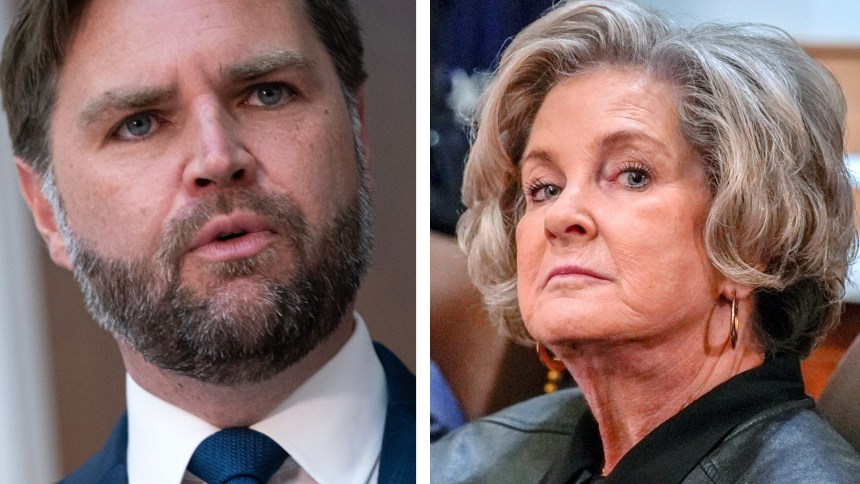
Vanity Fair published an explosive pair of interviews on Tuesday with President Donald Trump’s chief of staff, Susie Wiles, offering her takes on his second term. Comprising candid conversations with Wiles over the course of the year, the two-part article features insights from one of Trump’s most powerful staffers on his agenda, the scandals that have consumed the administration and various other top Trump officials.
Wiles quickly condemned the article as “a disingenuously framed hit piece on me and the finest president, White House staff and Cabinet in history.”
“Significant context was disregarded and much of what I, and others, said about the team and the President was left out of the story,” she said in a post on X. “I assume, after reading it, that this was done to paint an overwhelmingly chaotic and negative narrative about the president and our team.”
The White House also expressed support for Wiles.
“President Trump has no greater or more loyal adviser than Susie,” White House press secretary Karoline Leavitt said in a statement. “The entire administration is grateful for her steady leadership and united fully behind her.”
Here are some of the most striking details from the story:
Trump’s ‘alcoholic’s personality’
“Some clinical psychologist that knows one million times more than I do will dispute what I’m going to say. But high-functioning alcoholics or alcoholics in general, their personalities are exaggerated when they drink. And so I’m a little bit of an expert in big personalities,” Wiles said, alluding to her late father, Pat Summerall, the NFL player-turned-famed broadcaster whose struggle with alcoholism was well documented.
Trump, a known teetotaler, has “an alcoholic’s personality,” Wiles said. He “operates [with] a view that there’s nothing he can’t do. Nothing, zero, nothing.”
Hours after the Vanity Fair story was published, Trump defended Wiles to the New York Post, calling her “fantastic” and suggesting he was not offended by her description of his personality.
“I don’t drink alcohol. So everybody knows that — but I’ve often said that if I did, I’d have a very good chance of being an alcoholic. I have said that many times about myself, I do. It’s a very possessive personality,” he said.
Elon Musk’s drug use
“The challenge with Elon is keeping up with him,” Wiles told Vanity Fair writer Chris Whipple about the world’s wealthiest man, whom Trump appointed as a “special government employee” tasked with slashing government waste. Musk left Washington earlier this year after a falling-out with Trump and recently said he wished he’d stuck to running his companies.
“He’s an avowed ketamine [user],” she said, adding that Musk is “an odd, odd duck, as I think geniuses are.”
When I asked her what she thought of Musk reposting a tweet about public sector workers killing millions under Hitler, Stalin, and Mao, she replied: ‘I think that’s when he’s microdosing.’
In May, Musk denied a New York Times report about his drug consumption, posting on X, “I am NOT taking drugs!” He wrote that he tried prescription ketamine “a few years ago” but “[hadn’t] taken it since then.”
Wiles denied to the Times that she spoke to Whipple about Musk’s drug use. “That’s ridiculous,” she told the newspaper this week. “I wouldn’t have said it and I wouldn’t know.” Whipple, however, played the Times a recording of Wiles saying it.
The Jeffrey Epstein files
Wiles told Vanity Fair she did not expect the blowback that the Epstein files have generated. She said Trump is in the documents, which she said she has read, but “he’s not in the file doing anything awful.” The president and the convicted sex offender, she said, were “young, single playboys together.”
Wiles also said there was nothing incriminating about former President Bill Clinton in the documents, contrary to what Trump has said. “The president was wrong about that,” she said.
Wiles said FBI Director Kash Patel and Deputy Director Dan Bongino “really appreciated what a big deal this is … because they lived in that world.” As did Vice President JD Vance, “who’s been a conspiracy theorist for a decade,” she said.
Wiles said she and Trump weren’t consulted on the transfer of Epstein associate Ghislaine Maxwell to a minimum-security facility after Maxwell’s jailhouse interview with Deputy Attorney General Todd Blanche.
“The president was ticked,” Wiles said. “The president was mighty unhappy. I don’t know why they moved her. Neither does the president.”
Venezuela boat strikes
Wiles said Trump wants U.S. forces to continue destroying small boats the administration accuses of ferrying drugs until Venezuelan President Nicolás Maduro is ousted. Despite widespread speculation, that marks the first time anyone in the administration has acknowledged that that is the aim.
“He wants to keep on blowing boats up until Maduro cries uncle. And people way smarter than me on that say that he will,” she said.
Pete Hegseth’s Signal debacle
Wiles said she is “not horrified” by the defense secretary discussing military attack plans in a group chat on Signal, an encrypted messaging app, that inadvertently included The Atlantic Editor-in-Chief Jeffrey Goldberg, who then published portions of the exchanges.
“The burden’s on us to make sure that [national security] conversations are preserved,” she said. “In this case, Jeff Goldberg did it for us.”
The Pentagon’s inspector general determined this month that Pete Hegseth violated Defense Department policy by discussing those plans in a nonsecure setting.
Marco Rubio and JD Vance’s transition into Trump loyalists
Wiles said she believed Secretary of State Marco Rubio’s change of heart about Trump was sincere. Derided by Trump as “little Marco,” Rubio called Trump a “con artist” and a “third-world strongman” while challenging him for the 2016 GOP nomination, among other deeply personal attacks that gained renewed attention during the 2024 election amid reports that Rubio was being considered as Trump’s running mate.
“Marco was not the sort of person that would violate his principles. He just won’t,” Wiles said.
Vance, however, became pro-Trump “when he was running for the Senate,” she said. “And I think his conversion was a little bit more, sort of political.”
Trump’s sexist insults
Asked about the president’s recent attacks on female reporters, Wiles said, “He’s a counterpuncher. And increasingly, in our society, the punchers are women.”
A third term
Wiles denied that Trump will be running for a third term, as he has suggested.
“But he sure is having fun with it,” Wiles said, adding that he knows it’s “driving people crazy.”
“Sometimes he laments, ‘You know, gosh, I feel like we’re doing really well. I wish I could run again.’ And then he immediately says, ‘Not really. I will have served two terms and I will have gotten done what I need to get done, and it’s time to give somebody else a chance.’ So, you know, any given day, right? But he knows he can’t run again,” she said.
His political enemies
Wiles told Vanity Fair in March that she and Trump “have a loose agreement that the score settling will end before the first 90 days are over.”
Asked again about Trump’s “retribution tour” in August, she said, “I don’t think he’s on a retribution tour. A governing principle for him is, ‘I don’t want what happened to me to happen to somebody else.’ And so people that have done bad things need to get out of the government.
“In some cases, it may look like retribution. And there may be an element of that from time to time. Who would blame him? Not me.”
She then acknowledged that the Justice Department’s pursuit of mortgage fraud charges against New York Attorney General Letitia James — who won a civil fraud case against Trump and his company — “might be the one retribution.”
“She had a half a billion dollars of his money!” Wiles said.
This is a developing story. Please check back for updates.

Clarissa-Jan Lim is a breaking news reporter for MS NOW. She was previously a senior reporter and editor at BuzzFeed News.