




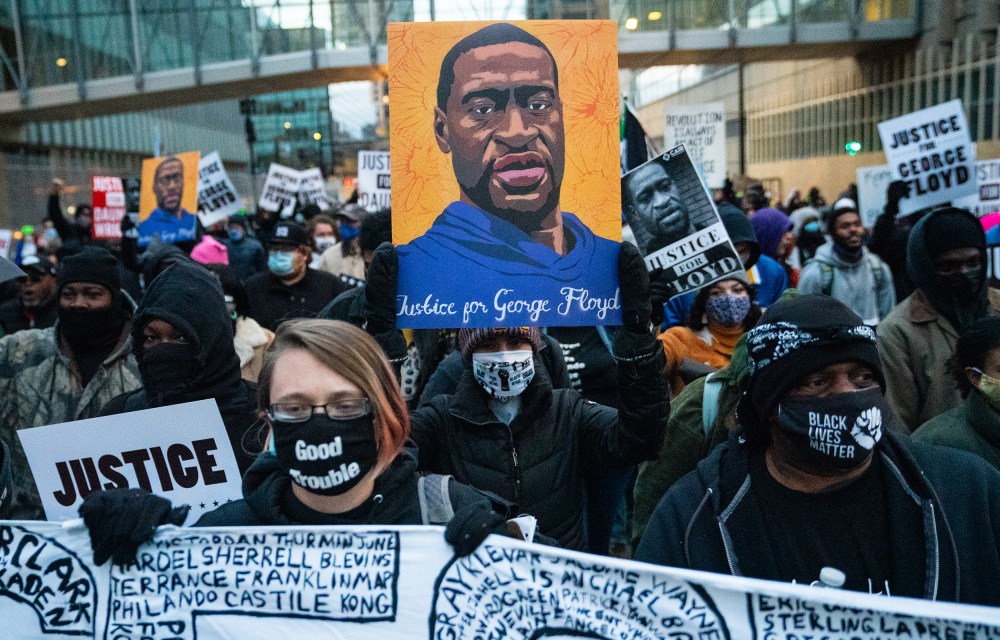
Tuesday’s guilty verdicts in the trial of former Minneapolis police officer Derek Chauvin provided a measure of accountability for George Floyd’s murder. But justice requires something different, something more. The death of Daunte Wright at the hands of police in Brooklyn Center, just a few miles from where Chauvin’s trial took place, confirms what we all know — policing must be transformed, or these killings won’t stop. True restorative justice means we must not stop here if we are going to fulfill the words of Floyd’s daughter, Gianna, last summer: “Daddy changed the world.”
It’s time to firmly reject the notion that law enforcement should play the role of a hostile force in American communities.
In a speech to police officers in July 2017, President Donald Trump made light of protecting people in police custody. “Don’t be too nice,” he told them to scattered laughter and cheers. Not anymore. It’s time to firmly reject the notion that law enforcement should play the role of a hostile force in American communities. The culture must be one of protection and service.
But how do we transform policing across 50 states, Washington, D.C., and the U.S. territories? Agency regulations and laws at every level of government will need to be reformulated to promote a culture in which police act as guardians, while professionals with expertise in areas like mental health and addiction are engaged where they can serve. Communities need to rethink where police resources are allocated, like routine traffic stops. Much of the transformation in policing will take place as part of a patchwork quilt. Some departments may move quickly, while others will prove more resistant to change.

That’s a key reason it’s critical for the Senate to pass the George Floyd Justice in Policing Act. The bill, which has already passed the House, would make it easier for federal prosecutors to prosecute police in excessive force cases under 18 USC 242, the federal civil rights statute, when state and local prosecutors decline to prosecute or when juries fail to convict. This law makes it a federal crime for law enforcement officers to deprive people of federally protected rights because of their race.
Current legal precedent requires that prosecutors prove “willfulness” — meaning they must establish, beyond a reasonable doubt, that a defendant intended to deprive a person of his or her constitutional rights. The George Floyd Act would reduce this inappropriately stringent burden to a more reasonable standard that would require proof of knowledge or recklessness, while still protecting officers from unwarranted prosecutions. Strengthening federal capabilities to backstop state criminal justice systems would deter lawless conduct.
The act includes other important measures. It would restore and expand law enforcement training in implicit bias, prohibit racial profiling and establish, for the first time, requirements for reporting use-of-force incidents so statistical trends can be analyzed and problems can be identified.
It’s impossible to dismiss the disparity between the arrests of violent white men like Dylan Roof, the white supremacist who killed nine people at Emanuel African Methodist Episcopal Church in Charleston, South Carolina, and was peacefully taken into custody the next morning and what happens to people of color like George Floyd, Eric Garner, Philando Castile, Breonna Taylor and others who are killed during arrests for minor crimes, during traffic stops or while sleeping in their beds. The act’s training and accountability measures are critical.


The bill would also enhance the Justice Department’s role; it would reinforce the consent decree process that Trump’s first attorney general, Jeff Sessions, terminated and that Attorney General Merrick Garland restored on Friday by expanding resources and investigative authority. The consent decree process mandates and enforces constitutional policing, and it can ensure, for instance, the adoption of use-of-force policies, limits on procedures to police mass gatherings and protection of First Amendment rights.
In their closing argument, Chauvin prosecutors pointed to the Minneapolis Police Department’s motto: “to protect with courage, to serve with compassion.” Re-envisioning policing so officers focus on actually getting to know the communities they protect and serve would give meaning to mottos like this. Deadly force must be used, if ever, only as a true last resort.
Although immediate passage of the George Floyd Act would be ideal, no clear consensus has emerged among senators yet, despite the urgent, vivid need for its reforms. Much like 17-year-old Darnella Frazier’s prescient recording of Floyd’s final moments, the national focus on America’s need for reform must be unshakable. Change comes when enough people unite to demand it, and that includes at the ballot box.
To paraphrase John Lewis, this isn’t the work of a day or a month or a year; it is the work of a lifetime. If people give up because results don’t come quickly enough, they won’t get them at all. It’s apparent that Tuesday’s verdict was an important moment, but alone, it isn’t the justice that Floyd deserves or that our country requires.
Passing the George Floyd Act would put us on a path toward restoring credibility in policing and ensuring that communities regain confidence in law enforcement. Elected officials who claim to be pro-police should be lining up to make sure this important measure passes. Even with the act in place, law enforcement would still have serious work to do. Chauvin’s final moments in the courtroom, when he was handcuffed and taken into custody, sent a strong message to both communities and law enforcement officers that killings like this must stop. But it is still just one case. Accountability has to become the culture if we’re really going to have justice for George Floyd.
