




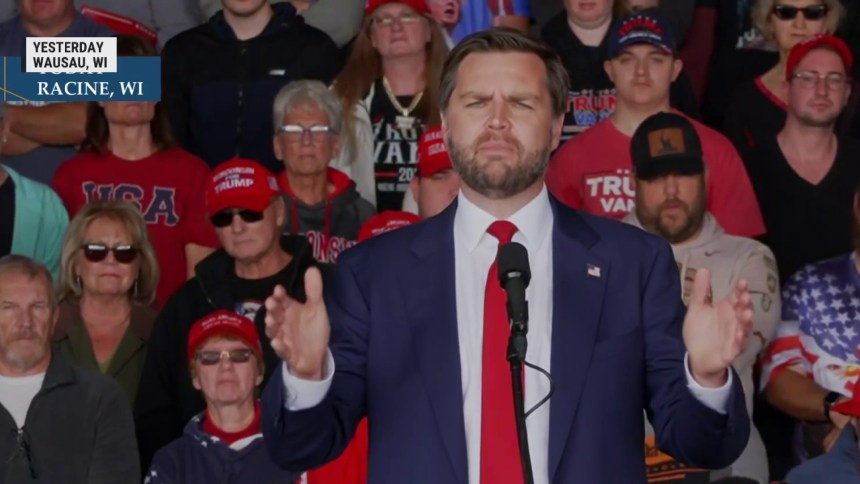
Since before former President Donald Trump announced Sen. JD Vance of Ohio as his running mate, conventional wisdom has held that this wasn’t a great pick. Vance is “historically unpopular,” Democrats have charged, and even some Republicans have been unenthusiastic.
Yet there’s a group of voters for whom Vance, not Trump, is the GOP ticket’s attraction — its sole attraction. These never-Trump maybe-Vance voters aren’t numerous, and they may not yet know how they’ll vote. But in a close race, their decisions could make a difference.
I stumbled upon this group by chance: I happen to know a few people thinking this way in real life. When I sketched the voter profile on Substack, the response was swift and surprising, both for me and for voters who didn’t realize there were others like them. This is a small sampling and not a scientific poll, mind you, but the cumulative nature of the collected testimonials reveals a certain type. “Dang, you described me perfectly here,” commented Thomas, an evangelical dad from Georgia.
These never-Trump maybe-Vance voters aren’t numerous. But in a close race, their decisions could make a difference.
Like Thomas, typical never-Trump maybe-Vance voters are men. They’re millennials, or perhaps younger Gen X or older Gen Z. They’re married fathers (or want to be) who went to college and have white-collar jobs. And they’re churchgoing, but probably not in the charismatic stream of Protestantism where Trump is the subject of devotion and prophecy.
Crucially, these voters have all the moral objections and gut aversion to Trump that conservative Christians were expected to have in 2016. They likely don’t call themselves never-Trumpers and aren’t preoccupied with criticizing the former president as self-identified never-Trumpers tend to be. But they’ve never voted for Trump, didn’t like him in office and don’t want him re-elected.
Vance, however, is intriguing for them, and not only on policy. With some issues, mostly around trade and labor, Vance’s policies may actually be a drawback. Other positions, like his skepticism of U.S. military intervention abroad, might be pluses. But the big draw is Vance’s orientation around fatherhood and family, the way he links children and the American dream and his clear interest in pronatalist family policy and fertility rates.
Vance’s views on “the value of family resonate strongly with me,” said Eddie Becker, who attends a nondenominational church and expressed dismay over ongoing Trump support among fellow Christians and Republicans. “Aside from snarky ‘childless cat ladies’-type remarks,” Becker said of Vance, “I believe he does care about families and values children.”

For Christina in Boise, Idaho, who told me she fits this voter profile except for her sex, Vance’s disparagement of “childless cat ladies” merely signaled his seriousness about family. “I admire his love of his wife, children, Mamaw and his faith,” she said. “I see people balk at the mere idea of children, and this scares me.” In comparison, for her, Vance “is spot on.”
How Vance talks about family is also part of why these voters identify with him, which is a significant element of his appeal. Rob Spangler, a Maryland Presbyterian and father of four, highlighted that sense of identification when explaining to me his interest in Vance. Thomas added that watching Vance “is the first time I’ve seen someone in politics and thought, ‘That could be me.’”
Beyond the family vibes, some of this alignment is as simple as commonalities of age and stage: Vance is a young father and the first millennial on a major-party ticket after decades of boomer dominance. But that level of resonance could’ve happened with any peer-aged candidate, like Florida Gov. Ron DeSantis or Vivek Ramaswamy. These voters’ affinity for Vance goes deeper.
Vance is a young father and the first millennial on a major party ticket after decades of boomer dominance.
Like them, Vance is bookish and speaks seriously about his Christian faith. He’s the first viable contender for high office with whom they’d like to have a beer. In Vance, they see someone — in starkest contrast to Trump — who could be a friend under other circumstances. Several told me that when Vance is attacked as “weird,” they bristle a bit. If he’s weird, they’re weird, too.


It’s hard to say how many never-Trump maybe-Vance voters there are. Maybe the most useful data comes from a Cygnal survey last month of 1,500 likely voters. In most demographics, including unmarried men and men who didn’t go to college, Trump’s favorability ratings were statistically identical to or higher than Vance’s.
Among married men and men who went to college, however, Vance had a more favorable rating by a 4- to 5-percentage-point margin. Cygnal also isolated answers from “double haters,” the small (and shrinking) subset of voters who reject both major-party candidates. For them, Trump’s favorability sits at zero, but Vance’s is as high as 33%.
These aren’t large numbers. I don’t think this group numbers in the millions, not even at the national scale. But that polling suggests there could be enough never-Trump maybe-Vance voters for their decisions to matter in the five states, as of this writing, with less than 1-point gaps in the presidential polls.

The question, then, is whether never loses to maybe — whether they stick to an eight-year aversion or decide that voting for Trump is a price worth paying to vote for Vance. The choice may well turn on how they expect a Trump-Vance administration to run. Would Vance wield real power, perhaps becoming president himself? Or would he be relegated to frippery and dirty work for a lame duck?
The voters I spoke with were mostly undecided. Luis, a millennial in Virginia, expects to cast a write-in vote. Though he likes how Vance recognizes “the way modern life makes various social ties harder to form,” particularly “regarding the birth rate,” the candidate’s election denial and vitriol are obstacles to earning his vote this year.
Thomas is leaning third-party for president but favoring the GOP farther down the ballot. Christina won’t commit until she’s in the voting booth, but she said she’ll probably vote “Trump-Vance and then go to confession and pray some more for our country.” Becker is still mulling options, but he’s disappointed Vance failed to “counter the Trump cult” in the GOP. “All I can say for sure,” he concluded, “is that I won’t be voting for Donald Trump.”
Spangler, too, remains undecided. On the debate stage, Vance struck him as reasonable and diplomatic, a sharp contrast to his running mate. “I’m still incredibly conflicted about it,” Spangler told me. “My mail-in ballot stares at me almost every day.”

Bonnie Kristian
Bonnie Kristian is the editorial director of ideas and books at Christianity Today. She is the author of “Untrustworthy” and a fellow at Defense Priorities.