




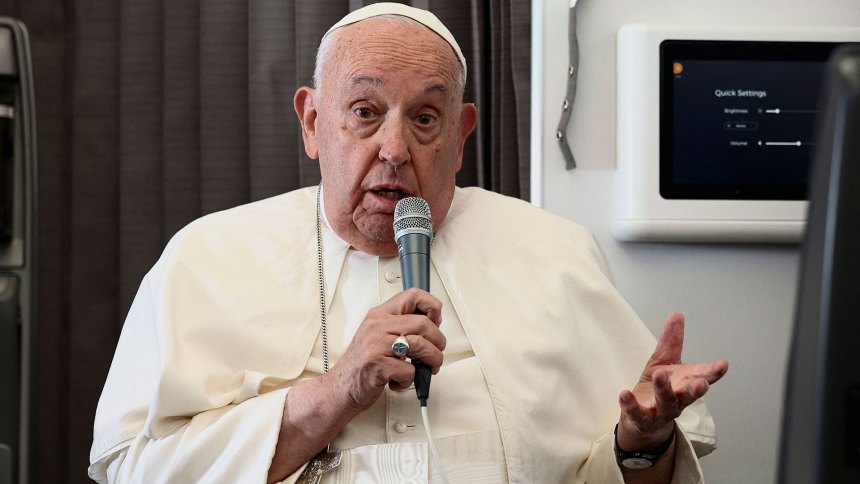
Pope Francis, while on a plane from Asia to Rome last week, told reporters that he has problems with both candidates for U.S. president — he said they’re “both against life” and that Americans should vote for the person they believe to be the “lesser of two evils.”
“One must choose the lesser of two evils,” he asserted, even as he said he doesn’t know if that candidate is Vice President Kamala Harris or former President Donald Trump.
Obviously, the idea of choosing the lesser evil did not start with Pope Francis. It is a phrase that voters have often used to characterize their ambivalence and lack of excitement.
Obviously, the idea of choosing the lesser evil did not start with Pope Francis. It is a phrase that voters have often used to characterize their ambivalence and lack of excitement over their choices on a ballot. Therefore, Francis was using the language American voters are likely to have used themselves. There is just one issue: Across the political spectrum, many people do not fully understand what the term “lesser of two evils” means or how those who originated the phrase intended it to work as a way of navigating essential decisions.
In fact, many Americans have come to disparage the very idea of choosing between the “lesser of two evils,” as if doing so means that they themselves are committing a kind of evil. When, in fact, we should see choosing the lesser of evils as our duty.
The concept itself is ancient. Aristotle articulated it in 350 B.C.E., and philosopher Baruch Spinoza wrote about it in 1677. Even so, if most people don’t fully grasp the concept of “lesser of evils,” that’s likely because “the lesser of evils” is only half of the original concept. In short, the principle states that if given a choice, the lesser of evils and the greater good in both the long term and the short term should be chosen. The problem with the typical American’s understanding of the concept is that “the greater good” gets dropped off. Some may argue that considering the greater good is inherent in the lesser of evils, but the framework demands that people look at a situation from all perspectives. What are the lesser evil, the greater evil, the lesser good and the greater good now and in the long term?
What does this mean practically for voters? The lesser of evils and the greater of goods is a way of thinking about harm reduction. According to the principle, people are supposed to choose what causes the least harm while also creating the best outcome. But all this rests on how a person thinks about good and evil and how the person judges what’s an acceptable amount of harm. In short, the lesser of evils/greater good framework requires people to engage in a hard factual analysis of the choices before them, rather than the choices they wish they had.
To give a hypothetical example that does not involve politics, imagine you are trapped in a burning house with only two ways out. One exit is engulfed in flames; if you take it, you will survive the fire but be badly burned over most of your body. The other exit is full of rattlesnakes; if you take it, you will be bitten. You choose the rattlesnakes. Why? Because antivenom can bring your body back to normal in ways that doctors could never restore a badly burned body.
A recent real-world example was the decision to shut down in-person learning during the Covid-19 pandemic.
A recent real-world example was the decision to shut down in-person learning during the Covid-19 pandemic. In 2020, before vaccines or effective treatment were available, the question that confronted society was: Do you keep the schools open and expose students, staff members and whole families to viruses that can kill and debilitate, or do you close the schools, which will disrupt society for millions of people and inevitably cause learning loss among students? Different communities answered this question in various ways, yet they all grappled with what choice caused the least harm while also creating the best outcome in both the short term and the long term in light of the realities on the ground they faced.
“Everyone in their conscience should think on this and do it,” the pope said after he advised the public to vote for the lesser of two evils. That’s not surprising. Telling people to “vote your conscience,” which means vote how you want you and other people to be treated by the government, is used about as often as telling them to choose the lesser of evils.
NEW: Pope Francis tells reporters that he believes Donald Trump and Kamala Harris "are both against life," and urges citizens to vote for whoever they consider the "lesser of two evils." https://t.co/OThOxISLbM But acts of conscience are not beyond scrutiny. People get to hold you accountable for how your conscience tells you to vote and the choices you made out of malice or ignorance, including any attempts you made to avoid accountability. To repeat a point made above, “I will not vote for the lesser of evils” is an abdication of responsibility. Contrary to its performative intent, it affirms that you are willing to accept either outcome, including the greater evil. It is the sort of stance made by people who have somehow convinced themselves that because they didn’t vote for the lesser evil, they’re somehow exempt from the greater evil that their failure to make a choice may have enabled. This is self-deception. No one is exempt from the effects of the greater evil, and if that greater evil were obvious, then nobody who failed to vote against it gets to avoid blame for helping bring it about. It is important to reiterate that the pope stated that he did not know who the lesser of evils was in the election and never mentioned either candidate by name. You, the reader, may be wondering who I think is the lesser of evils after reading to this point. My goal in writing this essay is to describe how the lesser of evils and greater of goods way of thinking works and what “voting your conscience” means. I cannot and will not tell you whom to vote for, because deciding between the lesser of evils and voting one’s conscience is a personal decision. What I will say is that these are serious times, and the lesser of evils and the greater good method of discernment is for serious people. It is a sober assessment of the state of affairs around us that culminates in a decision that affects everyone. Ultimately, voting your conscience demands that we all do what we think is right and fully own the consequences of that decision.
Nicholas Mitchell
Nicholas Mitchell is an assistant professor of curriculum studies at the University of Kansas. He is a curriculum theorist whose scholarship focuses on the intersection of education theory, policy and practice. He is the author of "On Bigotry" by Bloomsbury Publishing. 

