





It is unfortunate — and concerning — that there are so many stories to tell about gun violence, and I am deeply saddened that we at the Daily Tar Heel are the next newsroom tasked with telling them.
I want to say that when I received the alert to shelter in place I sprung into action, a picture-perfect student journalist leaping to her feet to cover the news bouncing on her phone screen — “Police report an armed and dangerous person on or near campus.”
Instead, I called my sister, a sophomore and fellow Tar Heel, to make sure she was safe. With the confirmation that she was sheltering in place in her dorm, I tabled feelings of fear and uncertainty and began what would be more than three hours of breaking news coverage.
An editorial team of nearly 40 students tuned into emergency service scanners to stay abreast of the crisis unfolding beyond their barricaded doors. Some editors worked in locked libraries, lecture halls and campus basements. Others logged on from their off-campus homes. I and some of my colleagues locked the doors of our newsroom, just half a mile away from the laboratories where associate professor Zijie Yan was killed.
I peered from our second-story office to see swarms of police cars headed toward UNC’s campus — the largest police presence I’ve seen in Chapel Hill during my time here. We had only experienced scenes like this through the television, as they unfolded on other college campuses (this year alone, there have been 86 instances of gunfire on school grounds).
In an almost dystopian sequence, sirens blared, people ran and students shakily sent panicked texts to their loved ones.
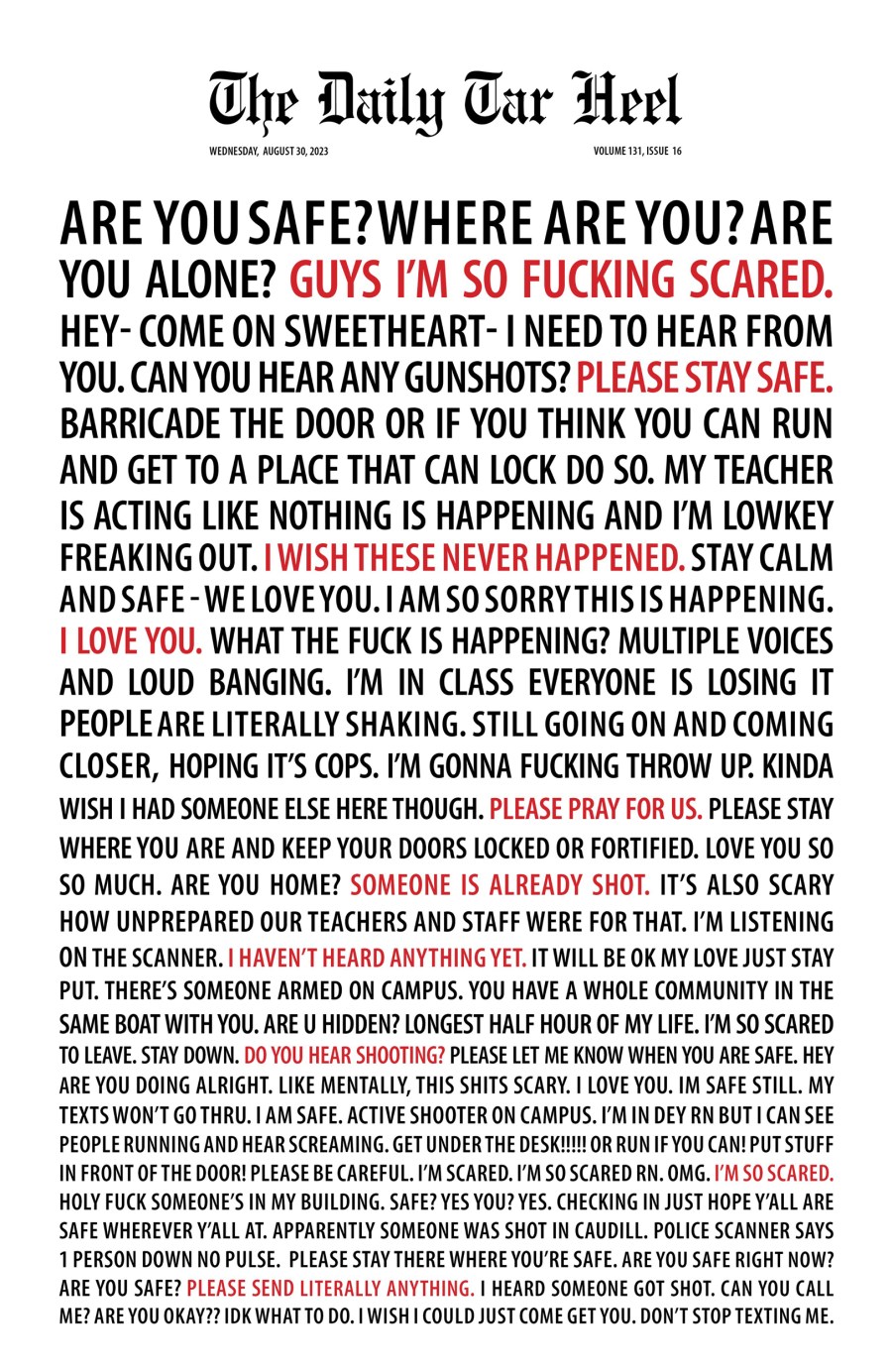
These were the messages that inspired the cover of The Daily Tar Heel’s Wednesday edition. We got to work Tuesday morning, reaching out to friends and classmates to ask them to contribute text messages from Monday’s lockdown. We received an avalanche of screenshots from family, friends, group chats and more by midday. The brainchild of my dear friend and editor-in-chief Emmy Martin, this front page reads as a flustered stream-of-consciousness: “Are you safe? Where are you? Are you alone?” Not unlike the questions I had asked my sister on our phone call earlier.
The story our front cover told was one of a long, uncertain three hours. It was a story about confusion, fear, anger and concern. Students texted confused expletives to each other, “What the fuck is going on?” Family members sent painfully hopeful affirmations, assuring their loved ones that they were not alone in their panic. Others simply said, “I love you” — to friends, roommates, classmates.
In our most fearful moments, we were there for each other. I won’t be forgetting that anytime soon.
So, when typing up terrifying text message after terrifying text message to go on our front cover, I found myself wondering if this is what student journalism is meant to be.
I received my B.A. in journalism from UNC in May, and while I work toward my master’s degree, I know I belong in the news. I’m not alone; the fast-paced work environment and the opportunity to tell stories have led countless student journalists to the same conclusion.

In my career so far, I have reckoned with the fact that I will be asked to cover tragedies — like the loss of Zijie Yan and the pervasive gun violence that surrounds his death. While it is the role of the journalist to work through difficult situations like these, I am beginning to doubt whether or not that should be the role of the student journalist.


Not only are we covering traumatic events, but we are also enduring them ourselves. The university canceled classes on Tuesday and Wednesday, but for me and my fellow editors, this time’s been spent delving further into the tragedy. Friends and family have lauded our resilience and adaptability, but we’ve had no time to look back and pause.
I am grateful that our diligent reporting has touched so many people, including those who are survivors of gun violence themselves, but I am distraught that this work had to be done in the first place. That any reporter has to cover gun violence, again and again, is disheartening.
Something is undeniably wrong, and I would urge anyone moved by our front cover not to become complacent in the struggle to make our communities safer. We can not sustainably continue on the path we are on.
I call on journalists everywhere to reassess how we approach issues of gun violence.
I call on my university to think critically about how it informs students, faculty and staff — housekeeping, dining hall and janitorial staff included — during crisis situations. How can we prevent mass confusion, misinformation and panic in high-intensity situations?
I call on law enforcement — which initially handcuffed the wrong person because he fit the description of an Asian male in a gray shirt — not to shy away from this mistake. It is past time to address it, transparently, with the UNC community. Accountability is integral to our safety.
Finally, I call on journalists everywhere to reassess how we approach issues of gun violence. It’s time to prioritize the experiences of the communities that feel these losses and this violence so intimately. Do not just tell stories of our fear, but also of our loss and how we have come together to heal. There will be a day when news cameras are gone and the nation’s eyes are no longer looking at Chapel Hill — but we will still be here, covering and living with the aftermath of Monday’s violence.
How we tell stories of gun violence is of the utmost importance. I hope we were able to tell UNC’s story, truthfully and wholly, with Wednesday’s front cover.
And I hope that we — as journalists, as a community, as a country — do not lose sight of our humanity in the days and weeks to come.

Caitlyn Yaede
Caitlyn Yaede is a first-year master’s student at UNC-Chapel Hill and the print managing editor of The Daily Tar Heel – UNC's student newsroom. She received her B.A. in media journalism and political science from UNC in May of 2023.