





On Tuesday night, Prince Harry and Meghan, the Duchess of Sussex, were followed by paparazzi after leaving an awards ceremony in midtown Manhattan. The finer details of how the evening played out differ depending on who is asked.
In an initial statement about the incident, a spokesperson for Harry and Meghan claimed the “relentless pursuit” of “highly aggressive” photographers resulted in a “near catastrophic car chase.” For many, the statement prompted immediate alarm, given the parallels to the car chase that resulted in Harry’s mother’s death in 1997.

But as more details emerged, the story got a little more complicated. Julian Phillips, the New York Police Department’s deputy commissioner of public information, said there were “numerous photographers that made their transport challenging.” Sukhcharn Singh, a cab driver who transported the couple for a short leg of their multi-vehicle journey, told The Washington Post, “I don’t think I would call it a chase.” Even New York City Mayor Eric Adams said he found it “hard to believe that there was a two-hour high-speed chase,” although he acknowledged that even a 10-minute chase could have dire consequences. Meanwhile, Tom Buda, the head of the security firm responsible for their transportation, told NBC News the “chase was frightening” for the couple and Meghan’s mother, Doria Ragland.
But no matter what exactly occurred, Tuesday’s events have refocused attention on Harry’s increasingly toxic relationship with the media.
Harry’s dislike of the press is well documented, and in many ways understandable. The memories he has of his late mother, Diana, Princess of Wales, are filled with flashbulbs and camera clicks, a sound that makes his “blood boil,” he said in the Apple TV+ documentary series “The Me You Can’t See.” Diana was hounded by the paparazzi throughout her life, culminating in the infamous Paris car chase that led to her fatal car crash. As Diana lay dying in her limo, photographers reportedly snapped photos instead of rendering aid.
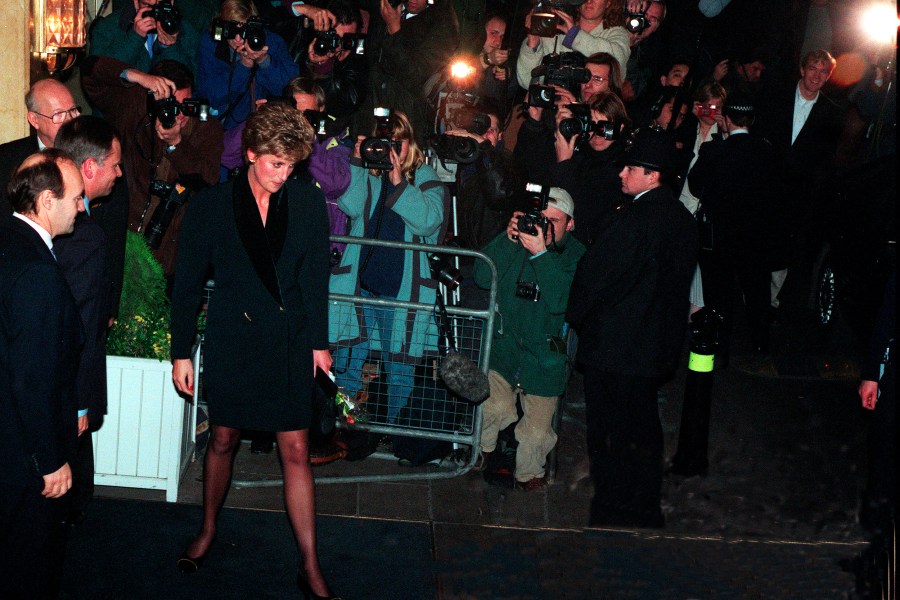
Now that he’s no longer a working royal, Harry wants to “change” the press, in particular, the United Kingdom’s tabloid media, he told interviewer Tom Bradby in January. It’s been a recurring theme for Harry. A desire to correct press narratives, especially those birthed by the British tabloids, seems to motivate the couple’s public commentary — from their Oprah Winfrey interview in 2021, to their Netflix series last year, and Harry’s memoir “Spare,” published earlier this year.
But Harry’s vendetta against the media, even if understandable from an emotional perspective, may also be blinding his ability to understand the nuances and motivations of the industry. This in turn could be creating a vicious cycle.
In “Spare,” and the interviews he did to promote it, Harry slammed the royal family’s culture of “briefings and leakings and planting of stories,” as he called it in an interview with Anderson Cooper. Harry implied family members and aides had leaked stories about him and Meghan, sometimes unfavorable, to ensure positive coverage for themselves.
The couple’s Netflix series doubled down on these accusations, and pointed to examples of what they called private information, like plans to move to South Africa, appearing in the British press without their involvement. Some royal reporters, however, have denied that the palace would plant negative stories about a prominent member of the family. Meanwhile, the palace has remained silent.


The rest of the royal family’s relationship with the press is also complicated, but arguably more realistic. In the modern world, where millionaire kings and queens supposedly exist to serve their subjects, journalists can (and should) provide accountability. The royal family doesn’t have to answer to voters, but just like all rich and powerful individuals, it should have to answer to the press. I may sound American for saying it, but a powerful press is often synonymous with a strong democracy (or in this case, a strong constitutional monarchy).
In the modern world, where millionaire kings and queens supposedly exist to serve their subjects, journalists can (and should) provide accountability.
The question of negative briefings aside, much of what Harry has said about the royal family’s cooperation with the press — sharing stories, providing background information and developing relationships with reporters on the royal beat — is standard journalistic practice in Hollywood, Washington, Westminster and beyond. In other instances, the British press seems to have more clearly deviated from standard journalistic ethics. There is a line. Harry is suing the publishers of The Mirror, The Sunday Mirror and The Sunday People, over alleged phone hacking, claiming staff at those publications illegally accessed his voicemails between 1996 and 2011. (The publishers of all three outlets denied wrongdoing.) There have also been blatant examples of racist bias, such as a 2016 Daily Mail headline proclaiming “Harry’s girl is (almost) straight outta Compton” shortly after the pair started dating.
There’s also another inconvenient truth here: how much Harry and Meghan actually need the press, and actively use the media to their advantage. The irony is that because they’ve chosen to pursue a public life, the couple is perhaps more reliant on traditional media outlets than ever. That’s especially the case because the couple no longer has active social media accounts, which would provide another path to communicate with people. They need journalists to publicize their foundation, Archewell, and to review their books, documentaries and podcasts. They need TV hosts like Oprah to provide them with a cozy public platform.

And indeed, there are plenty of empathetic journalists lining up to speak with the couple. Meghan has had multiple high-profile interviews within the last year, including with New York magazine’s The Cut and Variety. Harry went on a media blitz when his book was published in January that included an interview with British newspaper The Telegraph, a member of the aforementioned royal rota.
If Harry and Meghan want to influence the world — which they so obviously do — they will need the media’s help. The problem is how much they want to direct and dictate coverage. That’s a natural instinct, especially for the rich and powerful, but it’s just not how journalism is supposed to work.
So ultimately, it’s understandable that being followed by paparazzi in a car, late at night, in a foreign city is a situation that could be triggering for Harry. No one, no matter how famous, should feel hounded. But dramatizing the danger of the press — even a little — could become a potentially self-defeating slippery slope.

Diana Pearl
Diana Pearl is a writer and editor based in New York City. She is a former royals reporter for People magazine and has written for publications including The Atlantic and Elle.